

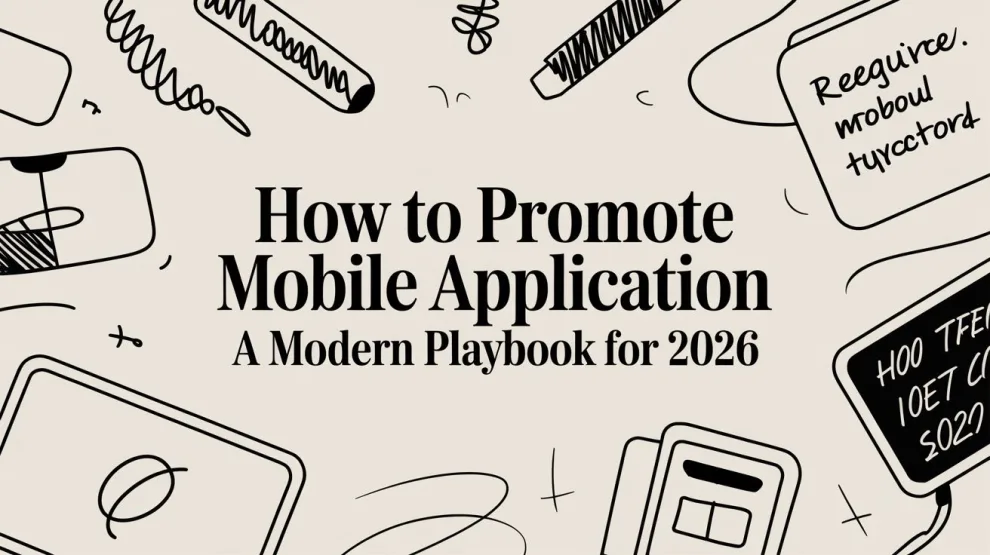

To truly get your mobile app off the ground, you need to think beyond isolated tactics. A successful launch isn't about just doing ASO or running a few ads; it's about weaving together five core pillars into a single, cohesive strategy. This blueprint is your key to not only launching with a bang but also achieving the kind of sustainable growth that stands out in a crowded market.
Your App Promotion Blueprint for 2026
Let's be honest: getting an app noticed today feels like shouting into a hurricane. New apps drop every single day, and just hitting "publish" and hoping for the best is a surefire way to get lost in the noise. The only way to break through is with a structured, integrated promotion plan that you start building long before launch day.
Marketing isn't an afterthought. It has to be baked into your app's DNA from the very beginning. This guide maps out the essential activities that drive discovery, downloads, and, most importantly, lasting engagement. It’s all about understanding how each piece of the puzzle fits together.
The Five Pillars of App Promotion
A modern app marketing strategy rests on five interconnected pillars. Each one targets a different part of the user journey, from the first time someone hears about your app to them becoming a loyal fan.
- Market Research: This is your foundation. It's where you figure out exactly who your ideal user is, what your competitors are doing right (and wrong), and how to position your app as the only logical choice.
- App Store Optimization (ASO): Think of ASO as your digital storefront. It's the art and science of fine-tuning your app store listing to climb the search rankings and convince people to tap that download button.
- Paid User Acquisition (UA): While organic growth is the goal, paid UA is the rocket fuel. This means strategically spending on ads across platforms like Apple Search Ads, Google Ads, and social media to pull in high-quality users quickly.
- Community & Content: This is how you build a real brand, not just a product. By creating genuinely useful content and nurturing a community, you turn everyday users into passionate advocates for your app.
- Retention & Growth Loops: Getting the download is just the start. This pillar is all about keeping users coming back and building features that naturally encourage them to invite their friends, creating a self-powering growth engine.
The real magic happens when you stop treating these pillars like a checklist. A truly great strategy creates a feedback loop. For instance, insights from your user retention data should directly inform the targeting for your paid UA campaigns.
The map below shows how these five concepts work together to form a complete app promotion system.

Core Pillars of Modern App Promotion
To better understand how these elements function, here's a quick breakdown of their roles and the channels you'll use to execute them.
| Pillar | Primary Goal | Key Channels |
|---|---|---|
| Market Research | Define target audience, competitive landscape, and unique value proposition. | Surveys, Competitor Analysis, User Personas, Market Trend Reports |
| App Store Optimization (ASO) | Increase organic visibility and conversion rate in app stores. | Keyword Optimization, A/B Testing, Screenshot & Icon Design, App Reviews |
| Paid User Acquisition (UA) | Drive targeted, high-quality installs at scale to accelerate growth. | Apple Search Ads, Google Ads, Meta Ads, TikTok Ads, Influencer Marketing |
| Community & Content | Build brand affinity, trust, and a loyal user base. | Social Media, Content Marketing (Blogs, Video), PR, Community Forums |
| Retention & Growth | Maximize user lifetime value and create viral growth loops. | Push Notifications, In-App Messaging, Email Marketing, Referral Programs |
This table isn't just a list; it's a framework for building a dynamic system where each part strengthens the others, creating a powerful engine for growth.
The data absolutely supports this integrated approach. In 2024, global app downloads soared to 218 billion, with forecasts expecting that number to climb to 255 billion by 2025. In such a competitive field, every advantage counts. For example, a solid ASO strategy alone can boost your app's organic visibility by up to 30%—a massive edge when you're fighting for attention. You can dig deeper into the numbers with these mobile app marketing statistics to see just how critical these trends are.
Win on the App Stores Before You Spend a Dime
Before you even think about putting a single cent into advertising, your app store listing needs to be a lean, mean, conversion machine. Driving traffic to a weak or confusing app page is like pouring water into a leaky bucket—you're just wasting money and losing users before you even have them. The real work of promotion starts right here, with a rock-solid organic foundation.
This whole process is called App Store Optimization (ASO), and it's hands-down the most powerful way to promote your app without an initial ad budget. A well-optimized page doesn't just pull in people searching for an app like yours; it dramatically improves how well your future paid ads will perform. You're setting the stage for every dollar you'll spend later.

Define Your Unique Market Position
You can't optimize anything if you don't know who you're talking to and what makes your app special. To stand out in a crowded store, you need to get crystal clear on your market position. I always start by drilling down on three core questions.
First, who is your ideal user? And I mean really who are they. "Busy professional" is lazy. "A project manager at a startup, struggling to track team tasks across different time zones" – now that's a person you can market to. Think about their goals, their biggest frustrations, and what motivates them.
Next, you need to understand what your competitors are doing right (and wrong). Look at the top 5-10 apps in your niche. Don't just glance at their features. I want you to study their marketing copy, analyze their screenshot style, and read the user reviews to find common complaints and praises. What keywords are they ranking for? What main benefit are they selling?
Finally, based on all that intel, you can nail down your unique value proposition (UVP). What's the one thing your app does better than anyone else for your ideal user? This isn't a feature list. It's the core promise. So instead of saying "AI-powered scheduling," your UVP might be "The only calendar that guarantees you’ll never have a meeting conflict again."
This research isn't optional. It’s the blueprint for every ASO decision you'll make.
Master Keyword Research for Discovery
Keywords are the bridges that connect your app to people actively searching for it. ASO is responsible for up to 65% of all organic installs, and it all begins with finding the right keywords. Your goal is that perfect sweet spot: high relevance, decent search volume, and manageable competition.
The biggest mistake I see people make is going after huge, broad keywords like "fitness app." You'll get crushed by the big players with massive budgets. The smarter play is to focus on long-tail keywords—longer, more specific phrases that show someone knows exactly what they're looking for.
Think about it. Instead of "fitness," a real user might search for:
- "at-home workout tracker for women"
- "bodyweight exercise planner no equipment"
- "HIIT workout app for beginners"
Someone searching with that much detail has a problem they want solved now. If your app is the solution, you've got a much higher chance of getting that download. Use ASO tools to find these phrases and check their search volume and difficulty scores.
Don't just think in keywords; think in problems. What question is a user asking right before they need an app like yours? Your app store description should be the answer.
Craft High-Converting App Store Assets
Once you have your keywords, it's time to weave them into the creative assets that will actually convince someone to tap "Get." Your app's name, subtitle, icon, and screenshots are your storefront.
App Title and Subtitle
Your app title is the single most important piece of ASO real estate. It needs your brand name and your most critical primary keyword.
- Weak Title: "BudgetTrack"
- Strong Title: "BudgetTrack: Expense Manager"
The subtitle (on iOS) or short description (on Android) is your next move. This is where you can use a top long-tail keyword and state your core value in one quick, benefit-focused sentence.
App Icon and Screenshots
People judge an app by its cover. Your icon has to be clean, memorable, and instantly give a clue about what your app does. Ditch the tiny text or cluttered designs that are impossible to make out on a phone screen.
Your screenshots are your visual sales pitch. Please, don't just upload random screens of your UI. You need to tell a story.
- Use the first 1-2 screenshots to hammer home your app's main benefit.
- Add short, punchy text overlays to explain the value of what's being shown.
- Focus on the outcome the user gets—the feeling of success or relief—not just the feature itself.
For a deeper dive into these tactics, our detailed guide on App Store Optimization best practices provides a complete checklist. Nail your app store presence first, and you'll guarantee that every marketing dollar you spend later works as hard as it possibly can.
Scaling Your Reach with Paid User Acquisition
Organic growth is your foundation, but paid user acquisition (UA) is the rocket fuel. While ASO gets your app discovered, strategically spending on ads is how you actively go out and grab high-value users, scaling your growth on a predictable schedule. This is where you shift from just hoping for growth to actually engineering it.
Let's be clear: spending on ads isn't about chasing vanity metrics. It's a calculated investment to acquire users who will stick around, engage, and ultimately boost your bottom line. The math can look intimidating—customer acquisition costs have jumped over 60% in the last five years—but having a disciplined plan is what separates the apps that scale from the ones that just burn through cash.

Choosing Your Paid Acquisition Channels
Not all ad platforms are built the same. Where you spend your money depends entirely on your app and who you're trying to reach. A classic rookie mistake is spreading a small budget thin across every platform out there. Instead, get really good at one or two channels where your ideal users actually live.
Here’s my take on the major players and what they're best for:
- Apple Search Ads (ASA): This is non-negotiable for any iOS app. You're catching people at the exact moment of high intent—when they're literally searching the App Store for a solution like yours. Conversion rates here are fantastic.
- Google App Campaigns (UAC): The undisputed powerhouse for Android. UAC is a beast, automatically placing your ads across Google Play, Search, YouTube, and more. Its machine learning finds users who are most likely to install and perform key actions.
- Meta Ads (Facebook & Instagram): Unmatched for its incredibly deep demographic and interest targeting. If your app ties into a specific lifestyle, hobby, or user profile, Meta's platforms let you pinpoint them with compelling visuals.
- TikTok Ads: This is your direct line to Gen Z and millennials. TikTok is all about authentic, short-form video that feels native to the feed. It’s a goldmine for apps with a strong visual, entertainment, or community angle.
Think about it this way: a fitness app would probably kill it on Instagram and TikTok with short video tutorials. A B2B productivity app, on the other hand, will likely get a much better return from Apple Search Ads and Google Ads, targeting keywords like "team project management app."
Structuring Your Campaigns for Success
A solid paid UA strategy is built on clear goals and obsessive organization. Before you spend a single dollar, you have to know what a "win" looks like. Are you just trying to get the lowest Cost Per Install (CPI), or are you hunting for users who sign up for a free trial? The latter costs more upfront but is infinitely more valuable.
This is where your metrics become your guide. While CPI is a starting point, focusing on Return On Ad Spend (ROAS) is what tells you if your ad dollars are actually making you money. You can get a deeper dive on these performance indicators in our guide to essential mobile app metrics.
One of the most common mistakes I see is lumping all audiences and creatives into one giant campaign. It makes it impossible to figure out what's working. You have to build your campaigns with a granular structure from day one.
For example, a single campaign on Meta Ads should be broken down into distinct ad sets, each with a specific targeting strategy:
- Ad Set 1: A "lookalike" audience modeled after your most valuable existing users.
- Ad Set 2: An interest-based audience, targeting users who like "meditation" and "mindfulness."
- Ad Set 3: A retargeting audience for people who visited your website but never installed.
Inside each of these ad sets, you should be running multiple ad creatives. This allows you to test different visuals and copy against each audience, quickly see what resonates, and shift your budget to the winners.
Creating Ad Creatives That Convert
In a feed that never ends, your ad has maybe two seconds to stop the scroll. Generic, corporate-looking ads are a death sentence for your budget. Your creative needs to feel native to the platform and instantly connect with a user's problem or desire.
Here are a few battle-tested tips for developing creatives that actually work:
- Show the Outcome, Not Just the Feature. Don't just show a boring screenshot of your app's interface. For a budgeting app, show a picture of someone enjoying a stress-free vacation with the text, "Finally, a budget that works for you." Sell the destination, not the plane.
- Embrace User-Generated Content (UGC) Style. On platforms like TikTok and Instagram, ads that look like they were made by a real person almost always outperform slick, polished commercials. They feel more like a trusted recommendation than an ad.
- A/B Test Everything. Never, ever assume you know what will work. Always be testing. Test different headlines, images, videos, and calls-to-action (CTAs). A simple tweak from "Download Now" to "Start Your Free Trial" can dramatically change your conversion rates.
By marrying the right channels with a smart campaign structure and killer creative, you can transform paid UA from a money pit into a predictable, scalable growth engine.
Paid ads will get you downloads, but they won't buy you loyalty. True, sustainable growth—the kind that doesn't vanish the second you turn off your ad spend—comes from building a brand and a community that people genuinely want to be a part of. This is where you pivot from just acquiring users to creating a tribe of fans who become your best marketing asset.
At the heart of this strategy is a solid content engine. I'm not talking about pumping out generic, SEO-stuffed blog posts. I'm talking about creating genuinely useful resources that solve real problems for your ideal users, often before they even know they need your app.
Develop a Content Strategy That Attracts Users
Your content needs to do more than just exist; it needs to be a magnet. Think of it as the top of your funnel, pulling the right people into your world from search engines and social media. The objective here is to become the go-to authority in your space.
So, where do you start? Begin by digging into what your potential users are searching for online. What are their biggest headaches? What questions are they typing into Google or asking on YouTube? Every article, video, or guide you create should be a direct answer to one of those questions.
Let’s say you’ve built a meal-planning app. Your content calendar might look something like this:
- Blog Posts: "10 Quick and Healthy Weeknight Dinners for Busy Parents" or "How to Meal Prep on a Budget."
- Video Content: Short-form videos for TikTok or Reels showing "what I eat in a day" featuring recipes from your app.
- Downloadable Guides: A simple PDF checklist for stocking a healthy pantry.
This approach positions your brand as a helpful guide, building trust long before you ever ask for a download. When they're finally ready for a tool to make their lives easier, your app will be top of mind.
Rethink Public Relations for a Modern Audience
Forget the stuffy, old-school PR playbook of blasting out press releases. For most mobile apps, it's a waste of time. Modern PR is about earning authentic mentions where your target audience actually hangs out and what they actually trust. That means focusing on niche tech blogs, industry newsletters, and respected creators.
The real work is in building genuine relationships. Don't mass-email a generic pitch. Instead, identify a handful of specific writers who consistently cover your app's category. Follow them, read their work, engage with their content, and when you finally reach out, make it personal.
Don't just pitch your app; pitch a story. Your app is the solution to a problem or the perfect example of a new trend. A compelling narrative is infinitely more interesting to a journalist than a list of features.
Your pitch should immediately clarify why your app is different and, more importantly, why their readers would care. Offer them an exclusive, a unique data point from your user base, or early access to a new feature. A single, well-placed story in the right publication can drive more high-intent installs than a week of scattered ads.
Master Influencer Marketing with Micro-Partnerships
When people think of influencer marketing, they often picture massive celebrities with million-dollar price tags. That's not the play. The real magic happens when you partner with micro-influencers—creators with dedicated followings of 5,000 to 50,000 people.
These creators aren't just broadcasting; they've built real trust. A recommendation from them feels less like a sponsored post and more like a genuine tip from a knowledgeable friend. That authenticity is why their conversion rates are so much higher.
Here’s a simple way to approach a micro-influencer campaign:
- Find Your People: Search Instagram, TikTok, and YouTube for creators whose content is a perfect match for your app's mission. If you have a journaling app, look for creators in the mental wellness and self-care space.
- Make a Real Connection: Ditch the formal outreach template. Send a short, personal message. Tell them what you admire about their work and offer them free lifetime access to your premium features, asking if they’d be open to sharing an honest opinion.
- Let Them Create: The worst thing you can do is hand them a script. Give them the key talking points—what makes your app special—and then let them run with it in their own voice. The more authentic it feels, the better it will land with their audience.
- Measure What Matters: Give each creator a unique discount code or a trackable link. This isn't about being Big Brother; it's about seeing which partnerships are resonating so you can do more of what works.
A smart micro-influencer campaign can bring in hundreds of high-quality users. Better yet, the content they create continues to work for you long after the campaign ends, acting as a lasting testimonial for your app.
Turning Users into Advocates with Growth Loops

Getting that install feels like crossing the finish line, but in reality, you’ve just started the race. The apps that truly dominate their categories don't just find users; they build a system where their existing users bring in new ones. This is where your focus has to pivot from pure acquisition to smart retention and advocacy.
The data here is frankly brutal: roughly 80% of new users churn within the first three days. If that's happening, you don't have a leaky bucket—you have a gaping hole in your growth strategy. Let's talk about what happens after the download.
Nail the Onboarding and First Interaction
Those first few moments inside your app are make-or-break. A confusing or empty home screen is a one-way ticket to an uninstall. Your job is to rush the user to their "aha!" moment—that instant they truly grasp your app's value.
Don't just open the door and walk away. Guide them. A great onboarding experience feels less like a manual and more like a personal tour.
- Focus on one key action. Instead of a tour of every single button, what's the one thing they need to do to see the magic? For a budgeting app, that's probably linking a bank account. Push them there.
- Reveal features gradually. This is called progressive disclosure. Introduce new tools and concepts only when the user needs them. It prevents them from getting overwhelmed and bailing.
- Show, don't just tell. Use short, interactive tooltips or a guided first task. Let them do something valuable right away.
Think of it this way: you’re the host of a party. You welcome your guest, take their coat, and immediately introduce them to someone interesting. Your onboarding should be that purposeful.
Use Smart Messaging to Drive Engagement
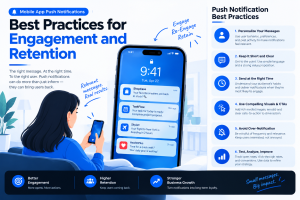
Push notifications and in-app messages are your direct lines to your users, but they're a double-edged sword. Get it wrong, and you become the #1 reason they uninstall. The goal is to be helpful, not just noisy.
It’s no surprise that users who opt-in to push notifications show 3x higher retention rates. But that's only if your messages are worth reading. Generic "Hey, come back!" pings are dead on arrival. The best messages are triggered by what the user is actually doing.
A personalized notification gets 4x higher open rates than a generic broadcast. We're talking about using their name, referencing their recent activity, and timing it perfectly.
A fitness app, for instance, could send a push celebrating a new personal record. An in-app message might pop up with a quick tip right after a workout. This transforms the experience from a simple tool into a personal coach.
Engineer Viral Growth with Referral Programs
This is the holy grail. The ultimate goal is to get your users to do your marketing for you. A well-crafted referral program can easily become your most powerful and cost-effective acquisition channel. The trick is to create a clear win-win-win scenario.
- The Referrer Wins: They get a tangible reward that they actually care about.
- The New User Wins: They get a special offer or bonus for signing up, making it an easy decision.
- You Win: You get a new, highly qualified user at a fraction of the usual cost.
Dropbox is the classic case study—they gave extra storage space to both the person referring and the person who signed up. It was a simple, brilliant loop. The reward has to tie back to your app's core value. More features, in-app currency, or premium access often work far better than a few dollars. You can also explore different mobile app monetization strategies like freemium models, which can be integrated into your referral rewards for an even bigger impact.
Incentivize Shareable User-Generated Content
Sometimes the best growth loop isn't a formal program at all. It's a built-in feature that makes people want to share what they're doing in your app. When a user shares content from your app, it’s an authentic, powerful endorsement that no ad can replicate.
The key is making the act of sharing both dead simple and socially valuable. The running app Runna, for example, turns every completed run into a beautiful, shareable graphic with stats. And of course, there's Spotify Wrapped, which has become a massive cultural event that people can't wait to post everywhere.
So ask yourself: what moments of achievement, creativity, or pure fun happen inside my app? Now, build a feature that packages that moment into a shareable asset. When your app helps your users look cool or feel proud, they'll become your most passionate promoters.
Your Top App Promotion Questions, Answered
Every app founder I talk to eventually asks the same core questions about promotion. Getting these right from the beginning can be the difference between a forgotten app and a breakout success.
Let's cut through the noise and get straight to the practical answers you need.
How Much Should I Budget to Promote My App?
This is the big one, and there's no single magic number. Some people will tell you to budget 50% of your total development cost for first-year marketing, which is a decent starting point. But a smarter way to think about it is to work backward from your goals.
Let’s say you’ve done your research and your target Cost Per Install (CPI) is $2.00. If your goal is to get your first 10,000 users in the first three months, you know you need a starting budget of at least $20,000 just for paid ads. That's on top of whatever you invest in organic channels like content or ASO.
My advice is always to start small, measure your return on investment obsessively, and then scale your budget based on which channels prove most effective. Don't just throw money at the wall; let the data guide every dollar you spend.
When Should I Start Promoting My App?
The short answer? Way before you launch. Promotion isn’t what you do after the app is live; it’s what you do to make sure people are excited and waiting on day one. I tell founders to kick off their pre-launch marketing at least 2-3 months before hitting the app stores.
This pre-launch window is your chance to build some serious momentum. Here’s what you should be doing:
- Put up a landing page: A simple "coming soon" page that explains your app's value and collects email addresses is non-negotiable. This is your first audience.
- Tease your app: Start dropping sneak peeks and behind-the-scenes content on the social media channels where your future users hang out.
- Do your ASO homework: Your keyword research and app store listing shouldn't be a last-minute scramble. Plan it all out well in advance.
- Start making friends: Begin building genuine relationships with tech bloggers, journalists, and influencers in your niche. A warm email is always better than a cold one.
Nailing this phase can give you a huge boost in initial downloads. That early velocity sends a powerful signal to the app store algorithms, helping you rank higher right out of the gate.
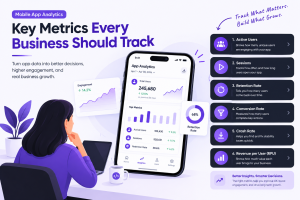
What Metrics Are Most Important for Promotion Success?
It's easy to get obsessed with the total download count. But that's a vanity metric if those users open the app once and never come back. To really know if your promotion is working, you have to look deeper.
These are the metrics that truly matter:
- Day 1/7/30 Retention: What percentage of people are still using your app after a day, a week, and a month? This tells you if your app actually delivers on its promise.
- Customer Lifetime Value (CLV): How much is an average user worth to your business over time? This is the key to sustainable growth.
- Cost Per Install (CPI): What are you paying, on average, to get a single new user through your paid campaigns?
- Organic vs. Paid Installs: Look at the ratio of users who find you for free versus those you pay for. A healthy, growing organic percentage means your brand is gaining traction.
Tracking these numbers gives you a complete, honest picture of your performance. It helps you focus on long-term profitability, not just a short-lived download spike.



Add Comment