

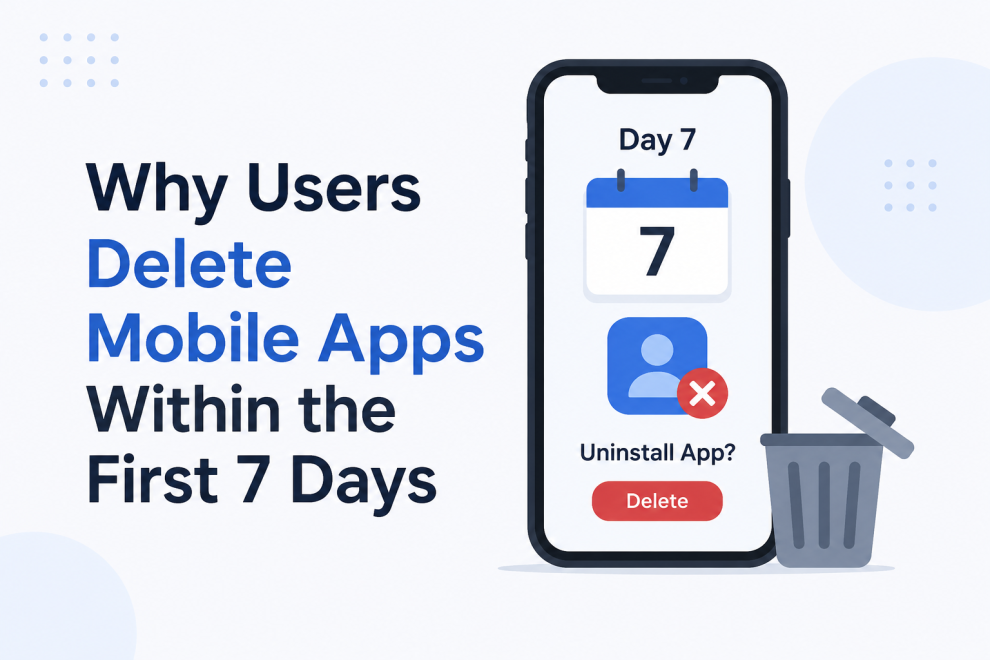

The mobile app market has become increasingly difficult for enterprises to navigate. Across industries, organizations continue investing heavily in digital products, customer platforms, and AI-powered mobile experiences. Yet despite rising development budgets and advanced technologies, one challenge continues to damage product performance across enterprise ecosystems: users are deleting mobile apps within days of installation.
For enterprise technology leaders, this is no longer just a UX issue. It directly affects customer acquisition costs, platform adoption, retention metrics, revenue growth, and long-term digital transformation outcomes. Enterprises can spend millions building feature-rich applications only to lose users before engagement even begins.
This is becoming one of the most expensive operational problems in mobile product strategy.
According to industry research from AppsFlyer, Statista, and Gartner, app abandonment rates remain high across categories, especially when onboarding friction, performance instability, and unclear value propositions affect early user experiences. Many users decide whether an app deserves long-term space on their devices within the first few interactions.
That means the first seven days have become critical.
For enterprises, the challenge is not simply attracting downloads anymore. The real challenge is creating mobile experiences that deliver immediate relevance, reduce friction, and maintain engagement before users abandon the platform entirely. Organizations that fail to improve early retention often experience rising acquisition costs, weaker customer lifetime value, lower conversion efficiency, and inconsistent product adoption across digital ecosystems.
The market is shifting toward retention-first mobile strategies where usability, responsiveness, and personalization matter more than feature quantity alone.
Poor Onboarding Is Still the Biggest Retention Failure
Many enterprises underestimate how quickly users evaluate mobile experiences. Users no longer explore applications patiently. They expect clarity, speed, and immediate value almost instantly after installation.
This is where many enterprise apps fail.
Complicated onboarding flows, excessive permissions, unclear navigation, slow loading times, and feature-heavy interfaces often overwhelm users during the first session. In many cases, applications attempt to introduce too much functionality before users even understand the core value of the platform.
The result is predictable: users disengage quickly.
Modern users compare enterprise applications not only against competitors within the same industry but also against consumer-grade experiences from platforms such as Spotify, Uber, TikTok, Netflix, and ChatGPT. These applications have shaped expectations around simplicity, personalization, and frictionless onboarding.
Enterprise mobile products now compete against those standards whether organizations acknowledge it or not.
Several onboarding problems consistently drive early uninstall behavior:
- Lengthy registration processes.
- Poorly optimized first-time user flows.
- Confusing interface hierarchies.
- Slow app responsiveness.
- Aggressive notification strategies.
- Limited personalization during onboarding.
Many organizations still prioritize feature exposure over user guidance. However, users rarely care about the full platform ecosystem during the first session. They want immediate outcomes with minimal effort.
This shift is forcing enterprises to rethink onboarding entirely. Instead of explaining every feature upfront, leading mobile teams increasingly focus on progressive onboarding models that introduce capabilities contextually as engagement grows over time.
This approach improves retention because it reduces cognitive overload during the most critical adoption window.
Mobile UX Expectations Have Changed Faster Than Enterprise Systems
One of the biggest reasons users abandon mobile apps quickly is the growing gap between user expectations and enterprise delivery quality.
Modern mobile users expect applications to behave intelligently. They expect fast load times, responsive interactions, predictive recommendations, seamless authentication, and highly personalized experiences across devices. Unfortunately, many enterprise systems still rely on fragmented backend architecture, inconsistent APIs, and legacy workflows that create friction inside mobile experiences.
Even small performance problems can damage retention significantly.
Users often uninstall applications because of:
- Delayed screen transitions.
- Inconsistent navigation behavior.
- Poor search functionality.
- Broken personalization experiences.
- Excessive battery consumption.
- App crashes and latency issues.
These issues may appear operationally small, but they heavily influence perception during the first week of usage. Users quickly associate poor performance with low platform reliability.
This is especially problematic for enterprises investing heavily in customer experience transformation initiatives. Organizations often focus aggressively on launching new mobile features while underestimating the importance of operational consistency and frontend optimization.
The market is increasingly rewarding simplicity over complexity.
Many successful mobile platforms now prioritize “invisible UX” where interactions feel intuitive enough that users barely notice the interface itself. AI-driven recommendations, adaptive workflows, contextual search systems, and predictive assistance are quietly improving experiences in the background rather than forcing users through complicated interaction layers.
At the same time, enterprises are learning that retention depends heavily on emotional momentum during early usage. Users stay engaged when applications reduce effort, save time, or simplify decision-making quickly after installation.
Across the enterprise technology landscape, engineering consultancies and digital modernization firms such as Thoughtworks, Globant, and GeekyAnts are increasingly contributing to mobile product modernization initiatives focused on frontend performance, scalable mobile UX systems, and intelligent engagement strategies.
AI and Personalization Are Reshaping Mobile Retention Strategies
AI is rapidly changing how enterprises approach mobile engagement and retention. Organizations are increasingly using AI-driven systems to personalize onboarding flows, optimize recommendations, predict churn risks, and improve behavioral engagement strategies in real time.
This shift is becoming necessary because static mobile experiences no longer perform consistently across large user bases.
Modern users expect applications to adapt dynamically based on behavior, preferences, and usage patterns. AI-driven personalization helps enterprises reduce friction by surfacing relevant actions, content, and workflows automatically instead of forcing users through rigid navigation structures.
Organizations are increasingly using AI to:
- Personalize onboarding experiences.
- Improve search and discovery systems.
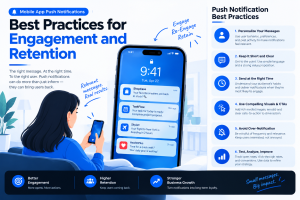
- Trigger contextual engagement prompts.
- Predict user abandonment risks.
- Optimize notification timing dynamically.
However, many enterprises still struggle to implement AI effectively within mobile ecosystems. Poorly designed AI interactions often feel intrusive instead of helpful. Excessive notifications, irrelevant recommendations, and over-automated experiences can accelerate app deletion rather than prevent it.
This is why successful retention strategies increasingly focus on subtle AI integration instead of highly visible automation.
The most effective mobile experiences reduce friction quietly in the background. They simplify user journeys without constantly reminding users that AI is operating underneath the platform.
At the same time, personalization introduces infrastructure complexity. AI-driven engagement systems depend heavily on real-time analytics, scalable cloud environments, behavioral data orchestration, and low-latency processing. Enterprises operating across fragmented backend ecosystems often struggle to deliver consistent personalization experiences at scale.
This operational challenge is forcing organizations to align mobile UX, cloud infrastructure, platform engineering, and AI governance more closely than before.
The Future of Mobile Retention Will Depend on Experience Quality
The enterprise mobile ecosystem is becoming increasingly competitive. Users now evaluate applications within seconds, not weeks. Enterprises can no longer rely on brand recognition alone to maintain engagement if product experiences fail to deliver immediate operational value.
This is changing how organizations approach mobile product strategy.
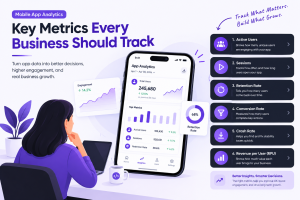
Instead of focusing primarily on download growth, enterprises are increasingly prioritizing retention quality, session consistency, onboarding optimization, and long-term engagement metrics. Product success is shifting away from acquisition volume and toward sustainable usage behavior.
For enterprise leaders, the challenge is no longer whether mobile platforms matter. Most organizations already understand the strategic importance of digital ecosystems. The bigger challenge is building applications that remain useful, responsive, and operationally efficient after installation.
This requires stronger collaboration between engineering, UX design, analytics, AI teams, cloud infrastructure leaders, and digital product strategists.
Organizations that continue treating mobile applications as standalone digital assets may struggle with rising churn rates and declining engagement over time. Meanwhile, enterprises investing in adaptive UX systems, scalable infrastructure, and intelligent personalization strategies will likely improve retention and customer lifetime value more effectively.
Across industries, the conversation is shifting away from app launches and toward retention sustainability. Enterprises increasingly evaluate mobile products based on engagement quality, workflow efficiency, operational resilience, and long-term user behavior rather than download visibility alone.
The broader industry lesson is becoming increasingly clear: users rarely delete mobile apps because of missing features. They delete them because the experience fails to justify staying installed.



Add Comment