


The enterprise AI market is expanding faster than most organizations expected. Across North America, enterprises are launching AI-powered mobile apps to improve customer engagement, automate workflows, personalize experiences, and increase operational efficiency. From healthcare and banking to retail and logistics, AI has moved beyond experimentation and entered mainstream product strategy.
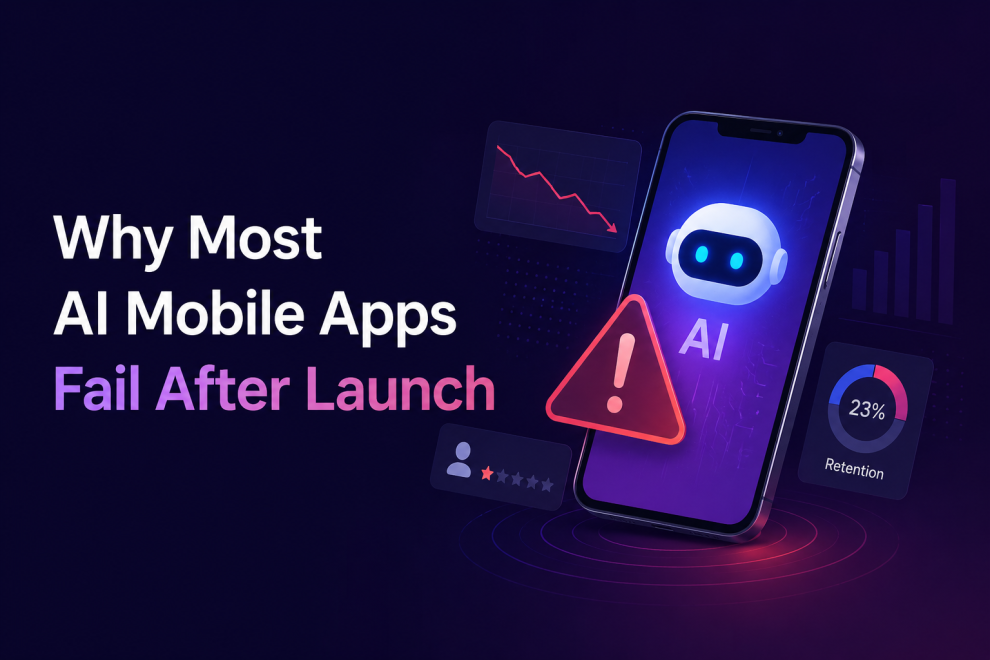
Yet many AI mobile apps fail quietly after launch.
The problem is not usually the technology itself. Most enterprise organizations now have access to advanced AI models, cloud infrastructure, and experienced development teams. The real issue emerges after deployment, when scaling the application becomes more difficult than building it.
For enterprise technology leaders, this creates a growing operational concern. AI applications now directly influence customer experience, platform reliability, cloud spending, retention metrics, and digital adoption goals. If the experience becomes inconsistent or expensive to maintain, organizations quickly struggle to justify continued investment.
According to reports from Gartner and McKinsey, enterprises continue increasing AI spending globally, but many organizations still lack operational maturity around AI governance, long-term infrastructure planning, and product lifecycle management. This gap explains why many AI applications generate strong launch visibility but lose traction within months.
The most successful organizations are beginning to approach AI mobile apps differently. Instead of treating AI as a standalone feature, they are building long-term ecosystems where product engineering, cloud operations, UX design, security, and platform scalability work together continuously.
Launch Momentum Often Hides Long-Term Product Weaknesses
Many AI mobile apps launch successfully because initial user curiosity is high. AI-driven recommendations, conversational interfaces, automation tools, and predictive experiences naturally attract attention. However, sustained engagement becomes much harder once users move beyond early experimentation.
This is where many enterprise teams encounter problems they underestimated during development.
AI-powered apps behave differently from traditional mobile products. They require continuous optimization after launch. Models need monitoring. Outputs need validation. Infrastructure needs scaling. Costs fluctuate based on usage patterns. Small latency increases can significantly affect user trust.
Many organizations still manage AI products using traditional software delivery assumptions. They focus heavily on launch deadlines and feature releases but underestimate the operational effort required after deployment.
Several common issues contribute to failure:
- AI features solve no meaningful workflow problem.
- Mobile experiences become overloaded with unnecessary AI interactions.
- Backend systems struggle with inference-heavy workloads.
- Governance frameworks fail to evolve alongside AI adoption.
- Product teams prioritize novelty instead of usability.
These problems become especially visible at enterprise scale.
Large organizations operate across distributed cloud environments, fragmented APIs, legacy systems, compliance requirements, and multiple user groups. AI applications increase the complexity of these environments because intelligent systems rely heavily on real-time orchestration, clean datasets, and responsive infrastructure.
As AI adoption grows, technology leaders are realizing that launch speed alone is no longer a competitive advantage. Operational sustainability matters more.
Infrastructure and Scalability Are Becoming the Biggest Enterprise Barriers
One of the largest misconceptions surrounding AI mobile apps is that model integration represents the hardest technical challenge. In reality, the biggest obstacles usually appear inside the platform ecosystem supporting the AI experience.
Enterprise AI applications require infrastructure capable of handling fluctuating workloads, large-scale data processing, low-latency responses, and continuous monitoring. Many legacy systems were never designed for these demands.
For example, AI-powered mobile apps often depend on:
- Real-time enterprise data access across multiple systems.
- Continuous cloud scaling for inference requests.
- Strong identity and access management frameworks.
- Observability systems for monitoring model behavior.
- Compliance controls for sensitive enterprise data.
These requirements place pressure on engineering, platform operations, cloud infrastructure, and cybersecurity teams simultaneously.
Cloud spending also becomes difficult to predict.
Inference-heavy applications can rapidly increase operational costs as user adoption grows. Enterprises often discover that AI workloads consume significantly more compute resources than initially estimated. Without proper optimization, infrastructure expenses can scale faster than business value.
Security creates another major challenge.
Many AI mobile apps process sensitive enterprise or customer information. This forces organizations to rethink data governance strategies, API security layers, and compliance frameworks. Industries such as healthcare, finance, and insurance face even greater complexity due to regulatory obligations around data privacy and auditability.
This operational pressure explains why many organizations struggle after initial deployment success. AI applications that perform well in controlled environments often behave unpredictably under real-world usage conditions.
As a result, enterprise leaders are increasingly shifting attention from AI experimentation toward AI operational resilience.
Companies like Thoughtworks, GeekyAnts, Globant, and Accenture are actively working with enterprises to modernize AI ecosystems through scalable engineering, cloud-native infrastructure, cross-platform development, and AI-focused product architecture. The broader industry trend suggests that long-term AI success depends less on isolated innovation and more on sustainable platform engineering.
Retention Has Become More Important Than Downloads
For enterprise AI mobile apps, retention is becoming the defining performance metric.
Many AI products attract downloads but fail to become part of users’ daily workflows. This usually happens when AI interactions feel inconsistent, repetitive, slow, or disconnected from practical outcomes.
Enterprise users and consumers now expect AI experiences to feel seamless. They compare enterprise applications with products from companies such as OpenAI, Google, Microsoft, and Apple. Even small usability gaps reduce confidence quickly.
This is pushing organizations to rethink AI UX strategies entirely.
The strongest AI mobile experiences today focus on reducing friction rather than showcasing AI capabilities aggressively. Instead of overwhelming users with visible automation, successful platforms integrate AI quietly into workflows where it improves efficiency naturally.
The market is also shifting toward invisible AI experiences. Users increasingly prefer systems that simplify decision-making without requiring constant interaction with AI interfaces directly.
This trend is influencing enterprise product strategy in several ways:
- Product teams now prioritize workflow optimization over AI novelty.
- Engineering teams focus more heavily on latency reduction and reliability.
- Organizations are investing in centralized AI governance models.
- Platform teams are building reusable AI service layers instead of isolated deployments.
This operational maturity is becoming a major competitive differentiator.
Enterprises that succeed with AI mobile apps usually maintain stronger collaboration between engineering, UX, cloud infrastructure, compliance, and digital product teams. They treat AI systems as continuously evolving operational platforms instead of static product releases.
The Future of AI Mobile Apps Depends on Operational Discipline
The AI mobile market is entering a more practical phase. Enterprises are becoming less focused on launching AI features quickly and more focused on sustaining business value over time.
This shift will likely reshape enterprise AI strategies over the next several years.
Organizations that continue prioritizing rapid deployment without investing in scalability, governance, infrastructure optimization, and user retention will likely struggle with rising costs and declining adoption. Meanwhile, enterprises building strong operational foundations around AI will be better positioned to scale intelligently.
For decision-makers leading digital transformation initiatives, the challenge is no longer proving the value of AI. The challenge is building AI ecosystems that remain usable, efficient, secure, and adaptable after launch momentum disappears.
This is why many enterprises are beginning to evaluate AI initiatives through a broader platform lens rather than treating them as isolated mobile products.
Across the industry, engineering consultancies, product modernization firms, and enterprise AI specialists are helping organizations rethink how intelligent applications should evolve at scale. The conversations increasingly focus on platform sustainability, operational resilience, and measurable business outcomes rather than short-term experimentation.
The broader lesson emerging across enterprise technology is simple: most AI mobile apps fail after launch because organizations prepare for the demo, but not for the operational reality that follows.



Add Comment