






Most businesses added mobile apps to stay digitally relevant. Now they are rebuilding those apps because user expectations have completely changed.
In 2026, users no longer judge an app only by its design or speed. They expect the app to think, predict, simplify, and respond instantly. If a mobile experience still feels manual, users abandon it quickly.
This shift is why AI integration is becoming one of the biggest priorities in mobile app development.
But many companies are approaching AI the wrong way. They are adding chatbots, AI assistants, or recommendation widgets without solving the actual friction users experience every day. That strategy increases complexity instead of improving usability.
The companies seeing real growth from AI are focusing on smaller but high-impact improvements inside the mobile experience itself.
They are using AI to reduce effort.
That difference matters.
Static Mobile Apps Are Losing User Attention
One of the biggest problems businesses face today is declining user engagement after app installation.
Downloads are still happening, but retention rates remain unstable across industries. Many users open an app once, struggle to find value quickly, and never return. This problem is especially visible in fintech, healthcare, ecommerce, and SaaS ecosystems where apps are overloaded with features.
AI is helping businesses solve this retention problem in smarter ways.
Instead of showing identical screens to every user, modern mobile apps are adapting in real time based on user behaviour. AI systems now track browsing patterns, click behaviour , inactivity, purchase history, and usage timing to reshape the app experience dynamically.
For example, ecommerce apps are changing homepage layouts depending on user intent. Fitness apps are adjusting recommendations based on workout consistency. Banking apps are prioritizing spending insights instead of generic dashboards.
This shift from “designed interfaces” to “adaptive experiences” is becoming one of the most important trends in mobile app development.
Users no longer want to learn the app.
They want the app to understand them.
That single change is influencing how businesses design onboarding flows, navigation systems, notifications, and even mobile search experiences.
Companies like Duolingo and Spotify are already using behavioral AI to keep users engaged through personalized interactions instead of feature-heavy interfaces.
The Most Successful AI App Features Are Almost Invisible
The biggest misconception about AI in mobile apps is that users want flashy AI experiences.
Most users actually prefer invisible AI.
They want apps that quietly save time, remove repetitive actions, and make decisions easier without constantly reminding them that AI exists.
This is why predictive UX is growing rapidly in enterprise and consumer mobile products.
Instead of asking users to search manually, AI-powered apps now surface actions before users request them. Travel apps predict destinations. Delivery apps estimate reorder timing. Finance apps warn users before unusual spending behavior happens.
These small predictive interactions create stronger engagement than oversized AI assistants.
Voice AI is also evolving differently than many businesses expected.
Users are not using voice interfaces for long conversations inside apps. Instead, they are using voice for quick actions:
- Booking appointments
- Creating reminders
- Searching products
- Generating summaries
- Navigating workflows
- Logging tasks
This behaviour is changing how businesses approach mobile UX architecture.
The goal is becoming speed, not novelty.
Enterprise apps are seeing similar changes. Employees increasingly prefer AI shortcuts that reduce dashboard fatigue instead of adding more screens or workflows.
For internal enterprise mobility systems, AI is helping teams reduce repetitive administrative work. Sales teams are getting automated meeting summaries. HR apps are auto-generating reports. Field service platforms are predicting maintenance requests before equipment failures happen.
The AI layer is becoming operational rather than visual.
Businesses Are Discovering the Real Cost of AI Integration
While AI adoption is increasing, many businesses are also discovering that AI integration creates new product challenges.
One of the biggest problems is performance.
Large AI systems can slow down mobile experiences significantly if not optimized correctly. Users still expect apps to load instantly, especially on lower-bandwidth networks and mid-range devices.
Because of this, businesses are shifting toward lightweight AI architecture instead of relying entirely on cloud-heavy AI processing.
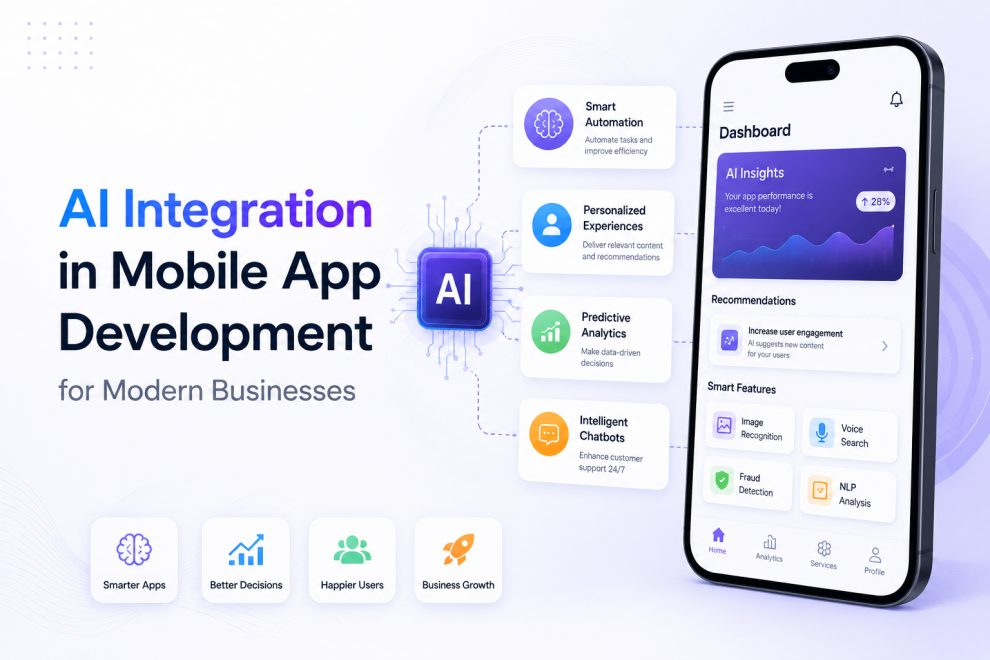
On-device AI is becoming more important in mobile development because it improves speed, privacy, and offline functionality. Features like image recognition, smart replies, fraud detection, and predictive typing increasingly run directly on the device instead of external servers.
Privacy is another growing concern.
Users are becoming more cautious about how apps collect behavioral data. Businesses now need to balance personalization with transparency. Apps that feel intrusive often lose user trust quickly.
This is why ethical AI UX is becoming part of modern mobile strategy discussions.
Businesses are redesigning consent flows, data visibility controls, and recommendation systems to improve trust while still maintaining personalization benefits.
Companies building enterprise-grade mobile products are also prioritizing AI governance much earlier in the development lifecycle than before.
Firms like GeekyAnts, Accenture, and Thoughtworks are increasingly involved in AI modernization projects where the focus is not just AI deployment, but creating scalable and usable mobile experiences around it.
The Future of Mobile Apps Will Feel Less Like Apps
The next generation of AI-powered mobile applications will likely look very different from today’s interfaces.
Apps are moving toward contextual experiences where navigation becomes less important than intent recognition.
Instead of opening an app and manually completing tasks step-by-step, users will increasingly rely on predictive systems that automate decisions, simplify actions, and surface information automatically.
This transition is already influencing product roadmaps across enterprise mobility, ecommerce, healthcare, fintech, and SaaS industries.
Businesses are no longer competing only on features.
They are competing on how quickly users achieve outcomes inside the app.
That is why AI integration is becoming less about adding intelligence and more about removing friction.
The companies that succeed in 2026 will not necessarily have the most advanced AI models. They will have mobile experiences that feel faster, simpler, and more useful every time users open the app.
For organizations evaluating their mobile strategy, the biggest opportunity may not be launching entirely new AI products. It may be redesigning existing mobile experiences around the everyday frustrations users already face but rarely talk about openly.





Add Comment