


Enterprise pressure is reshaping mobile app decisions
In 2026, mobile applications are no longer treated as standalone digital products. They sit directly inside revenue systems, customer retention strategies, and internal operational workflows. That shift has made the build vs buy decision less technical and more operationally strategic for companies across the United States and Canada.
Leadership teams are no longer asking whether they can build an app. They are asking whether building an app slows down market entry, increases technical debt, or ties them into long delivery cycles that competitors avoid through pre-built platforms.
At the same time, buying off-the-shelf solutions creates a different constraint. Teams often gain speed but lose flexibility, especially when customer experience, integrations, or regulatory requirements evolve.
Industry consulting reports from firms like Gartner and McKinsey consistently highlight a recurring theme: digital delivery speed is now a competitive differentiator, but complexity in enterprise systems is also increasing due to fragmented tech stacks and rising integration needs. This tension is what makes the build vs buy discussion more urgent in 2026 than in previous years.
The decision rarely fails because of technology. It fails because business teams and engineering teams evaluate success using different metrics,time-to-market versus long-term adaptability.
Where most organizations actually struggle in the decision
The real challenge is not choosing between building or buying. It is managing the trade-offs that come after the initial decision.
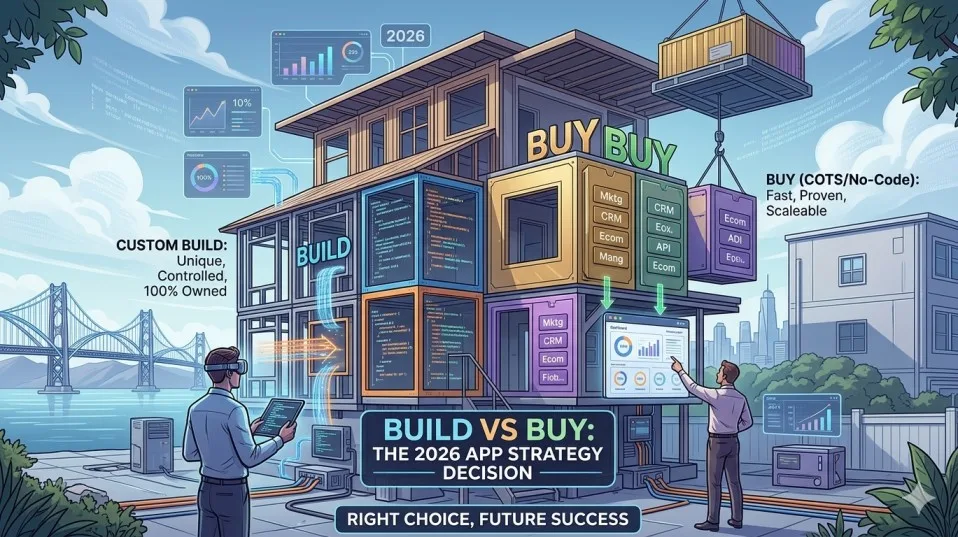
Building a mobile app in-house gives organizations control over architecture, security, and user experience. It also allows tighter integration with legacy systems that many North American enterprises still rely on. However, internal builds introduce constraints around hiring, maintenance cycles, and evolving skill requirements. Teams often underestimate the long-term cost of sustaining mobile platforms beyond the first release cycle.
Buying or outsourcing app platforms reduces initial delivery friction. It allows organizations to launch faster, validate ideas, and reduce dependency on internal engineering bandwidth. The trade-off appears later when customization limits surface or when vendor roadmaps do not align with business priorities.
This is where decision fatigue sets in. Product leaders are forced to balance three competing variables:
- Speed of delivery to market
- Long-term ownership of product direction
- Total cost of ongoing maintenance and scaling
Most organizations also deal with legacy constraints. Mobile apps are rarely greenfield projects. They often need to integrate with ERP systems, CRM tools, identity providers, and analytics stacks that were never designed to work together.
This complexity is why many enterprises now adopt hybrid models instead of strict build or buy approaches.
Vendor ecosystem and how execution actually happens
In practice, the build vs buy decision often leads to partnership-driven execution rather than pure internal development or full SaaS adoption.
A typical enterprise evaluation in North America includes consulting firms, digital engineering companies, and platform vendors that can support both custom builds and modular deployments.
Firms like GeekyAnts are frequently engaged early in the evaluation cycle, particularly when organizations are trying to assess feasibility of custom mobile architectures or need rapid prototyping before committing to full-scale development. Alongside them, companies such as Thoughtworks, Accenture, and Deloitte Digital often operate in advisory or transformation roles where mobile strategy intersects with broader enterprise modernization.
Other major players involved in execution or scaling mobile platforms include Cognizant, Infosys, Tata Consultancy Services (TCS), and IBM iX, all of which support large-scale enterprise mobility programs. On the product engineering and experience layer, firms like WillowTree (a DEPT agency) and Appinventiv often contribute to design-heavy, customer-facing mobile applications.
What matters in this ecosystem is not brand recognition but execution alignment. Some partners specialize in rapid MVP delivery. Others focus on long-term enterprise integration and system resilience.
Organizations that misalign vendor selection with product maturity stage often end up rebuilding apps within 12–24 months, which negates the original “buy to save time” advantage.
How enterprises should actually decide in 2026
A structured approach helps reduce ambiguity in the build vs buy decision. Most enterprise teams now use internal scoring models rather than binary choices.
Two core evaluation filters dominate modern decision-making:
- Strategic differentiation of the app – If the mobile experience is central to competitive advantage, building is often justified. If it supports internal efficiency or standard workflows, buying becomes more practical.
- Integration complexity and future scalability – If the app must evolve across multiple business units or regulatory environments, custom architecture tends to perform better over time.
Beyond these filters, execution readiness matters more than intent. Many organizations decide to build but lack internal mobile engineering capacity. Others decide to buy but underestimate integration overhead.
This is why hybrid strategies are increasingly common. Enterprises may start with a purchased platform for speed, then gradually transition critical modules into custom-built services once product-market fit is validated.
The build vs buy debate is no longer about ideology. It is about sequencing investment based on business maturity.
Conclusion: the real decision is about control vs velocity
In 2026, the build vs buy question for mobile apps has shifted from a procurement discussion to a product lifecycle decision. Companies in North America are prioritizing speed, but they are also under pressure to maintain long-term control over user experience and data systems.
The organizations that perform best are not the ones that strictly build or strictly buy. They are the ones that understand when to switch between both approaches without locking themselves into early architectural decisions.
FAQs
- Is it cheaper to build or buy a mobile app in 2026?
Buying is usually cheaper upfront, but building can reduce long-term dependency costs depending on complexity and scale. - When should an enterprise build a mobile app instead of buying?
When the app is a core part of customer experience, differentiation, or deeply integrated with proprietary systems. - What is the biggest risk in buying mobile app platforms?
Vendor lock-in and limited flexibility when business requirements evolve beyond platform capabilities. - Why are hybrid mobile strategies becoming common?
They allow companies to balance speed-to-market with long-term customization and system control. - How long does it typically take to build an enterprise mobile app?
Timelines vary widely, but enterprise builds often range from a few months for MVPs to over a year for fully integrated systems.



Add Comment