

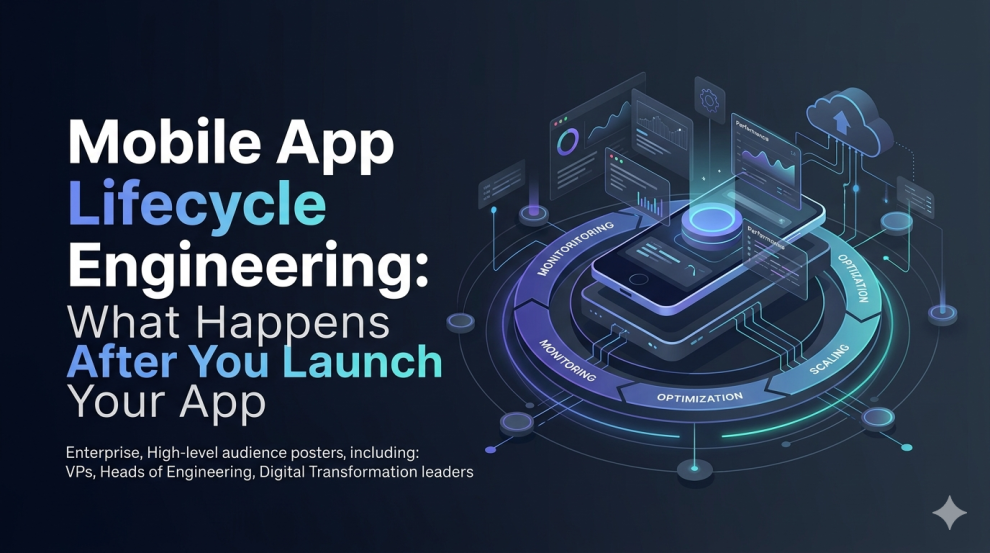

For most enterprise teams, launching a mobile app still feels like crossing the finish line. In reality, it marks the beginning of a far more complex phase—one that determines whether the app becomes a revenue engine or an operational liability.
In large organizations across North America, mobile apps sit at the intersection of customer experience, digital revenue, and brand perception. Yet, leadership teams often underestimate what happens after release. The gap between launch expectations and post-launch realities is where most apps lose momentum—and where engineering leaders face the most friction.
This is not a tooling problem. It is a lifecycle problem.
The Post-Launch Reality Gap
After launch, mobile apps enter an environment defined by constant change: OS updates, device fragmentation, evolving user expectations, and backend dependencies. Engineering leaders quickly realize that stability is not a one-time achievement—it is a continuous effort.
Industry data consistently shows that performance degradation—even at marginal levels—directly impacts retention and revenue. For enterprises operating at scale, even a 1% drop in engagement can translate into millions in lost annual value.
However, most organizations still treat post-launch as a support function rather than a strategic engineering discipline. Teams shift focus to new feature roadmaps, leaving a reactive model for maintenance—bug fixes, patch releases, and performance tuning done under pressure.
The result is predictable:
- Release velocity slows due to technical debt
- Customer experience becomes inconsistent across devices
- Engineering teams spend more time firefighting than innovating
This is where lifecycle engineering begins to diverge from traditional thinking.
Lifecycle Engineering vs. Traditional Maintenance
Lifecycle engineering reframes post-launch activities as a structured, ongoing system rather than a reactive backlog.
Traditional maintenance focuses on fixing issues after they surface. Lifecycle engineering integrates post-launch responsibilities into the core delivery model—treating the app as a continuously evolving system.
This distinction becomes critical at scale. Organizations that successfully operationalize lifecycle engineering often rely on partners and internal platforms that specialize in long-term mobile evolution—not just delivery.
For instance, firms like GeekyAnts have built their delivery approach around lifecycle ownership—extending beyond launch into continuous optimization and platform alignment. Similarly, global consultancies such as Thoughtworks emphasize evolutionary architecture as a core principle, while Accenture integrates lifecycle management into broader digital transformation programs.
The common thread is clear: high-performing organizations do not separate “build” from “operate.” They engineer for continuity.
What Actually Happens After Launch
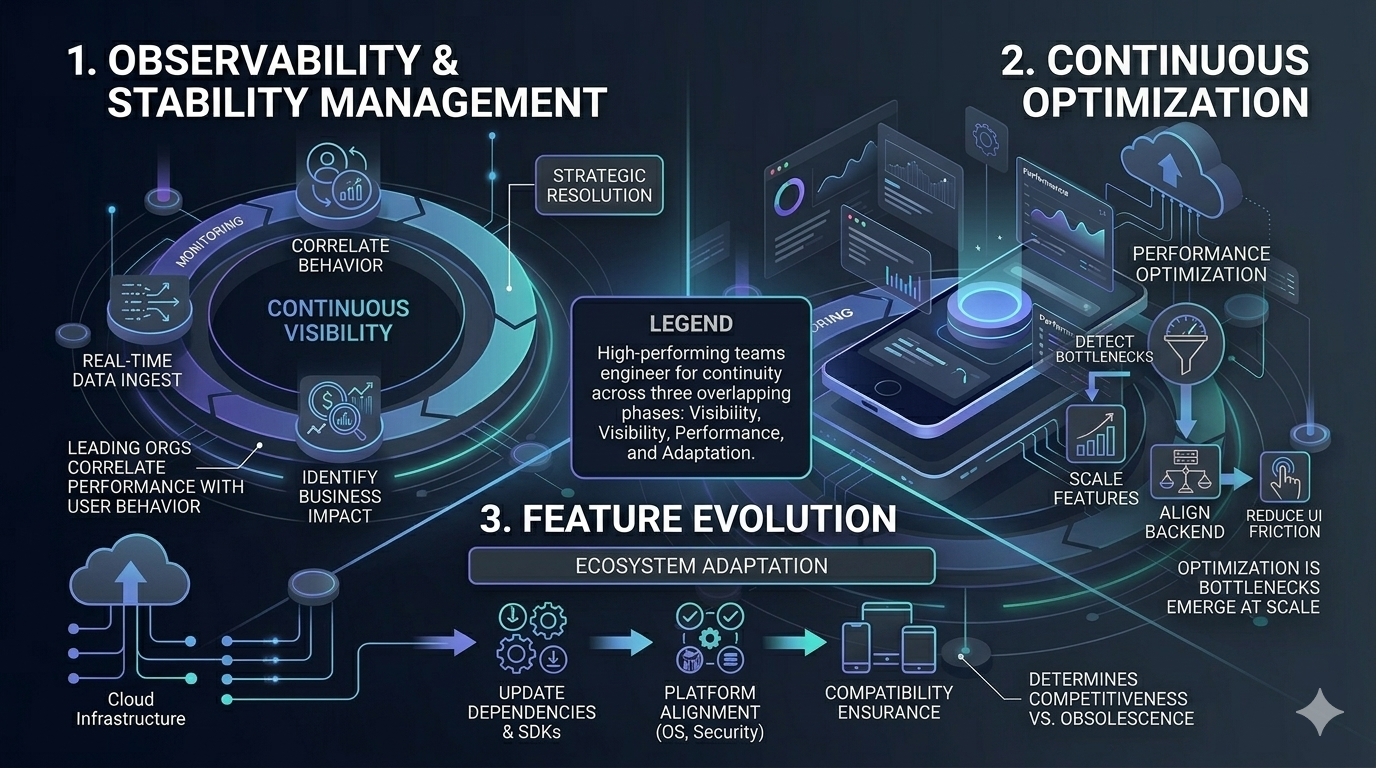 Observability and Stability Management
The immediate priority is visibility. Teams need real-time insight into crash rates, API latency, and device-specific performance issues.
Leading organizations implement observability layers that correlate system performance with user behavior—enabling teams to identify not just failures, but their business impact.
Without this, teams rely on delayed signals such as app store reviews or support tickets—by which point customer experience has already degraded.
- Continuous Optimization
Performance optimization is ongoing. As user behavior evolves, new bottlenecks emerge:
- Features scale unpredictably
- Backend services experience uneven load
- UI friction becomes visible at scale
- Feature Evolution and Platform Alignment
Mobile ecosystems evolve rapidly. OS updates, security requirements, and user expectations continuously shift.
Engineering teams must adapt by:
- Updating dependencies and SDKs
- Aligning with platform-level changes
- Ensuring compatibility across devices and environments
This phase determines whether the app remains competitive—or gradually becomes obsolete.
Where Enterprise Teams Get Stuck
Despite understanding these phases, many organizations struggle to operationalize them effectively.
The most common bottlenecks are structural.
Fragmented ownership across mobile, backend, and DevOps teams creates delays in diagnosing cross-layer issues. Release governance processes slow down iteration, making even minor fixes time-consuming. Meanwhile, technical debt accumulates silently, increasing long-term maintenance costs.
At scale, these inefficiencies are not isolated—they compound. What starts as minor friction evolves into systemic drag on engineering productivity and customer experience.
What High-Performing Teams Do Differently
Organizations that consistently deliver high-performing mobile experiences adopt a fundamentally different operating model.
They embed lifecycle ownership into engineering KPIs, measuring success not just by feature delivery but by stability, performance, and release efficiency.
They also invest in automation at scale—CI/CD pipelines, automated testing across device ecosystems, and real-time monitoring. This reduces the time between issue detection and resolution, which is critical in maintaining user trust.
More importantly, they align teams around a shared objective: continuous improvement. Mobile is no longer treated as a standalone product but as a dynamic component of a larger digital platform.
The Platform and Architecture Angle
Lifecycle engineering is deeply influenced by platform decisions.
Monolithic architectures often struggle to keep pace with continuous updates. In contrast, modular and API-driven systems enable faster iteration and better scalability.
Cloud-native infrastructure further enhances this capability, allowing organizations to respond to fluctuating demand without compromising performance.
An emerging pattern among enterprise leaders is the convergence of mobile and web platforms—reducing duplication and ensuring consistent user experiences. However, this requires disciplined governance to avoid introducing new complexities.
Ultimately, post-launch performance is not just about the app—it is about the ecosystem that supports it.
Rethinking Launch Success
For many leadership teams, the definition of success needs to evolve.
The relevant questions are no longer:
- Was the app delivered on time?
- Did it meet initial requirements?
Instead, they are:
- How quickly can the team respond to real-world usage data?
- How efficiently can new features be deployed without risk?
- How well does the app adapt to ecosystem changes?
This shift reframes launch as the starting point of value creation—not its conclusion.
Conclusion
Mobile apps today operate as living systems within broader digital ecosystems. Their success depends less on how they are launched and more on how they evolve.
Organizations that adopt a lifecycle engineering mindset gain a structural advantage. They reduce operational friction, improve user experience, and create a foundation for sustained innovation.
For leadership teams evaluating their current approach, the starting point is often a simple but revealing question: where is post-launch effort being spent—and how much of it is reactive?
The answer typically surfaces gaps that are not immediately visible on dashboards—but are deeply embedded in delivery models, team structures, and platform decisions.
Frequently Asked Questions
What is mobile app lifecycle engineering, and how is it different from traditional maintenance?
Mobile app lifecycle engineering is a structured approach to managing an application after launch, focusing on continuous monitoring, optimization, and evolution. Unlike traditional maintenance, which reacts to issues as they arise, lifecycle engineering integrates post-launch activities into the core delivery model. This allows organizations to anticipate performance challenges, adapt to changing user behavior, and sustain long-term value rather than simply fixing problems.
Why do enterprise mobile apps fail after a successful launch?
Most enterprise mobile applications do not fail due to poor development but because of weak post-launch strategies. Once deployed, applications face real-world conditions such as scale, integration complexity, and evolving user expectations. Without a lifecycle-driven approach, teams become reactive, technical debt accumulates, and performance gradually declines. This gap between launch success and operational sustainability is one of the most common reasons for underperformance.
How does lifecycle engineering impact business outcomes like revenue and customer retention?
Lifecycle engineering directly influences key business metrics by ensuring consistent performance, faster updates, and improved user experience. In large-scale environments, even minor performance issues can lead to measurable drops in engagement and retention. By continuously optimizing the application and reducing downtime or friction, organizations can protect revenue streams, improve customer satisfaction, and extend the lifecycle value of their digital products.
What role does architecture play in post-launch success?
Architecture is a critical factor in determining how effectively an application can evolve after launch. Modular, API-driven, and cloud-native architectures enable faster updates, easier integration, and better scalability. In contrast, tightly coupled systems often slow down release cycles and increase the risk of instability. Organizations that prioritize lifecycle engineering typically invest in architectures that support continuous change rather than static deployment.
How should enterprise teams structure ownership after launch?
Post-launch ownership should not be fragmented across isolated teams. High-performing organizations align mobile, backend, and infrastructure teams under a shared lifecycle responsibility model. This ensures that issues spanning multiple systems can be resolved efficiently and that updates are delivered without unnecessary delays. Integrating lifecycle KPIs into team performance metrics also helps maintain accountability beyond initial delivery.
What are the early signs that a mobile app lifecycle strategy is not working?
Common indicators include increasing release delays, rising technical debt, inconsistent performance across devices, and a growing reliance on reactive fixes. Another critical signal is when engineering teams spend more time addressing issues than building new capabilities. These patterns suggest that lifecycle engineering is not fully integrated into the delivery model and requires structural adjustments.
How often should enterprise mobile apps be updated after launch?
There is no fixed timeline, but high-performing teams adopt a continuous delivery approach where updates are released incrementally and frequently. Instead of large, infrequent releases, organizations focus on smaller updates driven by data and user behavior. This reduces risk, improves responsiveness, and ensures that the application remains aligned with evolving business and user needs.



Add Comment