




Enterprise leaders no longer ask, “How much does it cost to build an app?” They ask, Why did the last one overshoot the budget by 40%?
In 2026, mobile app development costs are not inherently unpredictable—but they are frequently misunderstood. The challenge is not a lack of benchmarks. It is the mismatch between how leadership teams estimate cost and how modern digital products actually evolve in production environments.
For North American enterprises operating at scale, mobile apps are no longer standalone deliverables. They are extensions of complex ecosystems—cloud infrastructure, data pipelines, AI layers, security frameworks, and customer experience platforms. This shifts cost from a one-time build mindset to a continuous investment model.
The result: budgets appear inflated, timelines stretch, and ROI becomes difficult to attribute. This article breaks down where the money actually goes, what realistic cost expectations look like in 2026, and how engineering and digital leaders can regain control.
What Actually Drives Mobile App Costs Today
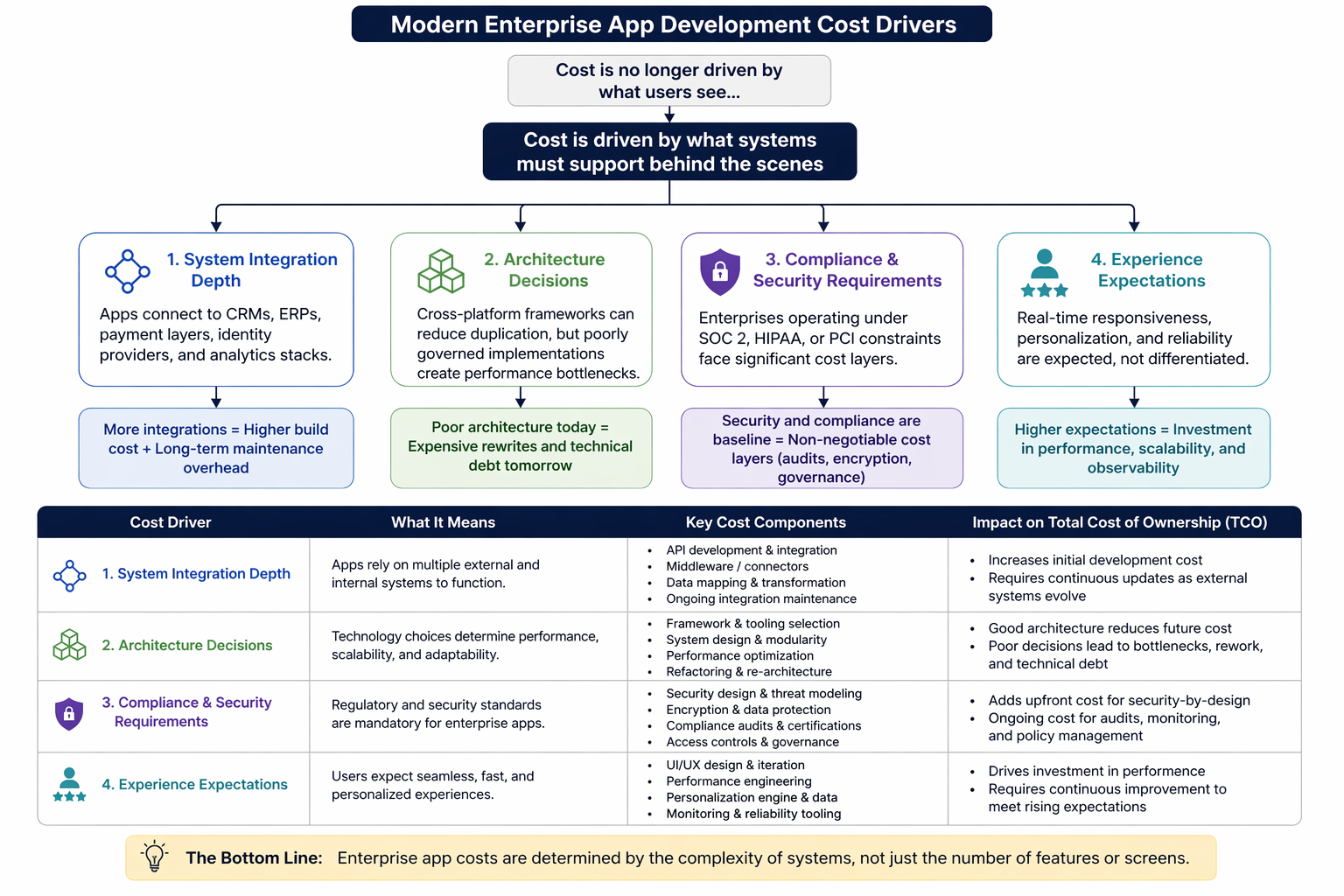 Most cost discussions still revolve around features and UI complexity. That framing is outdated. In enterprise environments, four primary cost drivers dominate:
System integration depth defines cost more than feature count. Apps connect to CRMs, ERPs, payment layers, identity providers, and analytics stacks. Each integration adds not just build cost but long-term maintenance overhead.
Architecture decisions shape financial outcomes. Cross-platform frameworks can reduce duplication, but poorly governed implementations often create performance bottlenecks that require expensive rewrites later.
Compliance and security requirements are now baseline. Enterprises operating under SOC 2, HIPAA, or PCI constraints face significant cost layers tied to audits, encryption, and governance.
Experience expectations continue to rise. Real-time responsiveness, personalization, and reliability are expected, not differentiated.
The implication is clear: cost is no longer driven by what users see—it is driven by what systems must support behind the scenes.
The Realistic Cost Ranges in 2026
Enterprise-grade mobile applications typically fall into two broad categories:
- Mid-level applications ($150K–$400K)
Internal tools or customer-facing apps with moderate integrations and standard UX patterns. - Complex enterprise platforms ($400K–$1.2M+)
Applications with real-time processing, deep integrations, advanced UX, and scalability requirements.
These figures represent initial build costs. Ongoing investment—often overlooked—includes infrastructure, updates, performance optimization, and compliance. In most enterprise environments, this adds 15–25% annually to the initial build cost.
The consistent gap in planning is not underestimating development—it is underestimating evolution.
Hidden Cost Centers Leaders Consistently Underestimate
Budget overruns rarely come from obvious sources.
Design iteration cycles expand as customer expectations evolve. Backend scalability becomes a real cost only after usage spikes. Data architecture grows in complexity as personalization and analytics mature.
Cross-team dependencies introduce delays that compound costs. Platform, DevOps, and security teams add layers of coordination that are often invisible during planning.
The most expensive factor, however, remains technical debt. Short-term delivery decisions frequently result in long-term cost penalties that exceed the original build budget.
These are not anomalies—they are predictable patterns in enterprise delivery.
How Leading Companies Keep Costs Low While Scaling
Some organizations consistently deliver scalable mobile applications without runaway costs. The difference is not budget size—it is execution discipline and architectural foresight.
Firms like GeekyAnts have gained recognition for optimizing cross-platform development using frameworks like Flutter and React Native. Their approach focuses on building reusable component libraries and design systems early, reducing duplication across projects. This significantly lowers both development time and long-term maintenance costs.
Similarly, ThoughtWorks has long emphasized evolutionary architecture. Instead of over-engineering upfront, they advocate incremental scalability—allowing systems to evolve based on real usage patterns. This prevents overinvestment in infrastructure that may never be utilized.
Product-driven organizations like Airbnb and Shopify demonstrate a different dimension of cost efficiency. They invest heavily in internal platform standardization—shared tooling, unified design systems, and modular services. This enables multiple teams to build and scale features without reinventing core components.
Across these examples, a few consistent patterns emerge:
- Early investment in reusable architecture reduces marginal cost per feature
- Platform thinking replaces project-based thinking
- Cross-functional alignment minimizes rework and dependency delays
Cost Control Strategies That Actually Work at Enterprise Scale
Enterprises that manage mobile app costs effectively do not rely on tighter budgets. They rely on better decision frameworks.
They define product scope in terms of measurable business outcomes rather than feature lists. This reduces unnecessary expansion during development.
They adopt incremental delivery models, releasing in phases instead of large deployments. This allows early validation and limits expensive late-stage changes.
They enforce architectural governance across teams, preventing fragmentation and redundant development efforts.
They maintain lifecycle ownership, ensuring that applications are continuously optimized rather than abandoned post-launch.
They align external partners with internal engineering strategy, avoiding disconnects that lead to inefficiencies.
These practices shift cost management from reactive control to proactive design.
Final Perspective: Cost Is a Strategy Decision, Not a Line Item
Mobile app development in 2026 is not a budgeting exercise—it is a strategic investment decision.
The organizations that succeed are not those that spend the least. They are the ones that align cost with impact—customer acquisition, retention, operational efficiency, and revenue growth.
The question for leadership is not whether to invest, but how to structure that investment intelligently.
That typically requires stepping back from vendor quotes and feature estimates, and instead examining how architecture, platform strategy, and delivery models align with long-term business goals.
In many cases, that conversation surfaces opportunities to reduce cost—not by doing less, but by building smarter.
FAQs: Cost Breakdown of Mobile App Development in 2026
- Why do mobile app development costs vary so widely in 2026?
Costs vary because modern mobile apps are no longer standalone products. They depend on integrations, cloud infrastructure, security layers, and data systems. Two apps with similar interfaces can have completely different backend complexity, which significantly impacts cost.
- What is a realistic budget range for an enterprise mobile app today?
For North American enterprises, most mobile apps fall between $150K and $1.2M+ for initial development. However, ongoing costs—such as maintenance, cloud infrastructure, and feature evolution—can add 15–25% annually to the original investment.
- How can enterprises reduce mobile app development costs without compromising scalability?
Cost reduction comes from smarter architecture decisions, not cutting features. Leading companies like GeekyAnts focus on reusable components and cross-platform frameworks like Flutter, while firms like ThoughtWorks emphasize incremental scalability. This avoids overengineering and reduces long-term rework.
- Is cross-platform development always more cost-effective than native development?
Not always. Cross-platform frameworks such as React Native and Flutter can reduce initial development time, but poor implementation can lead to performance issues and higher maintenance costs. The decision should align with product requirements, not just budget.
- What are the most commonly overlooked costs in mobile app development?
The most underestimated costs include backend scalability, ongoing UX improvements, data architecture, compliance updates, and technical debt. These typically emerge after launch and can significantly increase total cost of ownership.
- How important is architecture in controlling long-term costs?
Architecture is one of the biggest cost drivers. A well-structured, modular architecture reduces future development effort, while poor architecture leads to expensive rewrites. Companies like Shopify and Airbnb invest heavily in platform standardization to keep costs predictable as they scale.
- Should enterprises build mobile apps in-house or outsource development?
Most large organizations adopt a hybrid approach. Core, differentiating capabilities are built in-house, while external partners handle acceleration and specialized tasks. The key is ensuring alignment between internal teams and external vendors to avoid inefficiencies.
- How long does it typically take to develop an enterprise mobile app?
Timelines usually range from 4 to 12 months depending on complexity. However, many organizations now prefer phased releases, launching a core version early and iterating continuously to reduce risk and control costs.
- What role does cloud infrastructure play in overall cost?
Cloud infrastructure is a recurring cost that scales with usage. While it enables flexibility and scalability, poor optimization can lead to significant overspending. FinOps practices are increasingly critical to managing this layer effectively.
- How should leadership evaluate ROI on mobile app investments?
ROI should be tied to measurable business outcomes such as customer acquisition, retention, operational efficiency, and revenue growth. Focusing only on development cost without linking it to these outcomes often leads to misaligned investment decisions.





Add Comment