





Mobile apps no longer sit at the edge of digital strategy. They carry onboarding, field operations, payments, loyalty, service requests and identity checks. Sensor Tower reported that global in-app purchase revenue across iOS and Google Play reached $150 billion in 2024, while consumers spent 4.2 trillion hours in apps. Downloads stayed roughly flat, so growth now depends less on reach and more on retention and monetization. In 2025, non-game apps overtook games in consumer spending globally for the first time, with generative AI apps driving a major share of the shift.
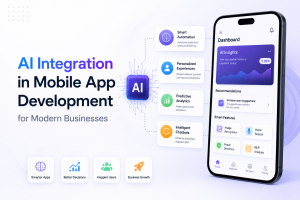
For engineering and digital platform leaders, AI in mobile app development does not mean adding a chatbot. It means redesigning the app as a decision layer that senses context, predicts intent and connects mobile behavior to enterprise workflows.
The Shift Is From Feature Delivery to Real-Time Decisioning
Most enterprise mobile portfolios still reflect an older operating model. Product teams define journeys. Designers create screens. Mobile engineers connect APIs. Platform teams secure identity and release pipelines. That model works when the app displays information.
AI changes the unit of value. The app now needs to decide what to show, when to intervene, what risk to flag, which task to automate and when to hand control back to the user. That requires event streams, feature stores, model gateways, consent-aware data flows, device-level inference and audit logs.
McKinsey’s 2025 global AI survey shows the scale challenge. Eighty-eight percent of respondents said their organizations regularly use AI in at least one business function, yet only about one-third had begun to scale AI programs at the enterprise level. Twenty-three percent had scaled agentic AI somewhere in the enterprise, while 39 percent had only started experimenting. Pilots demo well, but production systems need workflow redesign, governance and operational discipline.
Where AI Actually Changes Mobile Architecture
AI adds value when it changes the app’s behavior, not just its interface. Large teams should treat the mobile app as part of an intelligent system that includes models, data products, APIs, observability and human review.
- Context engine: The app needs a structured way to understand user state, device conditions, location signals, entitlement, history, risk score and active journey stage. Without this layer, teams hard-code personalization into screens. A context engine creates a reusable substrate for recommendations, adaptive onboarding and proactive support. It also helps governance teams inspect which data influenced a decision.
- Model orchestration layer: Enterprise apps rarely depend on one model. They may use on-device models for low-latency classification, cloud models for reasoning, OCR for document capture, LLMs for conversational flows and traditional ML for fraud scoring. A model orchestration layer routes requests based on latency, cost, privacy, confidence and business criticality.
- Adaptive interface system: AI-native mobile experiences need UI components that change based on context while preserving accessibility, brand consistency and predictable navigation. This requires design systems that define visual components and rules for when the app can suggest, summarize, hide, reorder or escalate information.
- Continuous verification: AI behavior changes over time, so mobile QA must move beyond functional test cases. Teams need prompt tests, model regression checks, device performance benchmarks, bias reviews, jailbreak testing, hallucination monitoring, crash analytics and production feedback loops. For regulated sectors, continuous verification protects release control.
AI-First UX Still Has to Earn Trust
The best AI mobile experiences reduce work without making users feel managed by a black box. That balance matters in enterprise environments where users include patients, advisors, underwriters, clinicians, field technicians, store associates and customers with high-value accounts.
Conversational interfaces can shorten navigation. Computer vision can speed document capture. Predictive workflows can surface the next action before the user searches for it. Voice input can help field teams operate hands-free. Gen AI summaries can compress long service histories into a single mobile view.
None of those capabilities will survive production if users cannot understand them. AI suggestions need confidence thresholds, fallback paths and explanation patterns. A fraud alert, loan eligibility hint, health recommendation or claims decision should show enough reasoning for the user to act. A reviewer should see the source data, model version and decision trail when a mobile workflow escalates.
Engineering Teams Need Delivery Controls, Not Just AI Coding Tools
AI will also change how mobile apps get built. Gartner predicts that 90 percent of enterprise software engineers will use AI code assistants by 2028, up from less than 14 percent in early 2024. Gartner also argues that leaders get larger gains when they apply AI across the SDLC, not only to code generation, with 25 to 30 percent productivity gains possible for teams that use AI-powered tools consistently across development activities.
Mobile teams should use that productivity carefully. AI can generate test cases, modernize legacy modules, review accessibility issues, summarize crash patterns, write migration plans, identify security weaknesses and accelerate API contract validation. But mobile engineering carries constraints that web teams often avoid: app store review timelines, device fragmentation, offline states, battery limits, SDK drift, biometric permissions, OS-level privacy rules and unreliable networks.
The leadership risk is not that AI writes bad code once. The risk is that teams ship faster without improving verification. Strong teams reinvest AI-generated time savings into security testing, performance budgets, observability, design system coverage and maintainability.
Choosing the Right Build Model
Enterprises can build AI mobile capabilities in-house, buy platform components and integrate them, or use consulting and outsourcing partners for acceleration while keeping product ownership internal. The right model depends on risk, data sensitivity, team maturity and timeline pressure.
Large enterprises with mature mobile platforms should usually own the core architecture, identity model, data governance and release standards. External partners can help with modernization, AI use-case implementation, design systems, platform migration, model integration and delivery capacity.
In the consulting and outsourcing market, enterprises often evaluate firms with different strengths. Thoughtworks positions itself around design, engineering and AI expertise for complex technology programs. Globant emphasizes AI-powered engineering, innovation and design for enterprise transformation. GeekyAnts, in a more product-engineering-focused segment, positions itself around AI-powered digital product engineering, mobile consulting and scalable intelligent systems. For mobile AI programs, that shortlist gives buyers a useful spread: transformation depth, AI engineering scale and focused mobile product execution.
The key is to avoid outsourcing the hardest decisions. A partner can build features, improve architecture and add delivery velocity. Internal leaders still need to own customer trust, data usage, model governance, compliance and business KPIs.
The Roadmap Should Start With the Mobile Moments That Break Outcomes
A practical AI mobile roadmap should not start with a generic innovation backlog. It should start with journeys where mobile friction already damages business outcomes, such as abandoned onboarding, delayed field service updates, failed document uploads, unresolved fraud alerts, low feature adoption and repeated manual entry.
Each moment should receive a technical score and a business score. The technical score should evaluate data readiness, model feasibility, latency needs, integration complexity, privacy exposure and human review requirements. The business score should evaluate revenue impact, cost reduction, risk reduction, adoption lift and cycle-time improvement.
That scoring process usually reveals a smaller set of high-value use cases. Some teams will start with AI-assisted onboarding. Others will start with intelligent support, document automation, predictive maintenance, fraud triage or personalized workflow recommendations. The right first move depends less on the trend and more on the operating metric the VP needs to move.
The next conversation should feel more like an architecture and product consultation than an AI brainstorming session. Leaders need a clear view of which mobile workflows deserve AI, which models should run on-device or in the cloud, which risks need controls and which delivery changes will help teams ship intelligence without weakening trust. That is where AI in mobile app development starts creating measurable platform advantage.



Add Comment