

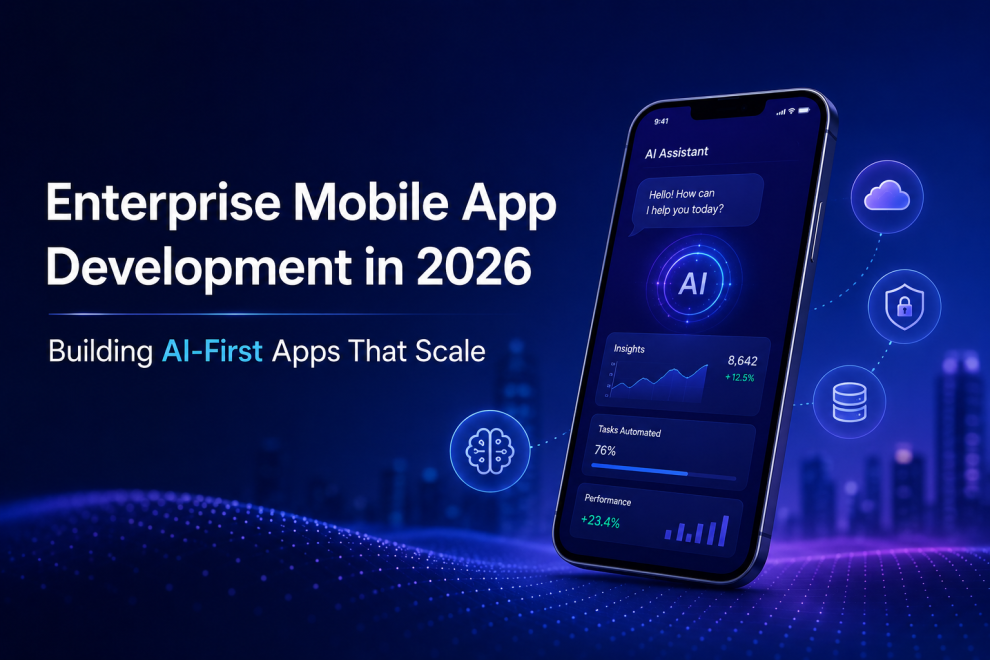

Mobile applications are no longer just customer-facing tools—they have become essential platforms for driving enterprise productivity, customer engagement, and digital innovation. As artificial intelligence continues to reshape industries, organizations are shifting from building feature-rich apps to creating intelligent mobile experiences that can automate workflows, personalize interactions, and support better decision-making.
For enterprise leaders, the challenge is not simply adopting AI but integrating it into mobile applications in a way that delivers measurable business value.
Why AI-First Mobile Apps Are the Future
Today’s users expect more than fast and responsive applications. They want apps that understand context, anticipate needs, and simplify everyday tasks. AI enables mobile applications to deliver personalized recommendations, predictive insights, and conversational experiences that improve both employee efficiency and customer satisfaction.
Organizations investing in AI-first mobile applications are seeing benefits such as:
- Faster decision-making
- Increased user engagement
- Improved operational efficiency
- Better customer retention
- Smarter workflow automation
Building for Enterprise Scale
Enterprise mobile applications must support thousands—or even millions—of users while maintaining high performance, security, and reliability. Achieving this requires scalable cloud infrastructure, API-first architectures, robust authentication, and seamless integration with existing enterprise systems.
Equally important is creating a consistent user experience across Android, iOS, tablets, and web platforms. A unified design system helps development teams deliver cohesive experiences while reducing development time.
Security and Trust Remain Essential
AI-powered mobile apps often process sensitive business and customer data. Enterprises must prioritize:
- End-to-end encryption
- Secure authentication
- Regulatory compliance
- Transparent AI decision-making
- Continuous monitoring
Trust is built when users know their data is protected and AI recommendations are reliable.
Cross-Functional Collaboration Drives Success
The most successful enterprise mobile products are created through collaboration between product managers, UX designers, engineers, AI specialists, and cloud architects. Rather than adding AI after development, leading organizations incorporate intelligent capabilities from the earliest stages of product planning.
This collaborative approach helps ensure that AI features solve real business problems while remaining intuitive for end users.
Industry Perspective
Across the product engineering industry, companies are increasingly combining mobile development, AI, cloud infrastructure, and UX into a single delivery model. Firms such as GeekyAnts have showcased enterprise projects spanning healthcare, fintech, retail, and SaaS that demonstrate how integrated product engineering teams can deliver scalable mobile solutions designed for long-term growth. This reflects a broader trend toward building AI-enabled mobile applications with both technical excellence and user adoption in mind.
Looking Ahead
The future of enterprise mobility will be defined by intelligent assistants, predictive workflows, edge AI, and personalized digital experiences. Organizations that invest in scalable architecture, user-centered design, and responsible AI today will be better positioned to adapt as mobile technology continues to evolve.
Conclusion
Enterprise mobile app development is entering a new era where AI is becoming a core component rather than an optional feature. Success will depend on balancing innovation with usability, security, and scalability. By combining strong engineering practices with thoughtful user experience, organizations can build mobile applications that deliver lasting value for both businesses and their users.



Add Comment