



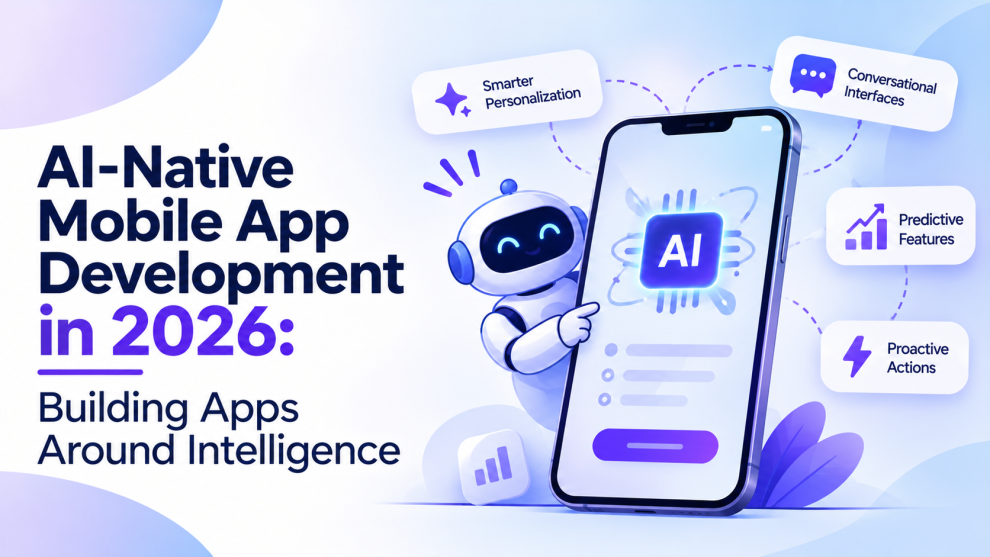

AI integration in mobile applications is moving beyond adding a chatbot or recommendation feature. Businesses are increasingly exploring applications where intelligence is built into the product architecture, workflows, and everyday user interactions.
This shift toward AI-native mobile app development is changing how teams plan, design, and engineer mobile products.
What Makes a Mobile App AI-Native?
An AI-native application is designed around intelligent capabilities rather than treating AI as an additional feature.
For example, a traditional shopping app may allow users to search and filter products manually. An AI-native shopping experience could understand natural-language requests, recommend relevant products, and help users compare options.
5 Trends Shaping AI-Native Mobile Apps
1. Natural-Language Interactions
Users can describe what they want instead of navigating multiple menus. Conversational interfaces can simplify search, discovery, and task completion.
2. Agentic Workflows
AI agents can coordinate multiple steps, use connected tools, and assist with tasks such as travel planning, scheduling, and customer support. Sensitive actions should still require user approval.
3. On-Device Intelligence
Running suitable AI models directly on smartphones can improve responsiveness, support offline capabilities, and reduce the need to send certain information to cloud services.
4. Context-Aware Personalization
Applications can use relevant user preferences and activity to provide more contextual recommendations and assistance, with appropriate privacy controls.
5. Multimodal Experiences
Mobile apps are increasingly combining text, voice, images, and other inputs. Users may search using a photograph, ask questions through voice, or interact with visual content.
Technical Considerations for AI-Native App Development
Building these applications requires careful engineering decisions:
- Selecting suitable AI models and providers.
- Integrating secure APIs and external tools.
- Balancing cloud and on-device processing.
- Managing latency, memory, and battery usage.
- Protecting personal information.
- Testing AI outputs and handling failures.
Flutter and React Native can support cross-platform development, while native integrations may be necessary for specific device capabilities.
Why Product Strategy Matters
Not every mobile application needs agentic AI or advanced machine learning. Businesses should first identify user problems and determine whether AI can make an existing workflow faster, simpler, or more valuable.
Companies such as GeekyAnts working across mobile engineering and AI-powered product development operate at this intersection of product strategy, architecture, and implementation.
Final Thoughts
AI-native mobile apps represent a shift in how applications are conceived and built. The opportunity is not simply to add more AI features, but to create intelligent experiences that solve meaningful problems while remaining secure, reliable, and easy to use.



Add Comment