


So, what exactly is an MVP? A Minimum Viable Product (MVP) isn't an unfinished app or a cheap prototype. It's the most stripped-down, essential version of your app that solves one core problem for a very specific audience. Think of it as a strategic first step, not a final destination.
Decoding the MVP in App Development

Let's use an analogy. Imagine your grand vision is to build a high-tech, self-driving car. The old way of thinking would be to spend years and a fortune building the entire car before letting anyone drive it. The MVP approach? You start by building a skateboard.
Sure, it's simple, but that skateboard validates your most critical assumption: that people need a way to get from point A to B. It gets a real product into users' hands immediately. The MVP for your app works the same way. It's built to answer one fundamental question with real-world evidence: “Is this something people actually want?” This allows you to learn from users, not just spreadsheets.
From Big Idea to Smart Start
I've seen it happen time and again: a founder has a brilliant idea, maps out dozens of features, and spends a year or more in a silo building the "perfect" app. The problem with this "big bang" launch is the staggering risk. You might burn through your entire budget only to find out you built something nobody needs.
The MVP flips that entire process on its head. It forces you to get laser-focused. What is the single most important function of your app? What is the one major pain point it must solve to be valuable? By building only that core functionality, you create a lean, targeted product you can get into the market fast.
In the fast-moving US app market, this speed is everything. Consider that while an estimated 90% of startups fail, those that launch with an MVP see far better odds. By focusing on just 3-5 core features, development time can plummet by 50-70%. This brings the initial cost down from over $150,000 to a much more manageable $50,000-$80,000 and gets you to market in 2-4 months instead of the traditional 9-12. You can find more insights on how MVPs accelerate market entry on Zco.com.
The core principle of an MVP is to maximize learning while minimizing risk. It's not about delivering less; it's about delivering the right thing sooner to validate your entire business model.
Full-Featured App vs MVP Approach at a Glance
This table provides a quick comparison of the traditional 'big bang' launch versus the strategic MVP approach, highlighting key differences in goals, risks, and outcomes. Seeing the two methods side-by-side makes the strategic advantage of the MVP crystal clear.
| Aspect | Full-Featured App Launch | MVP Launch |
|---|---|---|
| Primary Goal | Launch a complete, polished product with all planned features. | Validate a core business hypothesis with minimal resources. |
| Initial Investment | High (often $150,000+ for development alone). | Low (typically $50,000 – $80,000). |
| Time to Market | Long (9-12+ months). | Short (2-4 months). |
| Risk Level | Very High. Risk of building the wrong product is significant. | Low. Failure is a cheap lesson, not a catastrophic event. |
| Feedback Loop | Delayed until after the full launch, making pivots difficult. | Immediate. User feedback is collected from day one to guide iteration. |
In the end, the MVP isn't just a product; it’s a process. It’s a more scientific, data-driven way to build a company, proving out your assumptions one step at a time with real feedback from real users.
The Strategic Purpose of Your MVP
So, we know an MVP is the most basic version of your app. But why build one in the first place? It's much more than just a piece of code; think of it as a compass for your business idea. An MVP is built to answer a few critical questions that can mean the difference between sustainable growth and a costly dead end.
Every app idea starts with a big assumption. Maybe you believe "People will pay for a service that delivers dog-walking drones" or "Busy parents desperately need an app to coordinate carpools." An MVP takes that one core belief and tests it in the real world—with real users—instead of just a focus group.
This immediately kicks off an invaluable feedback loop. You stop building in a silo based on what you think people want and start gathering hard data on how they actually behave. Shifting from guesswork to evidence is what separates successful apps from expensive failures.
Validating Market Demand and Reducing Risk
Building an MVP is your first, best defense against a devastating mistake: creating a beautiful, perfectly engineered product that nobody actually wants. The tech graveyard is full of them. Your MVP is an early warning system that confirms there's a real audience for your solution before you bet the farm on it.
It does this by homing in on a few specific goals:
- Test the Core Value Proposition: Does your app solve a real problem people care about? The MVP is designed to give you a clear "yes" or "no" on this.
- Find Your First Fans: It helps you attract your first group of early adopters. These are the people who will become your champions, giving you the passionate, honest feedback you need to guide your next moves.
- Keep Initial Costs Down: By building only what is absolutely necessary, you slash your upfront development costs and timeline. This saves precious capital, letting you invest it based on what you learn, not what you guess.
An MVP turns your riskiest assumptions into data points. It’s a calculated experiment designed to prove—or disprove—your business model quickly and cheaply, preventing you from wasting a year and a fortune building the wrong product.
This risk-reduction strategy is especially crucial if you're looking for funding. Investors are far more likely to back a team that can show real-world traction, even on a small scale.
The MVP as a Fundraising and Product Roadmap Tool
A working MVP with active users is your single most powerful fundraising asset. Instead of walking into a pitch meeting with just a slide deck and some financial projections, you can show investors a real product people are already using. You have data, not just an idea.
This demonstrates a few things that get investors to pay attention:
- Market Validation: You have hard proof that at least one segment of the market finds your solution valuable.
- Execution Capability: You’ve shown your team can successfully build and launch a product, not just talk about it.
- User Traction: Metrics like daily active users, engagement rates, and even small amounts of initial revenue are concrete signs of life.
Beyond fundraising, the data you gather becomes the foundation of your product roadmap. The feedback tells you exactly what to build next. Are users constantly asking for a specific feature? Are they getting stuck somewhere in the user flow? This information is gold. It helps you prioritize what to build, ensuring your next moves are based on what people have already told you they want. This approach is a cornerstone of effective app development for startups, where every dollar and hour has to count.
Ultimately, the purpose of an MVP is to learn. It’s a strategic tool for gathering intelligence, validating your vision, and building a product that people genuinely need and love, one smart step at a time.
How to Build and Scope Your App MVP
Turning a great idea into a real, working app is a massive undertaking. It's easy to get lost in the weeds, but the MVP process is your roadmap. This isn't about throwing things at the wall to see what sticks; it’s a disciplined method for building the right product without wasting time or money.
We're going to walk through the essential stages for scoping and building your MVP, from figuring out the core problem to finally getting it into users' hands.
Stage 1: Nail Down the Problem You’re Actually Solving
Before you even think about code, you have to be absolutely sure the problem you're solving is real. More importantly, you need to know who has this problem. Building a solution for a problem no one has is the quickest path to failure.
Get specific with your target user. "Busy professionals" is way too broad. A better target is something like, "early-career financial analysts in New York City who work over 60 hours a week and can’t find time for healthy meal prep." That level of detail gives you a North Star for every decision.
Once you know who you're building for, it's time to validate their pain points:
- Talk to People: Don't hide behind surveys. Get on the phone or grab coffee with at least 10-15 people in your target group. Ask them open-ended questions about their struggles and what they've tried to do about them. Listen more than you talk.
- Spy on the Competition: See what other apps are out there. What do they do well? Where do they fall short? User reviews are a goldmine for finding out what frustrates people and where the gaps are.
- Check the Search Data: Use keyword research tools to see what people are actually searching for. This can uncover the exact language your audience uses to describe their problem and reveal needs you hadn't even considered.
This research isn't just a box to check. It's the bedrock of your entire strategy. You should come out of this phase with a crystal-clear problem statement that will anchor your project.
Stage 2: Prioritize Features With Ruthless Focus
Now that you have a validated problem, it’s time to decide what your app will actually do. This is where so many teams get tripped up by "feature creep"—that constant temptation to add just one more cool thing. Your mission is simple: include the absolute minimum set of features needed to solve the core problem. That’s it.
A great tool for this is the MoSCoW method, which helps you sort features into four distinct categories:
- Must-Have: These are the non-negotiables. Without them, the app is broken and can't deliver on its main promise.
- Should-Have: These are important and add a lot of value, but the app can launch without them. Think of them as top candidates for version 2.0.
- Could-Have: These are the "nice-to-haves." They might improve the experience, but hold off unless users start asking for them.
- Won't-Have: These are features you explicitly decide not to build right now. This is crucial for keeping your team focused.
For your MVP, you build only the "Must-Haves." Every other feature adds time, cost, and risk, which undermines the whole point of starting small.
Think through the primary user journey. What are the essential steps someone has to take to get value from your app? Build only the features required to make that one critical path possible.
This entire process is designed to create a direct line from your initial idea to gathering real-world feedback and, eventually, securing funding.

The MVP isn't just about building a product; it's about learning from users and proving your concept has legs, which is exactly what investors want to see.
Stage 3: Build, Test, and Launch Your App
With a tight feature list, you can finally move into development. A well-scoped MVP typically takes about 2 to 4 months to build. This phase is all about writing the code, testing it relentlessly, and getting it ready for launch.
The MVP approach became essential for survival in the American market. When the App Store first exploded with over 1 million apps by 2013, getting noticed was tough. Founders who used an MVP cut their development time by up to 70%, giving them the speed to adapt to market feedback. The stats still back this up: with 42% of mobile apps failing because they solve no real market need, teams that launch an MVP see a 3x higher survival rate.
Your build-test-launch cycle should look something like this:
- Development Sprints: Break the work into small, focused cycles. Aim to build and finish a few specific features in each sprint.
- Quality Assurance (QA) Testing: Test constantly. This means running automated scripts and having real humans try to break the app to find bugs and usability issues.
- Beta Launch: Before you go public, release the app to a small, private group of beta testers. Their feedback is invaluable for catching critical flaws.
- Public Launch: Submit your app to the Apple App Store and Google Play Store and get it out into the world.
From day one, make sure you're compliant with U.S. privacy laws like the California Consumer Privacy Act (CCPA). Be transparent about how you handle user data. For a more technical breakdown of this phase, check out our guide on how to build a mobile app.
Once you launch, the real work starts. It’s time to collect data, talk to your new users, and start planning what comes next.
Real-World MVP Success Stories

Theory is one thing, but seeing how an MVP comes to life in the real world is where the most valuable lessons are found. Some of the most dominant apps on your phone right now started as incredibly focused, stripped-down products that did just one thing really, really well.
These stories aren't just for inspiration. They're practical case studies in how to validate an idea, listen to your first users, and have the discipline to ignore the noise and focus on what truly matters. Let’s look at a couple of classic examples from the US market.
Instagram: From Cluttered App to Photo-Sharing Giant
Long before it was the photo-sharing behemoth we know today, Instagram was a completely different app called Burbn. Launched back in 2010, Burbn was an ambitious, location-based social network. It let you check in at locations, make plans with friends, earn points, and, yes, post pictures. The only problem? It was a mess. The app was trying to be everything to everyone, and it felt clunky and confusing.
But the founders, Kevin Systrom and Mike Krieger, were paying close attention to their user data. They spotted a crucial pattern: while almost everyone ignored Burbn's other features, they were all using the photo-sharing function. The filtered, vintage-looking photos were a runaway hit.
That was the lightbulb moment. They decided to pivot and build an MVP that did only one thing, but did it perfectly. They ruthlessly cut everything else.
- The Problem: Burbn was overstuffed with features, leaving users confused and unengaged.
- The MVP Solution: They built a dead-simple, mobile-first app focused exclusively on one action: sharing beautiful photos quickly and easily.
- The Result: This new, focused app was relaunched as Instagram. It attracted 25,000 users on its very first day and soared to 1 million users in just two months.
The lesson from Instagram is crystal clear: Sometimes your best idea is buried inside a bigger, more complicated one. An MVP helps you find that core value by forcing you to watch what users actually do, not just what you assume they’ll do.
By stripping away the noise, Systrom and Krieger proved their core hypothesis—that people wanted a simple, elegant way to share photos from their phones. That laser focus is what ultimately let them conquer the market.
GoFan: Simplifying High School Sports Ticketing
Think about going to a high school football game a decade ago. It probably involved digging for cash and waiting in a long line. It was an inefficient, old-school process just begging for a modern fix. The founders of GoFan saw a clear opportunity to bring high school ticketing into the digital age for schools and fans across the United States.
Instead of trying to build a massive event management platform with every feature imaginable, they started with a lean MVP. Their core mission was to solve the single most pressing problem: letting people buy and scan tickets on their phones.
The first version of their app was incredibly focused:
- For Schools: A simple dashboard to create an event and set ticket prices.
- For Fans: An easy way to buy a ticket and pull up a QR code at the gate.
That's it. No complicated seating charts, no merchandise sales, no loyalty programs. The MVP's only job was to prove that athletic directors would use a digital system and that fans would find it more convenient.
The feedback was overwhelmingly positive. Schools loved how it reduced their administrative headache, and fans embraced the convenience. This early success gave GoFan the validation and user data they needed to grow. From there, they gradually added features like season passes, family plans, and reporting tools—all based on direct requests from the schools and fans who were their first adopters.
Today, GoFan is a leader in high school ticketing, serving thousands of schools nationwide. Their story is a perfect example of how an MVP can systematically win over a traditional market by solving its most obvious pain point first.
Measuring Your MVP's Success
Your MVP is officially live. The initial launch-day excitement is incredible, but once the dust settles, the most important question surfaces: is it actually working? The answer isn't found in vanity metrics like total downloads. True success is all about how people are really using your app and whether it’s solving the problem you designed it for.
The goal here is to gather data that tells a story. Are people getting value out of your core feature? Are they coming back for more? This data becomes your roadmap, guiding every single decision you make—whether it’s time to pivot, persevere, or prepare to scale.
Look Past Downloads and Focus on Engagement
Engagement is the heartbeat of a healthy MVP. It’s the clearest signal you have that people find your app genuinely useful and sticky. So, instead of getting hung up on install counts, you need to track the metrics that show people are actively using your product.
Here are the key engagement KPIs you should be watching:
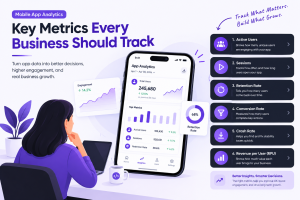
- Daily and Monthly Active Users (DAU/MAU): This classic ratio shows how many unique users are opening your app daily versus monthly. A strong DAU/MAU ratio is a great indicator that your app is becoming a habit.
- Session Duration and Frequency: How long do users stick around during a session, and how often do they come back? Depending on your app, short and frequent sessions can be just as valuable as long, deep dives.
- User Retention Rate: This is a big one. What percentage of users return one day, one week, or one month after their first visit? High retention is one of the most powerful signs that you’re on the path to product-market fit.
These numbers give you a raw, unfiltered view of what your users are actually doing. Tools like Firebase Analytics or Mixpanel are fantastic for tracking these KPIs from day one, giving you the insights to understand what’s clicking with users and what’s falling flat.
An MVP isn't about getting a million downloads; it's about making your first 100 users fall in love with your product. Engagement metrics tell you if that love is real.
Connect the Dots: User Feedback and Business Goals
While analytics show you what users are doing, you still need to find out why. This is where qualitative feedback comes in. You absolutely must talk to your early adopters—their insights are the compass that will point you toward your next feature set or a much-needed course correction. For a more detailed breakdown, check out our guide on essential mobile app metrics.
In fact, post-launch data shows that 65% of mobile app feature pivots are directly driven by user feedback collected during the MVP phase. This data-first mindset is essential for adapting to market demands, especially when navigating App Store rules or U.S. accessibility laws. You can discover more insights about MVP-driven pivots and how they set the stage for scaling.
Finally, you need to connect all this user activity back to your core business objectives. Be sure to track these bottom-line metrics:
- Customer Acquisition Cost (CAC): How much are you spending to get each new user? Keeping CAC low is fundamental to sustainable growth.
- Conversion Rate: What percentage of users are completing a key action? This could be signing up, making a purchase, or finishing a core workflow.
By weaving together engagement analytics, direct user feedback, and hard business metrics, you’ll have a complete 360-degree view of your MVP's performance. This holistic perspective is what empowers you to make smart, confident decisions and build on your initial success.
Common MVP Mistakes to Avoid
The MVP approach is designed to be a shortcut to learning, but it's a path with well-known traps. It’s surprisingly easy to misinterpret the core principles and end up with a product that fails to provide any real insight.
While an MVP is meant to reduce risk, making one of these common mistakes can actually sink your project before it ever has a chance to swim. Knowing what to watch out for is half the battle.
Let's walk through the most common pitfalls I’ve seen teams make and, more importantly, how you can avoid them.
Mistake 1: Overstuffing the M in MVP
This is, without a doubt, the most common trap. Teams get excited. They start brainstorming, and suddenly the "minimum" product is packed with dozens of "essential" features. This is feature creep, and it's the number one killer of MVP timelines and budgets.
It happens when you fall in love with your own ideas, convincing yourself that the product won't be good enough without just one more thing. Before you know it, you're building a "Maximum" Viable Product that’s slow to build, expensive, and too complicated for initial validation.
Here's how you fight back:
- Be Ruthless: Go back to your core "Must-Have" list. If a feature doesn't directly serve the single, primary problem you're trying to solve, it goes on the "later" list. No exceptions.
- Focus on One Job: Your MVP should do one thing flawlessly. What is the single most critical action your user needs to take to find value? Build for that. Everything else is a distraction.
Mistake 2: Ignoring the V for Viable
At the other end of the spectrum is the mistake of building something that's minimal but simply not viable. A viable product has to work. It needs to be stable, intuitive, and offer a respectable user experience, even with its limited scope.
If your app is buggy, crashes constantly, or is a nightmare to navigate, you haven't learned anything about your core idea. You've only learned that users hate frustrating, broken software—which you probably already knew. They'll abandon your app because of its poor quality, not because your solution is wrong.
Your MVP is not an excuse to ship a broken product. It must be polished enough to be usable and solve the user's core problem effectively. If it crashes or is impossible to navigate, you haven't tested your idea—you've only proven you can build a poor-quality app.
Mistake 3: Forgetting the Feedback Loop
Building and launching an MVP is only the beginning. The entire point of this exercise is to learn from real people. Yet, so many teams launch their product and then just… wait. They have no system in place for gathering, analyzing, and acting on what their first users are telling them.
If you aren't talking to your users, you're just guessing. Launching without a feedback plan is like throwing a message in a bottle into the ocean and hoping for a reply.
You need to build channels for feedback from day one:
- In-App Surveys: Use simple pop-ups or forms to ask quick, targeted questions.
- Direct Outreach: Get on the phone or email your very first users. Ask them what they love, what they hate, and what they wish the app could do. Their insights are gold.
- Analytics: Track what people are actually doing in your app. Where do they get stuck? What features do they use most? The data will tell a story your users might not.
Frequently Asked Questions About MVP Development
When you're diving into app development, it’s natural for questions to pop up, especially around the whole MVP concept. Let's clear up a few of the most common ones we hear from founders and product teams so you can move forward with confidence.
What Is the Difference Between an MVP and a Prototype?
It’s easy to mix these up, but they serve completely different roles. Think of a prototype as a sketch or a mockup. It’s often just a collection of non-working screens designed to test a visual idea or a user flow. A prototype helps you answer, “Can users figure out how to navigate this interface?”
An MVP, or Minimum Viable Product, is something else entirely. It's a real, functioning application that you release to your first group of users. Its job is to collect actual data and test a core business assumption. An MVP answers a much more fundamental question: “Should we even be building this?”
A prototype is a visual test of design; an MVP is a functional test of a business model. One tests how the app looks, the other tests if anyone wants it.
How Much Does an App MVP Typically Cost in the US?
In the US market, a well-scoped app MVP usually lands somewhere in the $50,000 to $80,000 range. Of course, this figure can shift based on how complex your features are, the technology you choose, and the development team you partner with.
It's helpful to see this as a strategic investment, not just a "cheaper" version of your final app. Building a full-featured product from day one can easily cost $150,000+, so an MVP allows you to prove your idea has legs without betting the entire budget upfront.
How Do You Decide Which Features to Include in an MVP?
This is where you have to be ruthless. The whole point of an MVP is to focus, so start by identifying the single biggest problem your app solves for a specific user. What is the one thing they absolutely must be able to do?
Map out the leanest possible user journey to solve that one problem—and nothing more. A great tool for this is the MoSCoW method, which helps you sort your feature wish list:
- Must-Have: These are non-negotiable. The app is broken without them.
- Should-Have: Important, but not essential for the very first launch.
- Could-Have: Nice-to-have features that can wait for a future update.
- Won't-Have: Ideas you are intentionally leaving out for now.
Your MVP should only contain your "Must-Haves." Sticking to this discipline is what keeps your scope tight and your learning focused.
Ready to transform your app idea into a smart, data-backed reality? At Mobile App Development, we specialize in guiding founders through building, launching, and growing their MVPs in the competitive US market. Check out our resources and let's talk about your project: https://mobappdevelopment.com.



Add Comment