



For nearly a decade, mobile AI strategies revolved around chatbots. Enterprises integrated conversational assistants into banking apps, retail platforms, healthcare systems, and customer service applications hoping to reduce support costs and improve engagement. In many cases, the results were mixed.
Most chatbot experiences solved only surface-level problems. They answered simple queries, redirected users to support pages, or automated repetitive conversations. But they rarely transformed how mobile applications actually functioned.
That shift is now happening.
In 2026, enterprise mobile applications are moving beyond static chatbot experiences toward AI agents capable of handling tasks, automating workflows, personalizing interfaces, and supporting real-time decision-making. This transition is changing how enterprise leaders think about mobile product strategy.
For large organizations across North America, the pressure is practical rather than experimental. Technology leaders are expected to improve operational efficiency, modernize customer experiences, increase retention, and accelerate digital transformation initiatives without dramatically increasing engineering overhead.
AI agents are becoming part of that solution.
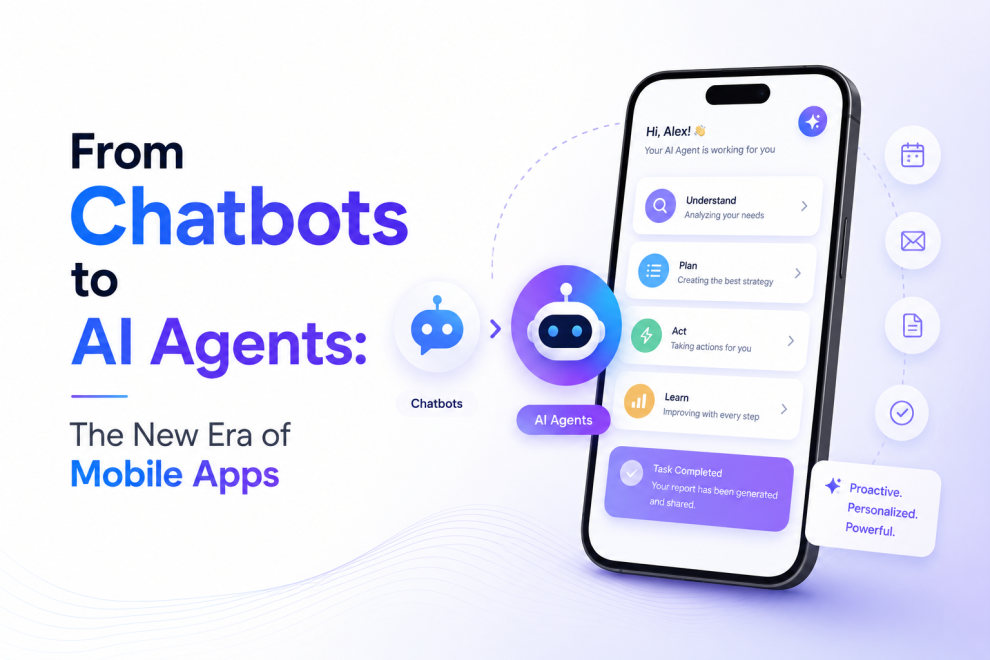
Unlike traditional chatbots, AI agents are designed to act, not just respond. They can analyze context, trigger workflows, interact with connected enterprise systems, and assist users proactively inside mobile applications. This changes the role mobile apps play inside enterprise ecosystems.
Instead of functioning as standalone digital interfaces, mobile applications are increasingly becoming intelligent operational layers connected to cloud infrastructure, enterprise APIs, analytics systems, and AI orchestration frameworks.
This trend is accelerating quickly. According to industry analysts including Gartner and McKinsey, enterprise AI investments continue to expand significantly as organizations prioritize generative AI adoption, automation infrastructure, and AI-native product experiences across digital platforms.
The impact is especially visible in sectors where operational complexity is high. Financial services firms are deploying AI agents to improve onboarding and fraud detection workflows. Healthcare organizations are using AI-driven mobile systems to support patient engagement and internal coordination. Retail enterprises are integrating intelligent recommendation and support systems directly into commerce applications.
The mobile app is no longer just a customer touchpoint. It is becoming an intelligent execution layer.
Why Traditional Chatbot Strategies Are Losing Relevance
Many enterprises are discovering that chatbot-first mobile strategies no longer align with user expectations.
Consumers and enterprise users now expect mobile applications to behave intelligently across the entire experience rather than only inside a chat window. They want faster task completion, contextual personalization, predictive assistance, and frictionless navigation.
Traditional chatbots struggle to deliver that level of operational support.
One major problem is fragmentation. In many enterprise applications, chatbot systems exist separately from core workflows. Users must leave operational tasks to interact with support interfaces that often lack context or real-time integration with enterprise systems.
This creates inefficiency rather than convenience.
AI agents are addressing this problem by operating within workflows instead of outside them. Rather than simply answering questions, they can complete actions across connected systems.
For example, inside an enterprise logistics application, an AI agent can analyze shipment delays, recommend alternative routing, notify stakeholders, and generate operational summaries automatically. Inside a banking application, AI systems can proactively identify suspicious activity, personalize financial recommendations, and streamline customer verification processes without requiring manual intervention.
This operational shift is influencing how enterprise engineering teams approach mobile architecture.
AI-native mobile applications require more than front-end conversational interfaces. They depend on scalable backend systems, real-time data orchestration, secure API frameworks, observability tooling, and governance layers capable of supporting autonomous AI-driven workflows.
This creates new challenges for platform engineering teams managing enterprise-scale mobile ecosystems.
Many organizations still operate on legacy infrastructure that was never designed for AI-native workflows. Integrating AI agents into these environments often exposes issues related to latency, fragmented data systems, compliance management, and scalability constraints.
As a result, enterprise leaders are increasingly focusing on modernization initiatives that combine cloud-native infrastructure, AI integration, and mobile product engineering together.
Companies like GeekyAnts, EPAM Systems, and Globant are among the firms actively working with enterprises on AI-powered product engineering strategies designed to support scalable digital transformation initiatives.
AI Agents Are Changing Mobile Product Expectations
The rise of AI agents is not just changing application functionality. It is changing user expectations entirely.
Enterprise users increasingly expect mobile applications to anticipate intent, simplify workflows, and reduce operational friction automatically. This expectation comes partly from the mainstream adoption of generative AI tools over the past few years.
Employees are becoming more comfortable interacting with AI systems through natural language prompts, contextual automation, and adaptive interfaces. That behavior is now influencing enterprise mobile design priorities.
This is especially important for organizations managing distributed workforces across multiple operational systems.
Mobile AI agents are increasingly supporting:
- Workflow automation
- Intelligent search
- Predictive recommendations
- Real-time summarization
- Internal knowledge retrieval
- Customer support escalation
- Personalized user experiences
- Multi-system task execution
These capabilities are becoming particularly valuable for enterprise productivity and operational efficiency.
However, the transition also introduces governance concerns.
Large enterprises cannot deploy AI agents without considering security, compliance, auditability, and data access management. AI systems operating autonomously inside enterprise applications create new layers of operational risk if governance frameworks are weak.
This is why many organizations are adopting human-in-the-loop models where AI agents support workflows while employees maintain approval authority for sensitive actions.
The conversation is also expanding beyond customer-facing experiences. Internal enterprise applications are becoming a major focus area for AI agent adoption.
Large organizations are using AI-powered mobile systems to improve employee onboarding, field operations, IT support workflows, sales enablement, and operational reporting. In many cases, the business value comes from reducing process friction rather than introducing entirely new capabilities.
That distinction matters.
Many enterprise AI initiatives fail because organizations pursue innovation without solving operational inefficiencies first. The enterprises seeing stronger outcomes are usually the ones aligning AI adoption with measurable workflow improvements.
What Enterprise Technology Leaders Should Prioritize Next
For technology leaders managing enterprise-scale digital ecosystems, the next phase of mobile AI adoption requires strategic discipline.
The focus should not be on deploying AI features as quickly as possible. The focus should be on building operationally sustainable AI experiences that improve usability, scalability, and measurable business outcomes.
Several priorities are becoming increasingly important in 2026.
First, enterprises need mobile architectures capable of supporting continuous AI evolution. AI models, orchestration systems, and workflow requirements will continue changing rapidly. Organizations operating on rigid mobile infrastructures may struggle to adapt efficiently.
Second, platform engineering and product teams need tighter collaboration. AI-native mobile experiences affect infrastructure planning, API governance, security models, user experience design, and analytics simultaneously. Siloed execution often creates fragmented outcomes.
Third, enterprises should prioritize AI observability and performance monitoring early. As AI agents become more autonomous, organizations need visibility into decision pathways, workflow outcomes, latency issues, and operational reliability.
Fourth, leadership teams should evaluate whether existing mobile experiences are designed for interaction simplicity. AI functionality alone does not improve adoption if applications remain operationally complex.
This is where many enterprise mobile strategies are evolving today.
Organizations are shifting from feature-heavy mobile products toward intelligent workflow-driven applications designed around operational outcomes rather than interface complexity.
The companies leading this transition are not necessarily the ones deploying the largest AI models. They are often the organizations building scalable AI experiences aligned with employee productivity, customer retention, and operational efficiency goals.
As AI-native applications become more mainstream across enterprise environments, the distinction between mobile apps and intelligent operational systems will continue fading.
For enterprise leaders evaluating the next phase of digital transformation, the real question is no longer whether AI belongs inside mobile applications. The question is whether existing mobile strategies are prepared for a future where AI agents become embedded into nearly every operational workflow.
That conversation is already shaping enterprise product roadmaps across industries and many organizations are now exploring strategic partnerships, platform modernization initiatives, and AI-focused product engineering models to prepare for what comes next.



Add Comment