



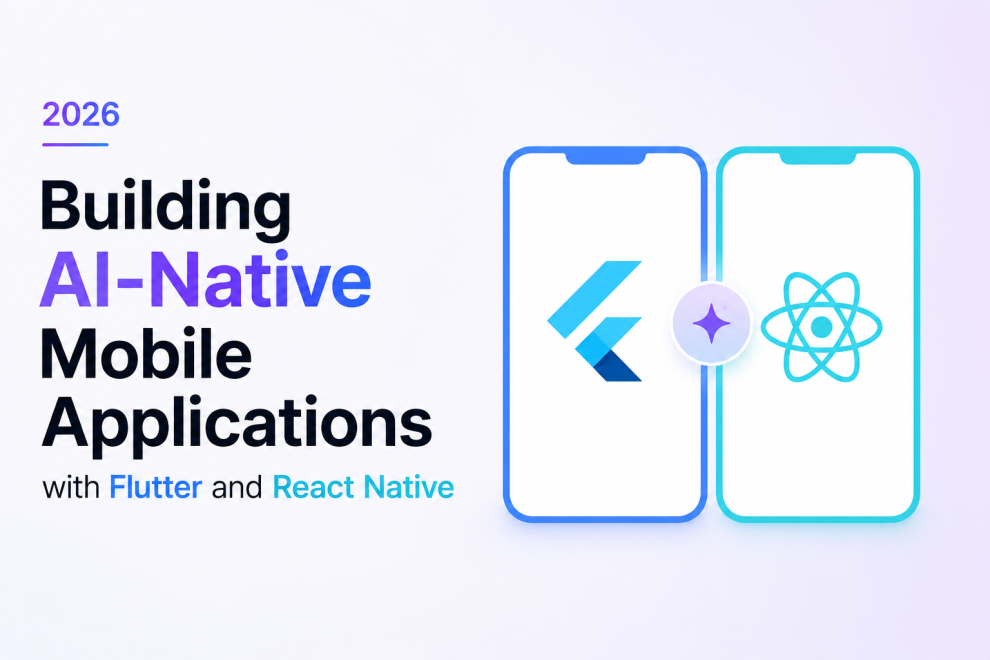

Mobile applications are entering a major transformation phase.
For years, businesses focused on building apps that were fast, responsive, and visually polished. But in 2026, those qualities are no longer enough to keep users engaged. Customers now expect mobile applications to understand behavior, personalize experiences, automate actions, and respond intelligently in real time.
This shift is driving the rise of AI-native mobile applications.
Unlike traditional apps that simply add AI as a feature, AI-native applications are designed around intelligence from the beginning. Personalization, prediction, automation, and conversational interactions become part of the product architecture itself instead of isolated add-ons.
As businesses accelerate AI adoption, Flutter and React Native are emerging as two of the most practical frameworks for building these next-generation mobile experiences.
The reason is not only cross-platform efficiency.
It is speed, scalability, and the ability to iterate AI-driven experiences rapidly across multiple devices without maintaining separate native teams.
Mobile User Expectations Have Changed Faster Than Most Businesses Expected
One of the biggest reasons companies are investing in AI-native mobile applications is changing user behavior.
Modern users have become accustomed to intelligent digital experiences across streaming platforms, ecommerce ecosystems, search engines, and productivity tools. As a result, expectations for mobile applications have shifted dramatically.
Users no longer want static interfaces.
They expect apps to recommend actions, predict intent, simplify workflows, and reduce manual effort automatically.
This is especially important because mobile users are increasingly impatient with friction-heavy experiences. Applications that require too many clicks, repetitive actions, or complex navigation structures often struggle with retention even if the app itself is technically strong.
AI-native apps solve this by creating adaptive experiences.
Instead of presenting the same UI to every user, AI systems dynamically modify content, workflows, search results, onboarding experiences, and recommendations based on real-time behavior and historical interaction patterns.
For example:
- Ecommerce apps personalize shopping journeys instantly
- Fintech apps predict spending behavior and fraud risks
- Healthcare apps generate contextual health insights
- SaaS mobile apps automate operational workflows
- Learning platforms adapt educational content dynamically
This transition from “feature-first apps” to “experience-first apps” is redefining mobile product strategy.
Businesses are no longer competing only on functionality.
They are competing on how intelligently the app reduces effort for users.
Flutter and React Native Are Becoming Strong AI App Development Choices
The rise of AI-native mobile experiences is also changing framework selection decisions.
Businesses increasingly choose Flutter and React Native because both frameworks support faster development cycles, scalable UI systems, and cross-platform deployment while integrating effectively with modern AI infrastructure.
For companies trying to launch AI-powered applications quickly, maintaining separate iOS and Android development pipelines creates operational inefficiencies. Cross-platform frameworks reduce that burden significantly.
Flutter has gained strong adoption because of its rendering performance, consistent UI behavior, and growing AI integration ecosystem. It works especially well for highly customized interfaces and real-time visual experiences where smooth performance matters.
React Native, on the other hand, continues to remain popular because of its JavaScript ecosystem, development flexibility, and strong integration capabilities with cloud-native AI services and enterprise web ecosystems.
Both frameworks are increasingly being used for AI-driven mobile products that require:
- Conversational interfaces
- AI copilots
- Recommendation engines
- Predictive notifications
- Voice-enabled interactions
- Intelligent search experiences
- Workflow automation systems
- Personalized onboarding
Businesses are also integrating machine learning models directly into mobile applications using tools such as TensorFlow Lite, Firebase AI services, OpenAI APIs, and cloud-based inference systems.
This allows mobile products to move beyond static interactions and become intelligent operational platforms.
Companies like Google Flutter and React Native continue expanding ecosystem capabilities around AI-ready development, while engineering firms such as GeekyAnts, Infinite Red, and Callstack are helping enterprises modernize mobile ecosystems around AI-first experiences.
The Biggest AI Mobile Challenge Is Not the AI Model
Many businesses assume the hardest part of AI-native app development is integrating advanced AI models.
In reality, the bigger challenge is creating usable product experiences around those systems.
Poorly designed AI experiences often overwhelm users with unnecessary prompts, inaccurate recommendations, excessive notifications, or confusing workflows. Instead of simplifying the product experience, weak AI implementation can increase friction significantly.
This is why UX architecture is becoming critical in AI-native app development.
Successful AI apps focus on contextual assistance instead of constant AI visibility.
For example, predictive search suggestions, intelligent task prioritization, automated summaries, and adaptive interfaces often create stronger user engagement than oversized chatbot interfaces.
Performance optimization is another major challenge.
AI-heavy mobile experiences can increase memory usage, battery consumption, and latency if not architected properly. Businesses are increasingly moving toward lightweight AI systems and on-device inference models to improve responsiveness and reduce cloud dependency.
Privacy is also becoming a major factor.
Users are more aware of how applications collect behavioral data. Businesses building AI-native apps now need stronger transparency around personalization systems, recommendations, and data usage practices.
This is particularly important in fintech, healthcare, and enterprise SaaS ecosystems where compliance expectations continue increasing.
AI-Native Apps Will Redefine Mobile Product Development
The next generation of mobile applications will likely feel fundamentally different from traditional apps.
Users will increasingly interact through intent rather than navigation. Interfaces will become more adaptive, predictive, and conversational. AI systems will quietly automate repetitive actions while surfacing relevant insights in real time.
This evolution is already influencing enterprise mobility, ecommerce, productivity tools, SaaS platforms, and customer experience ecosystems.
Businesses that continue treating AI as an optional add-on may struggle to compete with products designed around intelligence from the start.
However, the companies likely to succeed in this transition will not necessarily have the most advanced AI technology.
They will be the businesses that use AI to make mobile experiences feel faster, simpler, and more useful every day.
That is why Flutter and React Native are becoming central to AI-native mobile development strategies in 2026.
They allow businesses to experiment, scale, and modernize intelligent mobile experiences faster while maintaining the flexibility needed for rapidly evolving user expectations.




Add Comment