







App development has changed dramatically over the last few years. Companies are no longer competing only on feature quality or visual design. They are competing on speed, adaptability, and the ability to validate ideas before investing heavily in full scale development.
That shift is making rapid prototyping one of the most important strategies in modern digital product engineering.
In 2026, product teams are under constant pressure to launch faster while reducing development risk. Enterprise leaders want quicker validation cycles. Startups need to test ideas before funding slows down. Product managers are expected to improve user experiences without extending release timelines.
Traditional development workflows struggle to meet those expectations.
For years, many organizations followed long development cycles where teams spent months planning, designing, and building products before real users interacted with them. In many cases, products reached the market too late or failed because assumptions were never tested early enough.
Rapid prototyping is changing that model entirely.
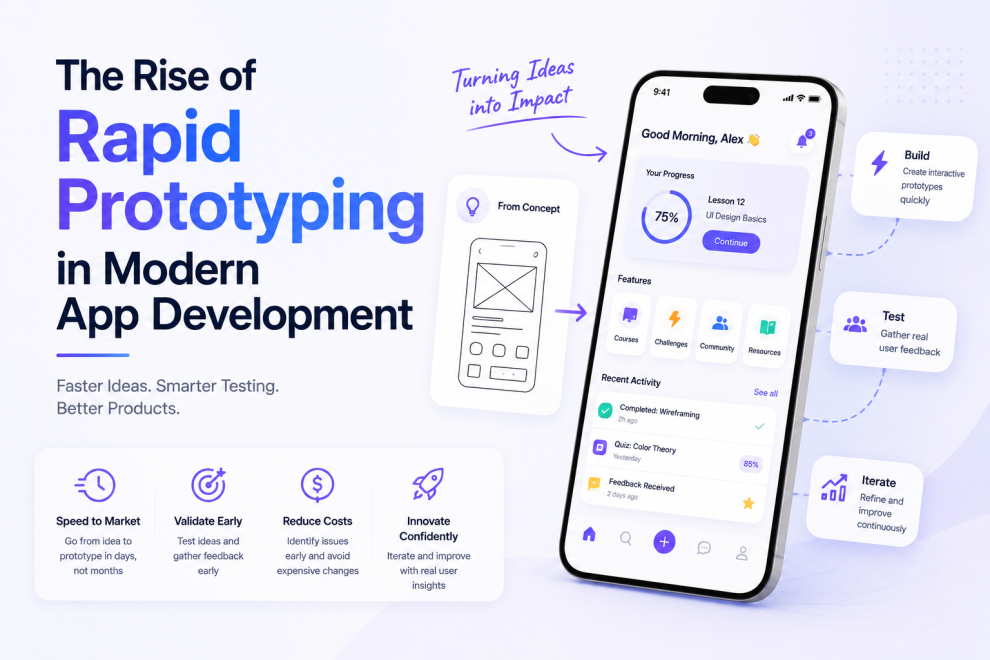
Instead of waiting for complete development, companies are now building interactive prototypes much earlier in the process. These prototypes help teams test workflows, user behavior, design decisions, and feature usability before major engineering investments happen.
This approach reduces uncertainty.
A recent GeekyAnts article on instant mobile app prototypes explored how instant prototyping is becoming a major shift in mobile product development, especially for teams trying to shorten idea to product timelines while improving collaboration between design and engineering teams.
The trend is growing across industries.
Companies building fintech platforms, healthcare applications, ecommerce ecosystems, logistics systems, and AI powered products are increasingly prioritizing faster product validation strategies. Teams no longer want to spend months building features users may never adopt.
According to research from Wikipedia on rapid prototyping and broader UX industry insights, iterative product validation has become central to modern digital product strategies because user expectations now evolve faster than traditional software cycles.
This change is especially important for mobile and web applications where competition moves quickly and user attention spans are shorter than ever.
Why Traditional App Development Models Are Becoming Riskier
One of the biggest problems in traditional app development is delayed feedback.
Teams often spend significant time building features based on internal assumptions rather than real user interaction. By the time feedback arrives, engineering resources are already heavily committed.
This creates expensive product mistakes.
A feature that looked promising during planning may feel confusing in practice. A workflow that seemed efficient internally may frustrate actual users. Navigation systems, onboarding flows, or engagement strategies can fail even when engineering execution is technically strong.
Rapid prototyping helps expose those issues earlier.
Instead of debating ideas theoretically, teams can test interactive experiences quickly and gather real user insights before full implementation begins. This allows faster iteration and better decision making across product, design, and engineering teams.
The approach is becoming especially valuable in AI powered applications.
AI driven workflows are often unpredictable because user interaction patterns change constantly. Product teams need the flexibility to experiment with conversational interfaces, recommendation systems, onboarding flows, and adaptive experiences rapidly.
Static development cycles do not work well in those environments.
Rapid prototyping supports faster experimentation by allowing teams to validate:
- User journeys
- Interface behavior
- AI interactions
- Workflow efficiency
- Navigation clarity
- Cross platform consistency
This reduces both technical and business risk.
The shift is also influencing enterprise product development strategies. Large organizations are increasingly trying to avoid multi year transformation projects that deliver results too slowly. Leadership teams want measurable validation before approving larger development investments.
As a result, prototype driven development is becoming part of broader digital transformation planning.
Many companies now use prototypes not only for UX testing but also for stakeholder alignment, investor presentations, operational workflow reviews, and internal product approvals.
This is changing the role of design teams as well.
Design is no longer treated only as a visual layer added after product planning. In many organizations, prototyping is becoming part of strategic product thinking itself.
Companies like Figma, Adobe, and Google continue influencing broader product design ecosystems where rapid iteration and collaborative development workflows are becoming standard expectations.
How AI and Cross Platform Development Are Accelerating Prototyping
The rise of AI powered development tools is making rapid prototyping even faster.
In previous years, prototypes often required significant manual design effort before teams could test interactions properly. Today, AI assisted design systems and cross platform frameworks allow product teams to create interactive experiences much more efficiently.
This is particularly important for mobile applications.
Modern users expect seamless experiences across iOS, Android, tablets, web platforms, and connected devices. Building separate prototypes for each environment increases operational overhead significantly.
Cross platform frameworks are helping reduce that complexity.
Teams can now validate user experiences across multiple platforms simultaneously while maintaining design consistency. This allows organizations to test product assumptions earlier without increasing development timelines dramatically.
AI is also improving workflow speed.
Product teams increasingly use AI assisted tools for:
- Wireframe generation
- UX suggestions
- Interface testing
- Content adaptation
- User flow optimization
- Design system scaling
This creates faster iteration cycles.
However, rapid prototyping is not only about speed. The real advantage is learning velocity.
Companies capable of testing ideas quickly can respond to market changes faster than organizations relying on rigid development structures. That flexibility is becoming a competitive advantage across industries.
This is especially true in sectors where customer expectations evolve constantly such as ecommerce, SaaS, education technology, fintech, and AI products.
Another important trend is collaborative prototyping.
Product managers, developers, UX teams, marketing stakeholders, and operational leaders increasingly work together inside shared prototyping environments. This reduces communication gaps and improves alignment before engineering execution begins.
A growing number of enterprises are realizing that faster collaboration often matters as much as faster coding.
The result is a broader shift toward product development ecosystems designed around continuous iteration rather than long sequential release cycles.
What Product Teams Should Prioritize in 2026
For product leaders, engineering managers, and digital transformation teams, rapid prototyping is becoming less of a design tactic and more of an operational strategy.
The organizations moving fastest today are often the ones learning fastest.
Several priorities are becoming increasingly important.
First, companies should focus on validation speed instead of feature volume. Building fewer features with stronger user validation often creates better long term product outcomes.
Second, teams should integrate prototyping earlier into engineering workflows. Waiting until late stage design reviews limits the strategic value of rapid iteration.
Third, organizations should prioritize cross functional collaboration during product planning. Prototypes become significantly more valuable when engineering, UX, operations, and business stakeholders align early.
Fourth, enterprises should evaluate whether existing development structures support continuous iteration effectively. Many traditional release models still slow experimentation unnecessarily.
Most importantly, companies should recognize that rapid prototyping is not about replacing engineering quality with speed. It is about reducing uncertainty before major technical investment happens.
That mindset is reshaping modern app development.
As digital products become more intelligent, connected, and experience driven, companies need product workflows capable of adapting continuously. User expectations now evolve too quickly for rigid development cycles to remain effective.
This is why rapid prototyping is increasingly moving into the center of product strategy conversations across startups and enterprise organizations alike.
The companies gaining the strongest advantage are often not the ones building the most features. They are the ones identifying the right product direction faster than everyone else.



Add Comment