

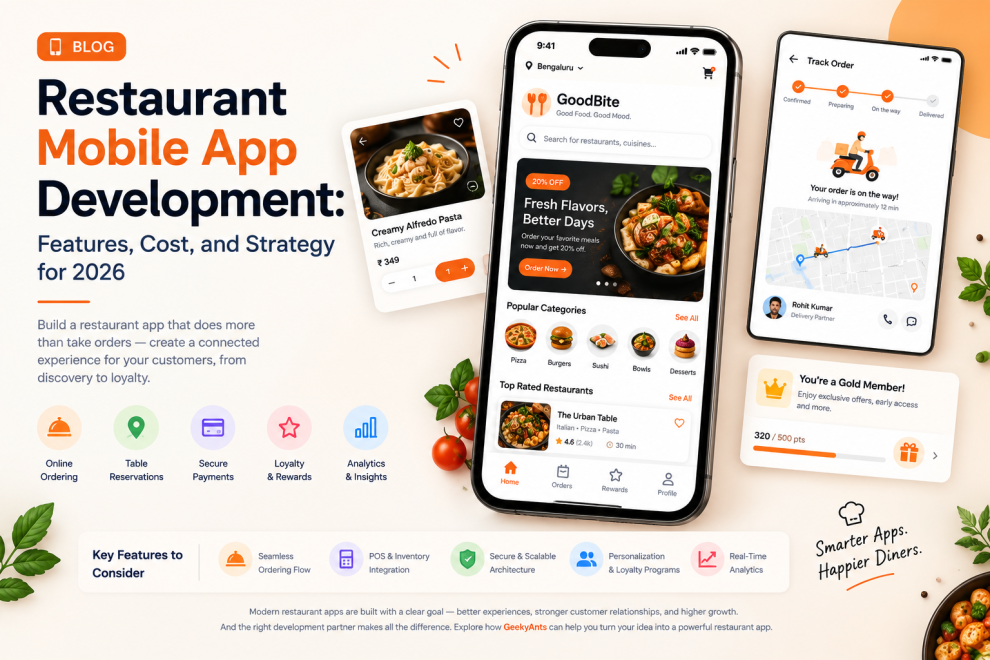

Restaurant mobile app development has moved well beyond creating a branded menu.
Modern restaurant apps can connect ordering, payments, loyalty, reservations, delivery, customer profiles, promotions, and restaurant operations within a single digital experience.
That makes a restaurant mobile app less of a marketing channel and more of a customer engagement and revenue platform.
Current restaurant technology research shows this shift clearly. Restaurant brands are increasingly rebuilding apps around loyalty, personalization, digital ordering, and ongoing guest engagement.
At the same time, consumers increasingly expect convenience across ordering, pickup, delivery, reservations, and payments.
SevenRooms reports that 64% of consumers would prefer one app for managing delivery, pickup, and reservations, while 83% of restaurant operators surveyed believe connecting these systems could positively affect profitability.
For restaurant operators considering an app in 2026, the question is therefore no longer simply:
“Should we build a restaurant app?”
It is:
“What should the app actually solve?”
What a Restaurant Mobile App Should Do
A restaurant app should make frequent customer actions faster.
The core experience commonly includes:
- Menu browsing
- Online ordering
- Pickup
- Delivery
- Digital payments
- Reservations
- Order tracking
- Loyalty
- Offers
- Saved preferences
- Order history
But not every restaurant needs every feature at launch.
A single-location restaurant may prioritize ordering and loyalty.
A large restaurant chain may require integrations with POS, inventory, delivery systems, customer data platforms, and enterprise analytics.
The right feature set depends on the operating model.
Online Ordering Should Be the Core Flow
For many restaurant apps, ordering is the most important customer journey.
The flow should be straightforward:
Open App → Select Restaurant → Browse Menu → Customize → Pay → Track Order
The application should minimize friction at every step.
Customers should be able to save:
- Favorite items
- Previous orders
- Addresses
- Payment methods
- Dietary preferences
A returning customer could then complete an order much faster than a first-time customer.
This is one reason branded restaurant apps can become valuable: they create a direct relationship between the restaurant and its repeat customers.
DoorDash’s restaurant trend research also highlights the importance of connected guest journeys across discovery, ordering, dining, and return visits.
Restaurant App Development Needs POS Integration
A restaurant mobile app cannot operate effectively if its menu and operational systems are disconnected.
Consider a simple scenario.
A customer orders a dish that is no longer available.
If the app does not receive updated inventory information, the customer may complete an order that the restaurant cannot fulfill.
That creates frustration for both sides.
A production-ready restaurant application may therefore need integrations with:
- POS systems
- Kitchen display systems
- Payment providers
- Inventory platforms
- Delivery systems
- Reservation platforms
- CRM systems
- Loyalty platforms
- Analytics tools
The application becomes an orchestration layer connecting the customer experience with restaurant operations.
Digital Loyalty Should Be Built Into the App
Loyalty is one of the strongest reasons for customers to keep a restaurant app installed.
But loyalty should not simply mean:
Spend money → collect points.
Modern loyalty experiences can connect rewards with behavior.
For example:
- Order frequency
- Favorite categories
- Birthday offers
- Visit frequency
- New-item trials
- Personalized recommendations
- Location-based promotions
Restaurant technology reporting in 2026 shows brands increasingly using their apps to combine loyalty and personalized guest engagement.
The key is relevance.
A customer who regularly orders coffee should not receive promotions that have nothing to do with their behavior.
Personalized Restaurant Apps Can Increase Engagement
Restaurant apps have access to useful first-party behavioral information.
With appropriate privacy controls, brands can understand:
- What customers order
- When they order
- How frequently they visit
- Which locations they use
- Which promotions they engage with
- Which items they reorder
This can support more relevant experiences.
For example:
“Your usual lunch is available at your nearest location.”
can be more useful than:
“20% OFF EVERYTHING TODAY.”
Personalization should make the app feel more convenient, not more intrusive.
Restaurant Apps Need Strong Location Experiences
Location can be valuable for restaurants with multiple branches.
A customer could open the application and immediately see:
Nearest Restaurant
with:
- Distance
- Opening hours
- Available services
- Pickup time
- Delivery availability
- Current promotions
Location can also help customers switch between restaurants without manually searching every time.
However, location permissions should be requested carefully.
Customers should understand why location is useful before granting access.
Mobile Payment Should Be Simple
Checkout is one of the most sensitive parts of a restaurant app.
Customers expect fast payment without unnecessary redirects.
Depending on the market, applications can support:
- Cards
- Digital wallets
- Saved payment methods
- UPI
- Apple Pay
- Google Pay
- Restaurant-specific payment options
The experience should also communicate payment status clearly.
After payment, users should immediately know:
Order Confirmed
rather than wondering whether the transaction succeeded.
Order Tracking Builds Confidence
Once an order has been placed, customers want visibility.
A restaurant app can provide a simple status flow:
Order Received
↓
Being Prepared
↓
Ready for Pickup
↓
Out for Delivery
↓
Delivered
This reduces uncertainty and customer support requests.
For delivery orders, the experience can become more detailed with estimated arrival time and live location where appropriate.
For pickup, customers can receive a clear readiness notification.
The objective is not to create a complicated tracking interface.
It is to answer one question:
“Where is my order right now?”
Restaurant Apps Should Support Omnichannel Experiences
Customers do not think in terms of internal restaurant systems.
They simply expect their experience to continue across channels.
A customer might:
- Discover a restaurant through search.
- Browse its menu on the website.
- Download the app.
- Order pickup.
- Visit the restaurant.
- Scan a QR code.
- Earn loyalty points.
- Order again later.
The technology should recognize that this is one customer journey.
Recent research on food and restaurant UX similarly emphasizes connected experiences across discovery, ordering, delivery, and dining.
What Does Restaurant Mobile App Development Cost?
The cost depends heavily on the scope.
A relatively simple restaurant app might include:
- Menu
- Ordering
- Payments
- Basic loyalty
- Customer accounts
A larger enterprise restaurant application could require:
- Multi-location support
- POS integration
- Inventory synchronization
- Delivery management
- Advanced loyalty
- Personalization
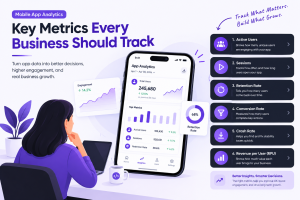
- Analytics
- Multiple payment methods
- Reservation management
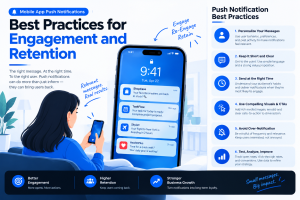
- Push notification infrastructure
- Admin dashboards
The technology stack, number of platforms, integrations, design complexity, security requirements, and maintenance strategy can all significantly affect the final development cost.
For this reason, restaurants should define the operational problem first rather than starting with a long feature list.
Build an MVP Before Building Everything
A restaurant does not necessarily need to launch with every possible feature.
A practical MVP could focus on:
Menu + Ordering + Payment + Order Tracking + Loyalty
Once customer behavior is understood, additional functionality can be introduced.
Potential later features include:
- Reservations
- AI recommendations
- Voice ordering
- Advanced personalization
- Location-based offers
- Subscription programs
- Table ordering
- QR-based experiences
This approach reduces initial complexity and gives product teams real usage data before investing in advanced functionality.
Security and Privacy Matter
Restaurant applications process more than food orders.
They may handle:
- Customer names
- Phone numbers
- Addresses
- Payment information
- Location information
- Order histories
- Loyalty activity
Security therefore needs to be designed into the architecture.
Important areas include:
- Secure authentication
- Payment security
- API protection
- Encryption
- Secure token handling
- Role-based access
- Data minimization
- Privacy controls
- Monitoring and logging
Security should not be added after the application is already built.
The Future of Restaurant Mobile Apps
The restaurant app is becoming a connected digital layer between customers and restaurant operations.
Future-focused applications will increasingly combine:
Ordering + Payments + Loyalty + Personalization + Operations + Data
AI can add another layer by helping customers discover meals, answer menu questions, personalize recommendations, and simplify repeat ordering.
At the same time, the most successful apps will probably remain simple on the surface.
The complexity should exist behind the scenes.
Companies such as GeekyAnts have worked across mobile application development and AI-driven product engineering, illustrating the broader industry movement toward connected applications that combine customer experience with intelligent backend capabilities.
For restaurant businesses, the goal of mobile app development should not be to create another digital channel.
It should be to create a faster, more personal, and more connected way for customers to interact with the brand.
When ordering, payment, loyalty, personalization, and operations work together, the restaurant mobile app becomes more than an ordering tool.
It becomes part of the restaurant’s long-term customer relationship.



Add Comment