

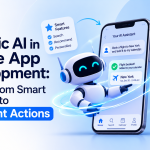

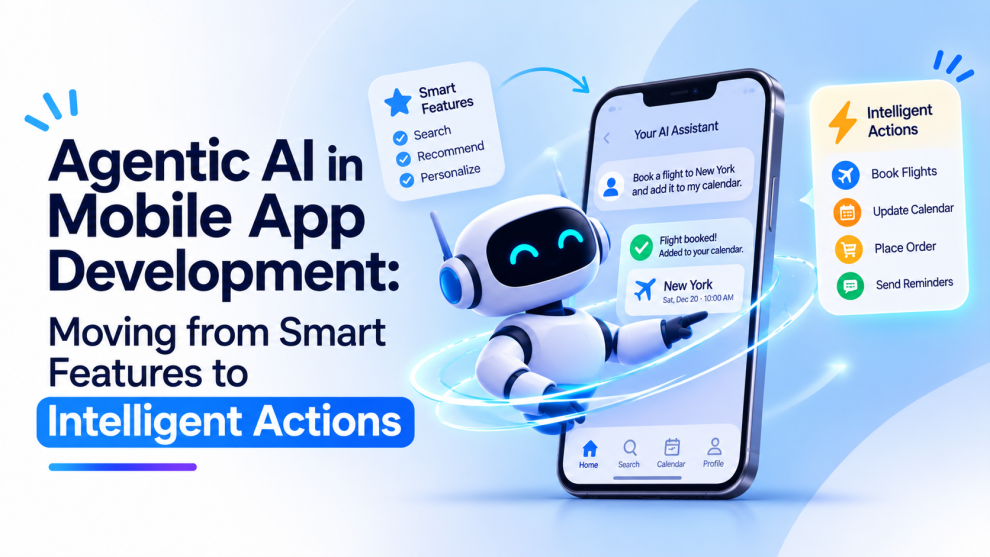

Mobile applications are evolving beyond traditional feature-based experiences. Instead of simply responding to taps and commands, a new generation of apps can understand user intent, plan tasks, and take actions with appropriate permission.
This is where agentic AI is becoming an important direction for mobile app development in 2026.
What Is Agentic AI in Mobile Apps?
Agentic AI refers to AI systems that can interpret goals, make decisions, and execute multi-step tasks using available tools and data.
For example, a travel app could help users compare flight options, prepare an itinerary, and organize bookings rather than only displaying search results.
5 Trends Shaping Agentic Mobile Apps
1. Apps That Complete Tasks
Traditional apps require users to navigate multiple screens to complete a task. Agentic experiences can coordinate several steps through a natural-language request, while keeping users informed and in control.
2. On-Device AI Processing
AI models running directly on smartphones can support features such as summarization, text assistance, and intelligent suggestions. On-device processing can reduce latency and limit the amount of sensitive information sent to cloud services.
3. Hybrid AI Architecture
Not every AI operation needs to run locally. Mobile applications can combine on-device models for lightweight tasks with cloud-based models for more complex reasoning.
Choosing the right balance depends on privacy, performance, connectivity, and operating cost.
4. Context-Aware Experiences
Mobile apps can use relevant context, such as user preferences and current activity, to deliver more useful assistance. Developers must implement clear permissions and privacy controls when handling personal data.
5. Human Approval and AI Safety
AI agents should not execute every action without oversight. Financial transactions, bookings, account changes, and other sensitive operations should include confirmation steps, clear explanations, and appropriate safeguards.
What Developers Should Consider
Building agentic mobile applications requires more than integrating an AI model.
Development teams should consider:
- Secure API and tool integrations.
- Permission-based access to user data.
- Reliable task execution and error handling.
- On-device versus cloud AI decisions.
- User confirmation for sensitive actions.
- Monitoring, testing, and AI response quality.
Frameworks such as Flutter and React Native can support cross-platform app experiences, while platform-specific capabilities may be needed for deeper device integration.
Companies such as GeekyAnts working across AI engineering and mobile product development operate in an environment where these architectural and user-experience decisions are increasingly important.
Final Thoughts
Agentic AI is changing what users can expect from mobile applications. The opportunity is not simply to add chat interfaces, but to build products that can complete meaningful tasks safely and efficiently.
Businesses planning their next mobile application should evaluate where intelligent automation can improve real workflows while keeping users in control.



Add Comment