

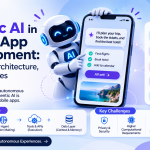


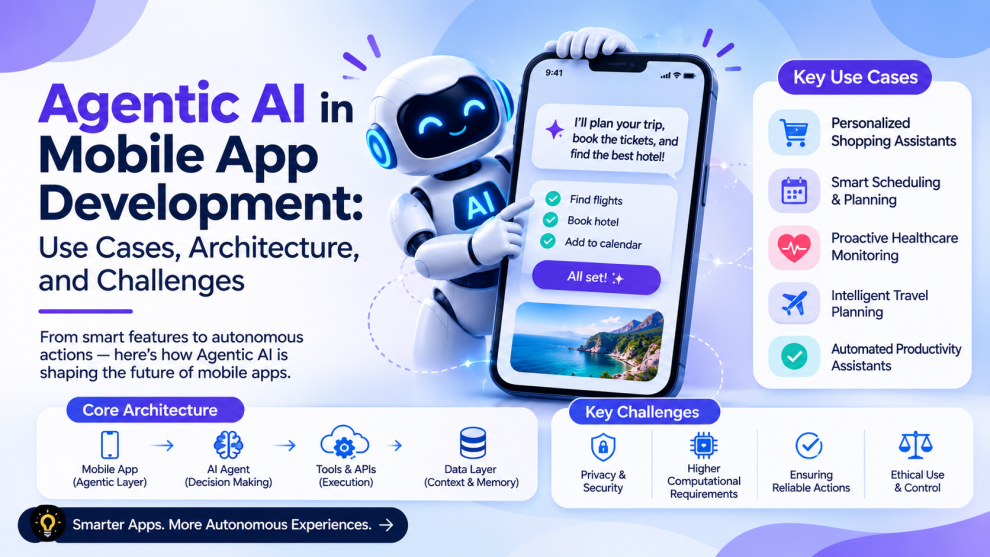

Artificial intelligence in mobile applications is moving beyond simple chatbots and recommendation engines. A new generation of AI-powered applications can interpret user goals, plan multiple steps, interact with connected services, and help complete tasks.
This approach is commonly associated with agentic AI.
Unlike a traditional AI assistant that primarily responds to individual prompts, an AI agent can work toward a defined objective by selecting actions, using tools, retrieving information, and evaluating results. When integrated into mobile applications, these capabilities can turn ordinary apps into more proactive digital experiences.
For businesses developing fintech products, healthcare platforms, travel applications, eCommerce products, and enterprise tools, agentic AI introduces new opportunities to simplify complex workflows.
This guide explains how agentic AI works in mobile app development, its practical use cases, architecture, benefits, and implementation challenges.
What Is Agentic AI in Mobile App Development?
Agentic AI refers to AI systems that can work toward specific goals by reasoning through tasks, selecting appropriate tools, and carrying out sequences of actions within defined permissions.
A conventional chatbot may tell a user how to book a hotel. An agentic travel application could help search available hotels, compare options, prepare an itinerary, and request confirmation before completing a booking.
The key distinction is the ability to move from providing information to coordinating actions.
Agentic AI in mobile applications may involve:
- Understanding natural-language instructions
- Breaking goals into smaller tasks
- Retrieving information from APIs and databases
- Using approved external tools
- Maintaining task context
- Evaluating results and handling errors
- Requesting user confirmation for important actions
An AI agent should not be treated as an unrestricted autonomous system. Its actions need clear boundaries, permissions, and monitoring.
How Agentic AI Differs From Traditional AI Features
| Capability | Traditional AI feature | Agentic AI |
|---|---|---|
| Primary role | Responds to a specific request | Works toward a defined objective |
| Interaction | Often single-step | Can involve multiple steps |
| Tool usage | Usually limited or predefined | Can select from approved tools |
| Task handling | Provides information or predictions | Can coordinate actions |
| User involvement | User directs each interaction | User can delegate bounded tasks |
| Control requirements | Output validation | Output validation plus action permissions |
For example, a traditional shopping assistant might recommend a laptop based on a user’s budget. An agentic shopping assistant could compare products, check availability, apply user-defined filters, and prepare a cart for review.
The purchase should still require explicit authorization.
How Agentic AI Works Inside a Mobile Application
An agentic mobile application typically combines the mobile interface, backend services, AI models, and connected tools.
A simplified workflow looks like this:
- User instruction: The user describes a goal in natural language.
- Intent understanding: The AI interprets the request and identifies the expected outcome.
- Task planning: The system divides the goal into smaller steps.
- Tool selection: The agent selects from permitted APIs, databases, or application services.
- Action execution: The backend performs authorized operations.
- Result evaluation: The agent checks the returned information and determines whether another step is required.
- User confirmation: The application requests approval for sensitive or irreversible actions.
- Final response: The application explains what was completed and presents the result.
For example, a user might ask a travel app to plan a three-day trip within a specific budget. The agent could identify suitable destinations, compare available accommodation, organize activities, and prepare a proposed itinerary.
The user should be able to review and modify the plan before making bookings.
Top Use Cases of Agentic AI in Mobile Apps
1. AI-Powered Travel Planning
Travel applications often require users to move between different services to organize a trip.
An agentic travel assistant can help coordinate:
- Destination research
- Flight and hotel comparisons
- Itinerary planning
- Local activity recommendations
- Travel reminders
- Reservation preparation
For example, a user could request a weekend itinerary within a fixed budget. The agent could collect relevant options and organize them into a proposed plan.
Booking and payment should remain subject to user approval.
2. AI Banking and Personal Finance
Banking applications can use agentic AI to simplify routine financial tasks.
Potential capabilities include:
- Summarizing spending patterns
- Organizing recurring expenses
- Explaining unusual transactions
- Preparing savings plans
- Sending payment reminders
- Helping users understand financial activity
Sensitive actions such as transferring money, changing account settings, or initiating payments should require strong authentication and explicit authorization.
3. AI-Powered eCommerce Applications
Agentic AI can make shopping experiences more interactive by helping customers complete multi-step product discovery tasks.
For example, a user could ask for a laptop suitable for video editing within a particular budget. The agent could compare specifications, identify suitable products, check availability, and prepare a shortlist.
Additional use cases include:
- Personalized product discovery
- Comparing product specifications
- Tracking orders
- Managing shopping lists
- Answering product-related questions
- Assisting with returns and support requests
4. Healthcare and Wellness Applications
Healthcare applications can use bounded AI agents to support administrative and informational workflows.
Potential use cases include:
- Preparing appointment information
- Organizing health records
- Helping users navigate provider services
- Summarizing approved health information
- Sending medication or appointment reminders
- Supporting administrative communication
Clinical decisions, diagnosis, and treatment recommendations require appropriate professional oversight, validation, and regulatory consideration.
5. AI Customer Support Applications
Agentic AI can help customer support applications manage more than basic question-and-answer interactions.
An agent may retrieve order information, identify account issues, check service status, and prepare a support request.
For complex or sensitive situations, the system should provide a clear path to a human representative.
6. Productivity and Enterprise Applications
Enterprise mobile applications can use agents to coordinate information across business tools.
Examples include:
- Creating task summaries
- Preparing meeting follow-ups
- Identifying project blockers
- Organizing assigned work
- Drafting status reports
- Retrieving information from approved enterprise systems
Access should follow existing organizational permissions rather than granting an agent unrestricted access to company data.
Essential Components of an Agentic Mobile App Architecture
Building an agentic application requires more than connecting a language model to a mobile interface.
1. Mobile Application Interface
The mobile interface is where users communicate goals, review results, provide permissions, and monitor progress.
Design should include clear task status, confirmation screens, editable results, and ways to stop or cancel an ongoing operation.
2. AI Model Layer
The model interprets instructions, generates responses, and supports planning and tool selection.
Depending on the application, teams may use hosted language models, specialized models, or a combination of model types.
3. Agent Orchestration Layer
The orchestration layer manages the agent’s workflow. It determines which steps to execute, which tools can be called, and how results should be evaluated.
It can also enforce limits on execution time, repeated attempts, and permitted actions.
4. Tool and API Integration Layer
Agents need controlled access to the services that allow them to complete tasks.
These may include:
- Payment and transaction APIs
- Maps and location services
- Booking systems
- Customer relationship management platforms
- Enterprise databases
- Notification services
- Search and retrieval systems
Each tool should have narrowly defined permissions and validated input and output formats.
5. Data and Memory Layer
Some applications need to maintain context across interactions.
This layer may store user preferences, task history, and relevant application data. Data retention and access should be designed around user consent, privacy requirements, and the application’s purpose.
6. Security and Monitoring Layer
This layer manages authentication, authorization, audit logs, sensitive-data handling, rate limits, and agent activity monitoring.
It is especially important when agents can interact with financial, healthcare, or enterprise systems.
Best Practices for Developing Agentic AI Mobile Apps
1. Start With a Clearly Defined Task
Avoid building a general-purpose agent before identifying the specific problem it should solve.
A focused task, such as preparing a travel itinerary or summarizing spending, is easier to evaluate and control than an unrestricted assistant.
2. Apply Human Approval to Sensitive Actions
Require explicit confirmation before payments, bookings, account changes, data deletion, or other high-impact operations.
The approval screen should clearly explain what the agent intends to do.
3. Use Permission-Based Tool Access
Give agents access only to the tools and data required for their assigned tasks.
Separate read-only operations from actions that modify records or initiate transactions.
4. Validate Every Important Action
Do not rely only on the AI model’s response to determine whether an operation succeeded.
Verify results through the underlying service and maintain a reliable record of completed actions.
5. Design for Failure and Recovery
Agents may encounter unavailable APIs, incomplete information, conflicting instructions, or unexpected model outputs.
Applications should support retries where safe, clear failure messages, cancellation, and human escalation.
6. Protect User Data
Use encrypted communication, secure credential management, access controls, and data minimization.
Avoid exposing private information in prompts, logs, or external model requests unless the integration and data handling are appropriately designed.
7. Evaluate Agent Behavior Continuously
Test agents against realistic scenarios, including ambiguous requests, unexpected inputs, unauthorized actions, and tool failures.
Track task success, incorrect tool calls, user corrections, completion time, and cost per task.
Challenges of Agentic AI in Mobile App Development
Unpredictable Model Behavior
AI models may interpret instructions incorrectly or produce inconsistent plans.
Solution: Use constrained workflows, structured outputs, validation rules, and task-specific evaluations.
Security and Unauthorized Actions
An agent with excessive permissions can create risks if it acts on incorrect instructions or malicious input.
Solution: Apply least-privilege access, authorization checks, explicit approvals, and audit trails.
API and Integration Complexity
Agents often depend on multiple external systems, each with its own authentication, data formats, and availability requirements.
Solution: Use a controlled integration layer with documented tool contracts, monitoring, and fallback mechanisms.
Latency and Battery Considerations
Complex AI workflows may require several model and API calls, increasing response time and network usage.
Solution: Optimize task planning, use asynchronous processing where appropriate, and provide visible progress updates.
Operating Costs
AI model usage, API requests, infrastructure, monitoring, and ongoing evaluation can increase operational costs.
Solution: Use smaller or specialized models for simpler tasks, limit unnecessary tool calls, and monitor cost per successful workflow.
How Much Does It Cost to Build an Agentic AI Mobile App?
The cost depends on the application’s complexity, number of agents, model selection, integrations, security requirements, and ongoing infrastructure.
A basic application with one bounded AI workflow will generally require less engineering effort than a multi-agent enterprise application that interacts with financial or operational systems.
Important cost factors include:
- Mobile app design and development
- Backend and orchestration architecture
- AI model integration
- Third-party API development
- Data infrastructure
- Security and compliance requirements
- Testing and evaluation
- Cloud infrastructure and model usage
- Post-launch monitoring and maintenance
Businesses should assess both initial development costs and recurring operational expenses before committing to an architecture.
How to Choose an Agentic AI App Development Company
Selecting the right development partner requires evaluating AI engineering alongside conventional mobile development expertise.
Consider these factors:
- AI engineering experience: Can the team design reliable agent workflows and evaluate model behavior?
- Mobile development capabilities: Does the company have experience building native or cross-platform applications?
- API integration: Can it connect agents with external services and enterprise systems securely?
- Security architecture: Does it understand permissions, authentication, auditability, and sensitive-data protection?
- Human oversight: Can the team design approval workflows and safe escalation paths?
- Ongoing support: Can it monitor performance, model costs, and integration reliability after launch?
GeekyAnts is one company businesses can evaluate for projects combining AI-powered product engineering, mobile development, and system integrations. The right partner should be selected based on relevant project experience and the complexity of the intended agent workflows.
The Future of Agentic AI in Mobile Applications
Agentic AI is moving mobile applications toward more task-oriented experiences. Instead of navigating multiple screens to complete every activity, users may increasingly describe their goals and review actions prepared by intelligent systems.
Future applications may combine multiple specialized agents, real-time information, voice interaction, and context-aware assistance.
However, increased autonomy also raises the importance of transparency, permissions, and accountability. Users should always understand what an agent can access, what it is doing, and when it needs approval.
Final Thoughts
Agentic AI creates opportunities to make mobile applications more capable by allowing them to coordinate information, interact with services, and support multi-step tasks.
Successful implementation requires more than selecting an AI model. It involves careful workflow design, reliable API integrations, secure permissions, user approval, and continuous evaluation.
Businesses that begin with focused use cases and clearly defined boundaries can explore agentic AI without sacrificing usability or user trust. The strongest mobile experiences will combine AI-driven assistance with human control and dependable application engineering.





Add Comment