


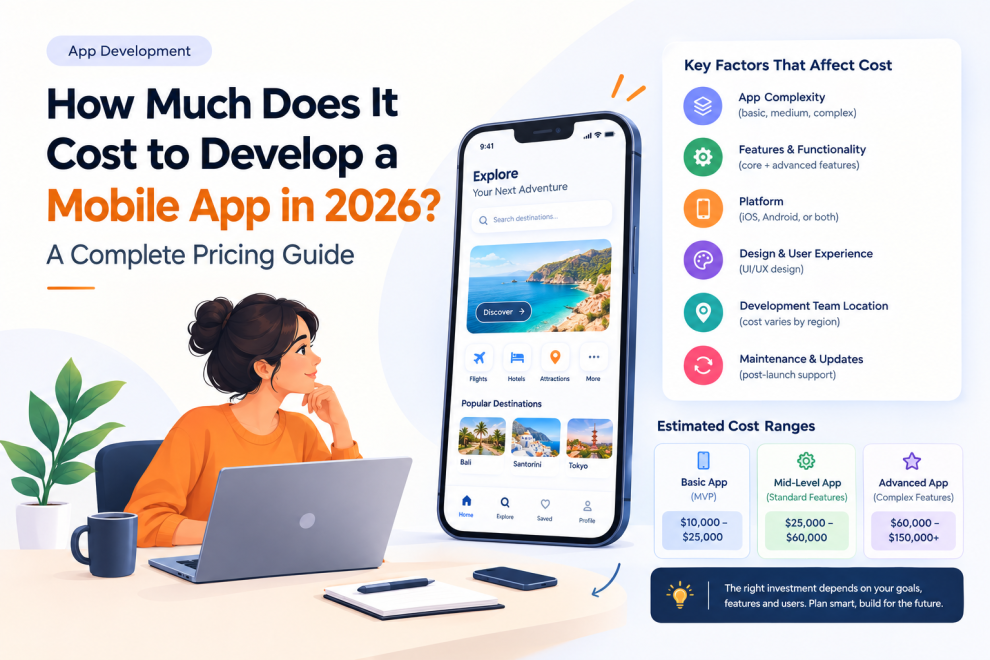

One of the first questions businesses ask before starting a mobile application project is, “How much will it cost to develop an app?”
The answer depends on what the application needs to do. A basic app with a few screens and simple functionality requires a different investment from an ecommerce platform with payments, an on-demand service with real-time tracking, or a fintech application with extensive security requirements.
Development costs also depend on the chosen platform, design complexity, backend infrastructure, integrations, testing, and the experience of the development team.
This guide explains the main factors that influence mobile app development cost in 2026 and how businesses can plan a realistic budget before beginning development.
How Much Does Mobile App Development Cost?
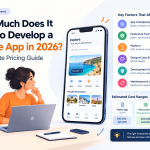
There is no universal price for building a mobile app. As an initial planning estimate, businesses hiring a development agency in India may encounter the following broad ranges.
| App complexity | Indicative development cost | Typical scope |
|---|---|---|
| Simple app or MVP | ₹1.5 lakh–₹5 lakh | Basic screens, simple workflows, limited backend requirements |
| Medium-complexity app | ₹5 lakh–₹15 lakh | User accounts, APIs, payments, notifications, or an admin panel |
| Complex application | ₹15 lakh–₹50 lakh+ | Multiple user roles, real-time features, advanced integrations |
| Enterprise platform | ₹50 lakh and above | Extensive integrations, advanced security, complex workflows, and scale requirements |
These are indicative planning ranges, not fixed market prices or quotes. Actual proposals may fall outside them depending on scope, vendor, technology, location, and project requirements. Recent pricing guides for India also show substantial variation across app categories and complexity. <Cite refs={[“turn306484search0″,”turn306484search1″,”turn306484search8”]}/>
Mobile App Development Cost by App Type
The type of application can have a major effect on the budget because different products require different workflows and backend capabilities.
1. Ecommerce App
An ecommerce app may include product catalogs, search, filters, shopping carts, checkout, payments, order tracking, customer accounts, and an administrative interface.
Costs increase when the application needs complex product variants, inventory synchronization, loyalty programs, personalized recommendations, or integration with existing commerce systems.
2. Food Delivery App
A food delivery platform often involves customers, restaurants, delivery partners, and administrators.
Each role may require a separate interface or set of permissions. Live order updates, location tracking, payment processing, dispatch logic, and delivery management can add substantial engineering effort.
3. Healthcare App
Healthcare applications may need appointment booking, patient profiles, secure communication, records access, or integration with healthcare systems.
Privacy, access control, auditability, and applicable regulatory requirements can increase the effort required for architecture, testing, and ongoing maintenance.
4. Fintech App
Fintech applications may include digital wallets, payment flows, transaction history, identity verification, account management, and fraud monitoring.
Security, regulatory obligations, financial integrations, and transaction consistency are important cost drivers. A simple financial tracking tool and a regulated financial services platform should not be treated as equivalent projects.
5. On-Demand Service App
Ride-hailing, home-service, and booking applications often support multiple user types, real-time availability, location services, scheduling, payments, and administrative controls.
The number of roles and the complexity of interactions between them can be more important than the number of screens alone.
8 Factors That Affect Mobile App Development Cost
1. Number and Complexity of Features
The number of features is one of the most visible cost drivers, but implementation complexity matters just as much.
A basic profile screen may be relatively straightforward. A profile that includes identity verification, document uploads, permissions, and external service integrations requires more work.
Define which features are essential for launch and which can be introduced later.
2. UI/UX Design Requirements
The budget should account for user research, user flows, wireframes, visual design, prototypes, accessibility, and usability testing where required.
A product with complex workflows may need more design validation than a simple informational application. Custom animations and highly specialized interfaces can also increase implementation and testing effort.
Investing in UX early can help teams identify confusing workflows before they become expensive development problems.
3. Android, iOS, or Cross-Platform Development
Your platform strategy affects both initial development and ongoing maintenance.
- Native development: Separate implementations using platform-specific technologies can be appropriate when deep native integration or platform-specific behavior is important.
- Cross-platform development: Flutter and React Native can allow teams to share substantial code across iOS and Android.
- Progressive web app: A web-based experience may be sufficient when users do not need extensive native device capabilities.
Cross-platform development can reduce duplicated effort, but it does not eliminate all platform-specific implementation or testing. The best choice depends on the required functionality and the team’s skills.
4. Backend Development and APIs
Mobile apps often depend on backend services for authentication, business logic, data storage, notifications, reporting, and communication with external systems.
Backend complexity can substantially affect the total cost. A simple application that stores limited information is very different from a platform that processes transactions or synchronizes data across many users.
Include backend architecture, API development, monitoring, and administration tools in the initial estimate.
5. Third-Party Integrations
Payment gateways, maps, messaging services, analytics platforms, authentication providers, and enterprise systems may require additional implementation work.
Before development begins, list the integrations the app needs and verify their capabilities, licensing, pricing, and technical constraints.
Some services charge ongoing usage fees that are separate from the initial development budget.
6. Security and Compliance
Security requirements should be defined early, especially for applications that handle financial, healthcare, identity, or other sensitive information.
Secure authentication, access control, encryption, vulnerability testing, audit logs, and compliance-related work can increase development effort.
The exact requirements depend on the product, its users, the markets in which it operates, and the applicable regulations.
7. Testing and Quality Assurance
Testing helps identify defects before they affect users.
The scope may include functional testing, device compatibility, performance, accessibility, security, integration testing, and user acceptance testing.
Applications with complex workflows or multiple user roles generally need broader test coverage than simpler products.
8. Maintenance After Launch
The initial development budget is not the entire cost of owning an application.
After launch, businesses may need to pay for hosting, monitoring, bug fixes, operating-system compatibility updates, third-party services, security patches, and new features.
Ask vendors to separate initial development from recurring maintenance and infrastructure costs so the long-term financial commitment is clear.
How Long Does It Take to Develop a Mobile App?
Timelines depend on the same factors that influence cost: scope, integrations, team size, design complexity, and testing requirements.
As a rough planning guide:
| Project type | Indicative timeline |
|---|---|
| Simple MVP | 6–12 weeks |
| Medium-complexity application | 3–5 months |
| Complex application | 5–9 months or longer |
| Enterprise platform | Depends on integrations, governance, and rollout scope |
These estimates assume a reasonably defined scope and an available delivery team. Research, regulatory reviews, third-party approvals, and changing requirements can extend the schedule.
A discovery phase can help identify risks and produce a more reliable estimate before full development starts.
How to Reduce Mobile App Development Costs
Reducing costs should not mean removing essential security, testing, or usability work. Instead, focus on controlling scope and avoiding unnecessary rework.
Start With a Minimum Viable Product
Identify the smallest version of the app that can solve a real user problem.
Launch with essential workflows, gather feedback, and use evidence to decide which features deserve investment next.
Prioritize Features
Classify features as essential, useful, or optional. Build the features required for the primary user journey first.
This helps prevent a project from expanding before the core product has been validated.
Choose the Technology Based on Requirements
Select native, cross-platform, or web-based development according to your product needs rather than following trends.
Consider developer availability, integration support, performance requirements, and long-term maintenance before committing.
Reuse Established Components Where Appropriate
Well-maintained libraries and existing backend services can reduce duplicated engineering work. However, third-party dependencies should be reviewed for security, reliability, licensing, and compatibility.
Custom development remains appropriate when the product needs specialized behavior that existing components cannot provide.
Define Requirements Before Development
Document the main user journeys, required features, integrations, and acceptance criteria.
Clear requirements make it easier to compare proposals and reduce avoidable changes during development.
Compare Proposals by Scope
When evaluating vendors, check whether each quote includes design, backend development, testing, deployment, source-code ownership, and maintenance.
Two proposals with different prices may describe substantially different products.
Hidden Costs to Include in Your App Budget
Before approving the project, account for costs that may sit outside the initial development quote:
- Cloud hosting and database services.
- Payment processing and third-party API usage.
- SMS, email, and push notification services.
- Apple and Google developer account fees.
- Security reviews and compliance-related work.
- Analytics and crash-reporting tools.
- App store preparation and release support.
- Ongoing maintenance and operating-system updates.
- Future feature development and customer support.
Not every application requires every item, and fees vary by provider and usage. Ask your development partner to identify recurring charges separately.
How to Get an Accurate Mobile App Development Quote
To receive a useful estimate, prepare a brief that explains:
- The problem the app will solve and its intended audience.
- The required platforms: Android, iOS, web, or a combination.
- The main features and user roles.
- Any third-party integrations.
- Security, privacy, and compliance requirements.
- The expected launch date and available budget.
- The support and maintenance needed after launch.
Ask the vendor to break the estimate into phases and identify assumptions, exclusions, dependencies, and potential risks.
An estimate based on clear requirements is generally more useful than a single price based on a short description of the idea.
Conclusion
Mobile app development cost depends on much more than the number of screens. Features, platform strategy, backend services, integrations, security requirements, testing, and long-term maintenance all contribute to the total investment.
Start by defining the core problem, prioritizing essential features, and selecting an appropriate technology approach. Then compare development proposals based on scope, quality, ownership, and ongoing costs.
A well-planned MVP can help validate demand while controlling initial spending. The objective is not simply to build the cheapest app, but to invest in a reliable product that can meet user needs and evolve with the business.



Add Comment