





AI powered mobile applications are entering the market faster than ever before. Development teams can now build working prototypes within days using generative AI tools, low code workflows, cross platform frameworks, and cloud based AI APIs.
At first glance, this acceleration appears to solve one of the biggest problems in product development: speed.
But many organizations are discovering a different challenge after the prototype stage ends.
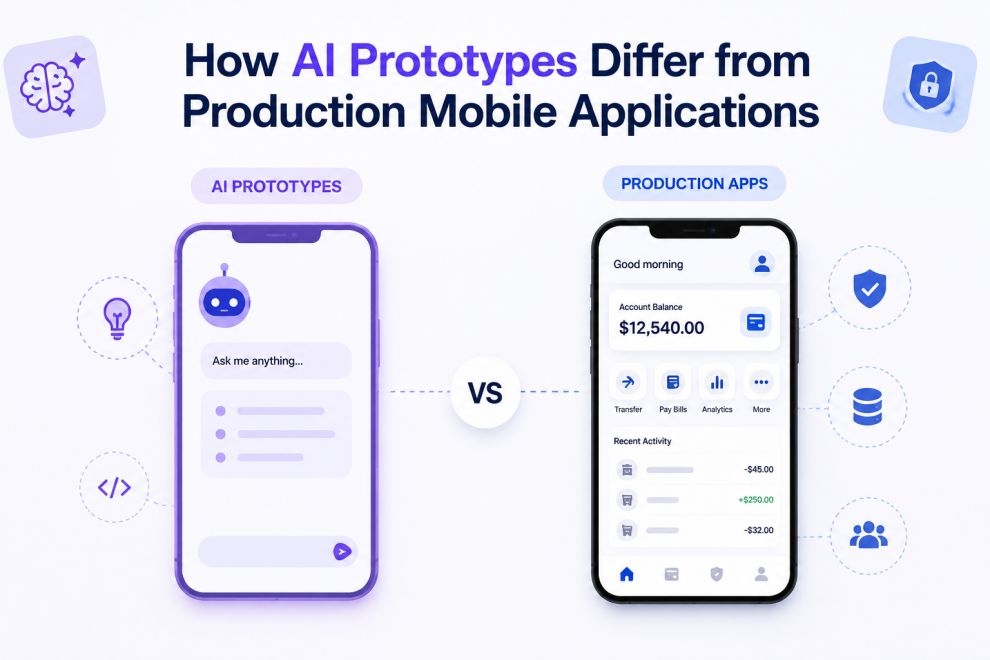
An AI prototype that performs well in demos often behaves very differently once it becomes a real production mobile application. Features that looked polished during testing may struggle under scale. Interfaces may feel inconsistent across devices. Security gaps appear. Infrastructure costs rise unexpectedly. Compliance requirements slow deployment.
This growing gap between prototype quality and production readiness is becoming one of the biggest operational challenges in AI mobile development.
In 2026, building AI functionality is no longer the hardest part. Building stable, secure, scalable mobile experiences around AI systems is where most complexity begins.
A recent GeekyAnts article on SOC 2 gaps in AI generated prototypes examined how many AI generated applications reach advanced prototype stages while still lacking critical production safeguards related to compliance, security, infrastructure governance, and operational reliability.
That issue is especially relevant in mobile ecosystems.
Unlike isolated AI demos, production mobile applications must operate continuously across unpredictable network environments, device types, user behaviors, operating systems, and security conditions. This introduces operational requirements that prototypes rarely account for fully.
The challenge affects startups and enterprises alike.
Many product teams assume that once an AI workflow functions technically, scaling into production is mostly an engineering expansion process. In reality, production readiness often requires rethinking architecture, UX systems, authentication flows, observability, and compliance structures entirely.
According to guidance from OWASP Mobile Security Project and enterprise AI governance discussions from NIST AI Risk Management Framework, AI enabled mobile products introduce broader operational risk surfaces than traditional applications because they depend on dynamic data processing, external model integrations, and adaptive workflows.
This means the difference between a prototype and a production app is no longer only about feature completion.
It is about operational maturity.
Why AI Prototypes Feel Simpler Than Real Mobile Applications
AI prototypes are usually designed to validate ideas quickly.
They focus on demonstrating functionality, proving user interest, or showcasing innovation potential. In controlled environments, this approach works well because teams can optimize workflows around ideal conditions.
But production environments are far less predictable.
A prototype may handle a limited number of users efficiently. A production application must support thousands or millions of interactions across different devices, network conditions, operating systems, and geographic regions simultaneously.
That changes development priorities significantly.
Prototype stage mobile apps often simplify:
- Authentication systems
- Data encryption
- Error handling
- Device compatibility
- Performance optimization
- Offline behavior
- Compliance workflows
- Monitoring infrastructure
These shortcuts help accelerate development, but they create operational risk later if not addressed properly.
One of the biggest differences involves infrastructure scalability.
AI powered mobile applications rely heavily on APIs, cloud inference systems, real time processing, and external data services. During demos, these systems may appear stable because traffic is controlled. In production, unpredictable usage patterns can expose latency problems, infrastructure bottlenecks, and rising cloud costs quickly.
User behavior also becomes more complicated.
Prototype users are usually guided through ideal workflows. Real users behave unpredictably. They multitask, interrupt processes, switch devices, lose connectivity, abandon onboarding flows, and interact with interfaces in unexpected ways.
This is where UX stability becomes critical.
AI interactions already introduce uncertainty because outputs can vary dynamically. If the surrounding mobile experience feels inconsistent or unreliable, user trust declines rapidly.
Cross platform consistency becomes another major challenge.
A prototype may work well on a single test device, but production mobile apps must function reliably across:
- Android ecosystems
- iOS versions
- Tablets
- Foldable devices
- Different screen sizes
- Variable network environments
This requires deeper engineering discipline than most early stage prototypes anticipate.
Companies like Google Android Developers, Apple Developer Platform, and Firebase continue shaping modern mobile engineering standards where scalability, observability, and security are becoming central to AI enabled application development.
Why Security and Compliance Become Bigger in Production
Security is one of the clearest differences between AI prototypes and production mobile applications.
Prototype environments often prioritize speed over governance. Teams may temporarily bypass strict authentication rules, simplify access controls, or use unsecured API structures to accelerate testing.
These decisions become dangerous if they remain unresolved during deployment.
AI powered mobile apps process highly sensitive information including:
- Behavioral data
- User conversations
- Financial information
- Personal preferences
- Contextual interactions
- Enterprise workflows
This creates larger attack surfaces compared to many traditional mobile systems.
Another major challenge is observability.
Production applications require continuous visibility into:
- API behavior
- Infrastructure performance
- AI response quality
- Crash analytics
- User interaction patterns
- Security anomalies
Without monitoring systems, diagnosing AI related failures becomes extremely difficult.
Compliance expectations also rise dramatically after launch.
Enterprise customers increasingly evaluate AI mobile applications based on:
- Privacy standards
- Data governance
- Auditability
- Security transparency
- Accessibility requirements
- Operational reliability
A technically functional AI prototype may still fail production readiness reviews if these areas remain weak.
This is particularly important for industries such as healthcare, fintech, insurance, and enterprise SaaS where compliance standards influence purchasing decisions directly.
AI generated code introduces another layer of complexity.
Many mobile development teams now use AI assisted coding tools to accelerate feature delivery. While this improves productivity, it also increases the need for deeper security reviews because generated code may contain insecure implementation patterns or incomplete validation logic.
As a result, production AI applications increasingly require stronger collaboration between:
- Mobile engineering teams
- Security operations
- Product managers
- UX designers
- Compliance leaders
- Infrastructure teams
The transition from prototype to production is becoming a cross functional operational process rather than only a technical milestone.
What Mobile Product Teams Should Prioritize in 2026
For mobile product leaders, engineering managers, and AI focused startups, the next generation of AI applications requires a different mindset around production readiness.
Several priorities are becoming increasingly important.
First, organizations should treat security architecture as part of the initial mobile product strategy instead of a post launch improvement phase. Prototype shortcuts often become expensive production problems later.
Second, teams should prioritize scalability testing early. AI workflows behave differently under real world mobile usage conditions than they do during controlled demos.
Third, companies need stronger UX consistency across devices and workflows. Users expect AI interactions to feel reliable regardless of platform or environment.
Fourth, organizations should invest more heavily in observability systems. AI driven mobile applications require continuous monitoring beyond traditional performance analytics.
Most importantly, enterprises should recognize that AI prototypes are designed to prove possibility while production applications must prove reliability.
That difference changes how products should be engineered.
In modern mobile ecosystems, users rarely tolerate unstable AI experiences for long. They expect applications to feel secure, responsive, predictable, and operationally mature from the first interaction.
As AI adoption continues accelerating across mobile products, the organizations gaining long term advantage will likely be the ones focusing less on prototype speed alone and more on sustainable production readiness.
Because in the current AI landscape, building a working demo is becoming easier every month.
Building a trustworthy production mobile application is still where the real challenge begins.



Add Comment