




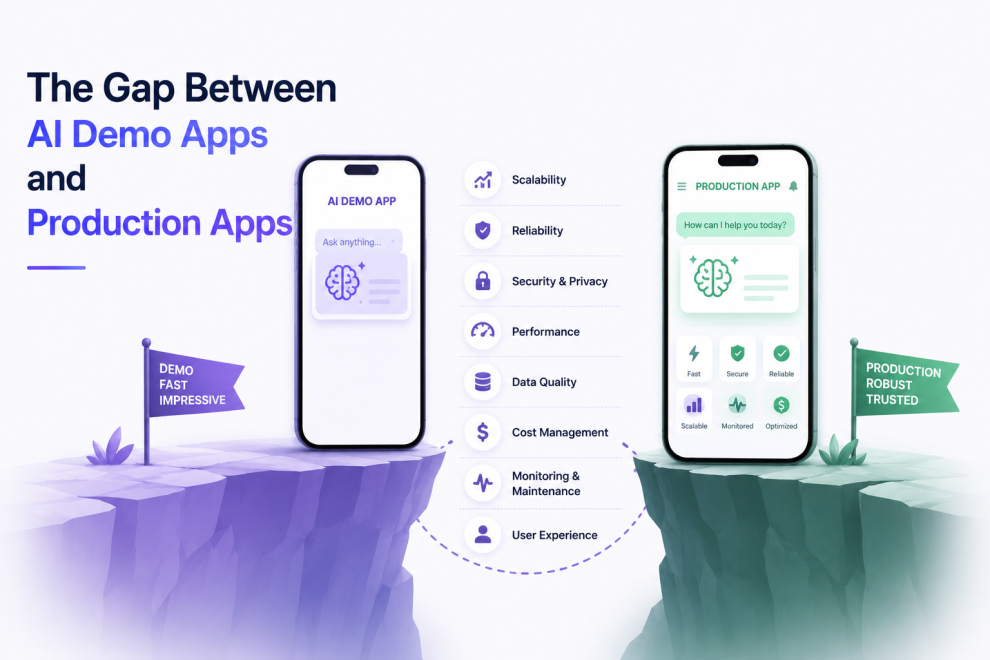

The Gap Between AI Demo Apps and Production Apps
AI demos have become incredibly convincing.
In just a few minutes, a prototype can generate content, automate workflows, summarize reports, answer customer questions, or simulate advanced business operations. For leadership teams, these demonstrations often create the impression that production deployment is only a small step away.
In reality, that step is usually much larger than expected.
Across industries, organizations are discovering that building an impressive AI demo is very different from operating a reliable production ready AI product at scale. What works smoothly in controlled demonstrations often struggles once real users, compliance requirements, infrastructure complexity, and operational unpredictability enter the picture.
This gap is becoming one of the biggest challenges in enterprise AI adoption.
In 2026, many companies no longer struggle with AI experimentation. They struggle with operationalization. Teams can prototype quickly using modern AI models and development tools, but converting those experiments into stable business systems requires significantly more engineering discipline.
That difference explains why many AI initiatives slow down after early excitement.
A recent GeekyAnts article examining why AI insurance projects fail in production explored how organizations often underestimate the operational complexity involved in scaling AI systems beyond pilot environments. The challenge is rarely about model capability alone. More often, it involves infrastructure reliability, workflow integration, governance, observability, and user trust.
This issue is especially visible in enterprise environments.
A demo application may perform well with limited data and ideal conditions. But production systems must handle unpredictable user behavior, security requirements, real time performance expectations, scaling pressures, and regulatory standards simultaneously.
That changes everything.
According to research and implementation guidance from McKinsey & Company and Gartner, many organizations continue facing difficulties transitioning generative AI initiatives from experimentation into reliable operational workflows.
The challenge is not only technical. It is organizational.
AI demo apps are usually designed to prove potential. Production apps must prove consistency.
Why AI Demos Create Misleading Expectations
AI demonstrations are designed for controlled success.
They typically operate with curated datasets, predefined workflows, optimized prompts, and limited edge cases. In those environments, AI systems can appear highly capable and stable.
But production environments are far more unpredictable.
Real users behave differently from test scenarios. Data quality changes constantly. API latency fluctuates. Infrastructure scales unevenly. Security requirements become stricter. Compliance reviews slow deployment decisions. Small UX inconsistencies suddenly affect adoption.
This is where many AI projects begin struggling.
One of the biggest issues is that organizations often focus heavily on visible AI behavior while overlooking operational systems supporting the experience.
For example, a conversational AI demo may answer questions accurately during testing. But once deployed at scale, teams may discover problems involving:
- Slow response times
- Inconsistent outputs
- Poor context handling
- Infrastructure instability
- Security vulnerabilities
- Escalating cloud costs
- Weak observability systems
These problems rarely appear during early demonstrations.
Another major gap involves workflow integration.
Most enterprises do not operate inside isolated AI environments. AI systems must connect with legacy platforms, enterprise databases, cloud infrastructure, analytics systems, customer platforms, and compliance frameworks simultaneously.
That integration layer often becomes the hardest part of production deployment.
User expectations also change dramatically between demos and real products.
During demonstrations, users tolerate experimentation because expectations are lower. In production environments, users expect reliability immediately. An AI assistant failing occasionally during a demo may seem acceptable. The same failure inside a customer support platform or insurance workflow damages trust quickly.
This is especially critical in regulated industries such as healthcare, fintech, logistics, and insurance.
Operational accountability matters far more in those environments than experimental novelty.
Companies like Microsoft, Google Cloud, and Amazon Web Services continue shaping enterprise AI infrastructure strategies as organizations work toward scalable and production ready AI deployment models.
The Infrastructure and Governance Challenges Most Teams Underestimate
The biggest difference between demo apps and production systems is operational complexity.
Production AI applications must function continuously under unpredictable conditions while maintaining performance, security, compliance, and user trust simultaneously.
This requires much more than model integration.
Infrastructure scalability becomes one of the first major challenges. AI applications processing large volumes of requests often face latency issues, inconsistent inference performance, and rising operational costs once usage increases.
Without scalable architecture planning, systems become unstable quickly.
Observability is another growing concern.
Traditional monitoring systems are often insufficient for AI powered applications because AI behavior itself can change dynamically. Teams increasingly need visibility into:
- Model performance
- Prompt reliability
- User interaction patterns
- Hallucination rates
- Infrastructure bottlenecks
- API failures
- Security anomalies
Without these insights, diagnosing production failures becomes extremely difficult.
Governance is equally important.
Many organizations launch AI pilots without establishing clear standards around data handling, explainability, compliance management, or human oversight. Those gaps become serious operational risks during scaling.
This is why production readiness discussions are becoming more strategic across enterprise technology teams.
Another underestimated issue is UX stability.
AI products are inherently dynamic, but users still expect predictable workflows and consistent experiences. Poor interaction design often increases confusion during AI usage, especially when outputs vary unexpectedly.
As a result, successful AI products increasingly rely on strong UX systems alongside technical infrastructure.
Cross functional collaboration also becomes critical.
Production AI systems require coordination between engineering, security, operations, compliance, product design, cloud infrastructure, and executive leadership. Many projects fail because these groups remain disconnected during development.
The transition from prototype to production is rarely only a technical milestone. It is usually an organizational transformation challenge.
What Enterprises Should Prioritize Before Scaling AI Products
For enterprise technology leaders, the biggest lesson emerging from recent AI adoption cycles is that production readiness cannot be treated as a final stage activity.
It must become part of the product strategy from the beginning.
Several priorities are becoming increasingly important in 2026.
First, organizations should evaluate operational scalability early instead of focusing only on demo performance. Systems that work for small pilot groups may fail under real world usage conditions.
Second, teams should prioritize observability and governance alongside model quality. Visibility into AI behavior becomes critical once applications operate at scale.
Third, companies need stronger workflow integration planning. AI products rarely succeed when operating separately from existing enterprise systems.
Fourth, leadership teams should assess whether user experience consistency supports long term trust. Reliable interaction design matters as much as technical capability.
Most importantly, organizations should recognize that AI adoption is moving into a more mature phase.
The market is shifting away from experimental hype and toward operational reliability. Companies are now being evaluated based on whether AI systems can function sustainably inside real business environments.
That changes how success should be measured.
The organizations creating long term value from AI are often not the ones launching the most impressive demos. They are the ones building stable, scalable systems capable of supporting real operational outcomes over time.
As enterprises continue investing in AI transformation initiatives, the gap between prototype success and production success will likely become one of the defining competitive challenges across the technology industry.
And for many companies, closing that gap will require a deeper focus on infrastructure maturity, governance discipline, user experience quality, and production engineering strategy long before deployment begins.



Add Comment