




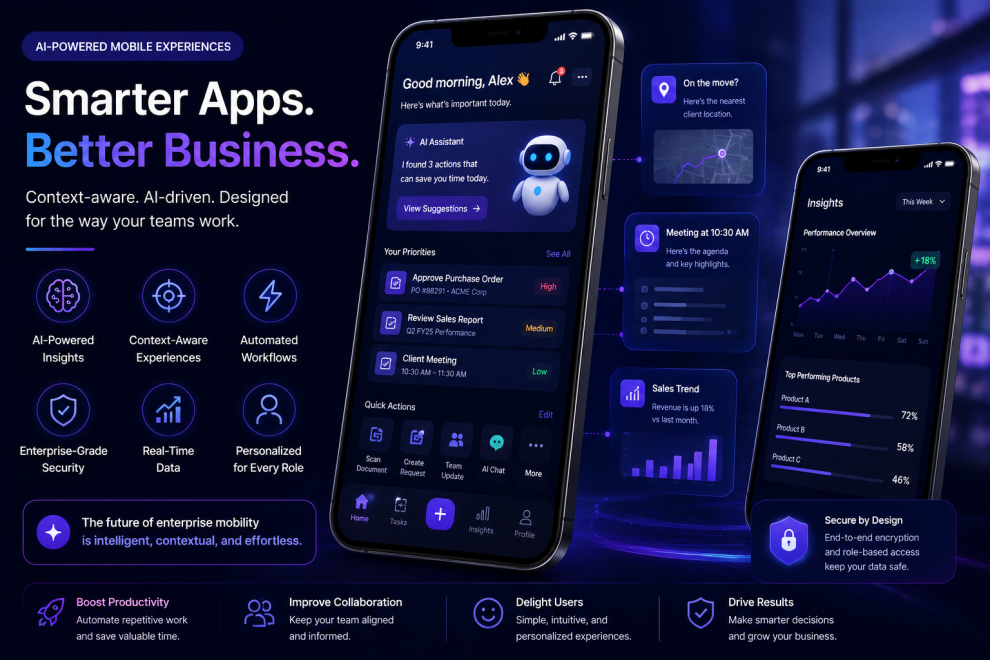

Enterprise mobile applications are evolving from simple digital tools into intelligent platforms capable of understanding user context and delivering personalised experiences in real time.
Instead of waiting for users to search, navigate, or manually complete workflows, context-aware mobile apps proactively deliver information, recommendations, and actions based on location, behaviour, device activity, and business priorities.
For organisations investing in digital transformation, context-aware experiences are becoming a key competitive advantage.
What Makes a Mobile App Context-Aware?
A context-aware application uses real-time information to understand what users are trying to accomplish.
This information may include:
- User role
- Previous activity
- Device location
- Time of day
- Business workflow
- AI-generated insights
Using this context, applications provide relevant experiences without unnecessary interaction.
Business Benefits
Enterprise organisations are adopting context-aware applications because they improve both efficiency and customer satisfaction.
Key advantages include:
- Faster task completion
- Better employee productivity
- More personalised customer experiences
- Improved operational efficiency
- Higher mobile app engagement
- Reduced manual work
These improvements create measurable business value across multiple departments.
AI Makes Mobile Apps Smarter
Artificial intelligence enables mobile applications to predict user needs rather than simply responding to requests.
Examples include:
- Suggesting the next workflow step
- Automatically summarising customer interactions
- Prioritising urgent notifications
- Recommending relevant documents
- Providing intelligent search results
These capabilities reduce friction while helping users make better decisions.
Security Remains Essential
Enterprise mobility requires balancing intelligence with security.
Best practices include:
- End-to-end encryption
- Secure authentication
- Privacy-first AI models
- Role-based access controls
- Secure cloud synchronisation
- Compliance monitoring
Strong security enables organisations to innovate while protecting sensitive information.
Industry Perspective
Across enterprise software development, organisations are increasingly combining mobile engineering, AI, UX design, and cloud infrastructure into integrated product engineering strategies. Companies such as GeekyAnts have publicly showcased enterprise digital products that reflect this broader industry trend of creating intelligent mobile applications focused on scalability, usability, and business outcomes.
Conclusion
Enterprise mobility is entering a new era where mobile applications understand users instead of simply responding to them.
By investing in context-aware experiences, AI-powered capabilities, and scalable architecture, organisations can build mobile applications that improve productivity, strengthen customer engagement, and deliver lasting competitive value.





Add Comment