





One of the first questions businesses ask before building an application is simple:
How much does it cost to develop a mobile app?
There is no single price because mobile app development costs depend on the application’s features, complexity, design, technology stack, integrations, security requirements, and development team.
A basic application can require a very different budget from a fintech platform, marketplace, healthcare app, or AI-powered product.
Understanding the factors behind mobile app development costs can help businesses plan their budgets before development begins.
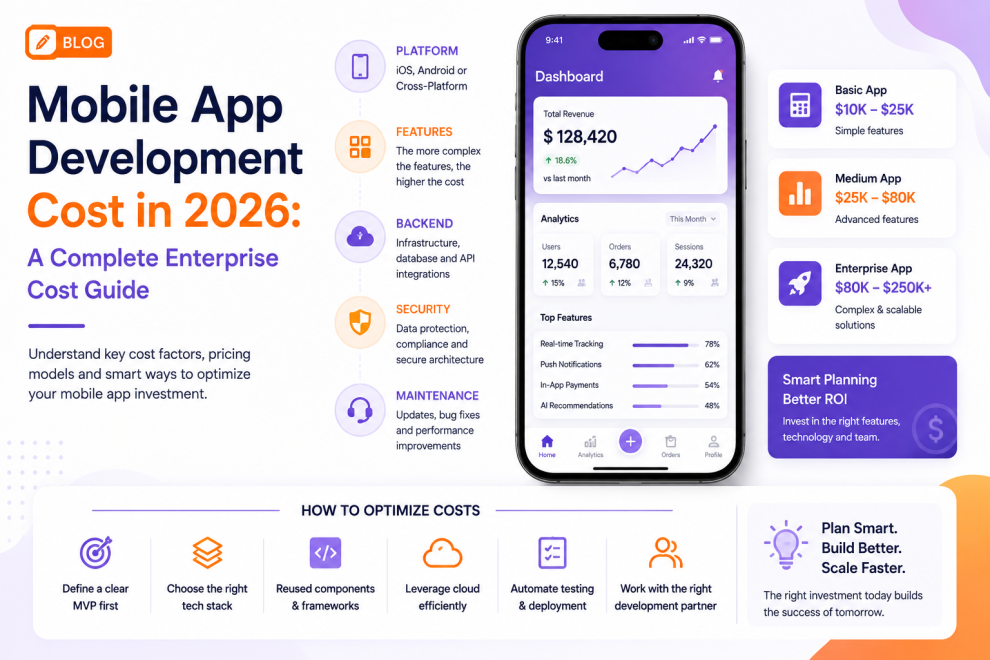
How Much Does It Cost to Develop a Mobile App?
A broad estimate can be divided into three categories:
| App Type | Approximate Development Cost |
|---|---|
| Basic App | $15,000–$40,000 |
| Medium-Complexity App | $40,000–$100,000 |
| Complex App | $100,000–$250,000+ |
| Enterprise / AI-Heavy App | $250,000+ |
These are indicative ranges rather than fixed prices. Actual costs depend heavily on the scope and technical requirements of the project.
1. Basic Mobile Apps
A basic application generally has a limited number of screens and straightforward functionality.
Examples can include:
- Information apps
- Simple utility apps
- Basic content applications
- Event applications
- Simple business apps
Typical features may include:
- User registration
- Login
- Basic profiles
- Static or dynamic content
- Push notifications
- Simple backend integration
Because these applications have fewer technical dependencies, development can usually be completed with a smaller scope.
2. Medium-Complexity Apps
Medium-complexity applications require more backend functionality and user interactions.
Examples include:
- Booking apps
- Fitness apps
- Restaurant apps
- Education apps
- Delivery apps
- Social applications
Features may include:
- Payments
- User profiles
- Search
- Filters
- Maps
- Notifications
- Chat
- Ratings and reviews
- Third-party APIs
- Admin dashboards
The additional functionality increases development and testing requirements.
3. Complex Mobile Apps
Complex applications often involve multiple user types, real-time functionality, advanced integrations, and sophisticated backend systems.
Examples include:
- FinTech apps
- Healthcare platforms
- Marketplaces
- Ride-hailing apps
- Large eCommerce applications
- Enterprise applications
- AI-powered applications
These projects can require:
- Real-time data
- Complex APIs
- Advanced security
- Multiple dashboards
- Payment infrastructure
- Analytics
- Cloud architecture
- AI or machine learning
- Third-party integrations
As the number of interconnected systems increases, architecture and testing become increasingly important.
What Factors Affect Mobile App Development Cost?
The final cost is influenced by several factors.
App Features
The number and complexity of features directly affect development effort.
For example, a simple login screen requires considerably less work than a complete authentication system with social login, multi-factor authentication, account recovery, and role-based access.
UI/UX Design
Design costs depend on the number of screens, interaction complexity, design systems, animations, prototypes, and user research involved.
A simple utility application may require relatively few screens.
A large marketplace can require hundreds of different states and interactions.
Platform
Businesses need to decide whether they want to build for:
- iOS
- Android
- Both iOS and Android
Building for multiple platforms can increase scope, although cross-platform technologies can allow teams to share a significant portion of the codebase.
Native vs Cross-Platform Development
Native development uses platform-specific technologies.
For example:
- Swift for iOS
- Kotlin for Android
Cross-platform technologies can allow teams to develop applications for multiple platforms using a shared codebase.
The right choice depends on performance requirements, device functionality, development resources, and the product roadmap.
Backend Development
The mobile application is only one part of the system.
Many apps require backend services for:
- User accounts
- Databases
- APIs
- Payments
- Notifications
- File storage
- Analytics
- Authentication
- Business logic
For complex applications, backend development can represent a significant portion of the overall project cost.
Third-Party Integrations
Mobile applications often depend on external services.
Examples include:
- Payment gateways
- Maps
- Analytics
- Social login
- Cloud storage
- Communication services
- AI APIs
- Shipping platforms
Each integration introduces development, testing, maintenance, and sometimes recurring service costs.
Security Requirements
Security requirements vary significantly by industry.
A standard content application may have relatively straightforward security needs.
A fintech or healthcare application may require much more extensive security architecture, data protection, access controls, auditing, and compliance considerations.
Security should be planned from the beginning rather than added after development.
App Maintenance Costs
Development does not end when the application is launched.
Ongoing costs can include:
- Bug fixes
- OS compatibility updates
- Security updates
- Server maintenance
- Performance optimization
- Feature improvements
- Third-party API changes
A business should therefore consider both initial development cost and long-term maintenance cost.
How Long Does It Take to Build a Mobile App?
Development time depends on scope.
A basic application may take a few months.
A medium-complexity product may require several months of design, development, testing, and deployment.
Complex applications can take significantly longer because they involve more architecture, integrations, testing, and iterations.
A clear MVP scope can help businesses launch an initial version sooner.
MVP vs Full Product
One way to control development costs is to start with an MVP.
Instead of building every possible feature, teams identify the functionality required to solve the primary user problem.
For example, a food delivery MVP might initially include:
- User registration
- Restaurant discovery
- Menu browsing
- Cart
- Payment
- Order tracking
Advanced loyalty programs, AI recommendations, complex promotions, and other features can be introduced later.
This allows the business to validate the product before investing heavily in the complete roadmap.
How to Reduce Mobile App Development Costs
Businesses can control costs without necessarily reducing product quality.
Define the Scope Clearly
Unclear requirements often result in changes during development.
A detailed scope can reduce unnecessary rework.
Prioritize Features
Separate features into:
Must Have
Should Have
Could Have
This helps teams focus the initial budget on the most important functionality.
Consider Cross-Platform Development
For products that do not require extensive platform-specific functionality, cross-platform development may reduce duplicated development work.
Reuse Design Components
A consistent design system can help teams build screens faster and maintain visual consistency.
Build in Phases
Rather than developing every feature simultaneously, businesses can release functionality in planned stages.
Mobile App Development Cost by Feature
Individual features can also influence the overall budget.
| Feature | Relative Complexity |
|---|---|
| Login & Registration | Low |
| User Profile | Low |
| Push Notifications | Low–Medium |
| Search & Filters | Medium |
| Chat | Medium–High |
| Payment Integration | Medium–High |
| Maps & Location | Medium–High |
| Real-Time Tracking | High |
| AI Assistant | High |
| Video Processing | High |
| Complex Marketplace | Very High |
The actual cost of each feature depends on implementation requirements and integrations.
Choosing a Mobile App Development Partner
The cheapest development quote is not necessarily the lowest total cost.
Businesses should also consider:
- Technical expertise
- Industry experience
- Development methodology
- Communication
- QA practices
- Security capabilities
- Post-launch support
- Scalability
- Technology choices
Companies such as GeekyAnts work across mobile app development, UI/UX, AI-powered product engineering, and backend development, allowing businesses to approach mobile products as complete digital systems rather than isolated applications.
Final Thoughts
Mobile app development cost in 2026 depends on far more than the number of screens.
Features, design, platforms, backend architecture, integrations, security, testing, and long-term maintenance can all affect the final investment.
For businesses planning a new application, the most practical approach is to:
Define the problem → Identify core features → Estimate the MVP → Select technology → Build → Test → Launch → Iterate
A clear scope at the beginning can make the development process more predictable and help businesses avoid spending heavily on features before they know whether users actually need them.




Add Comment