



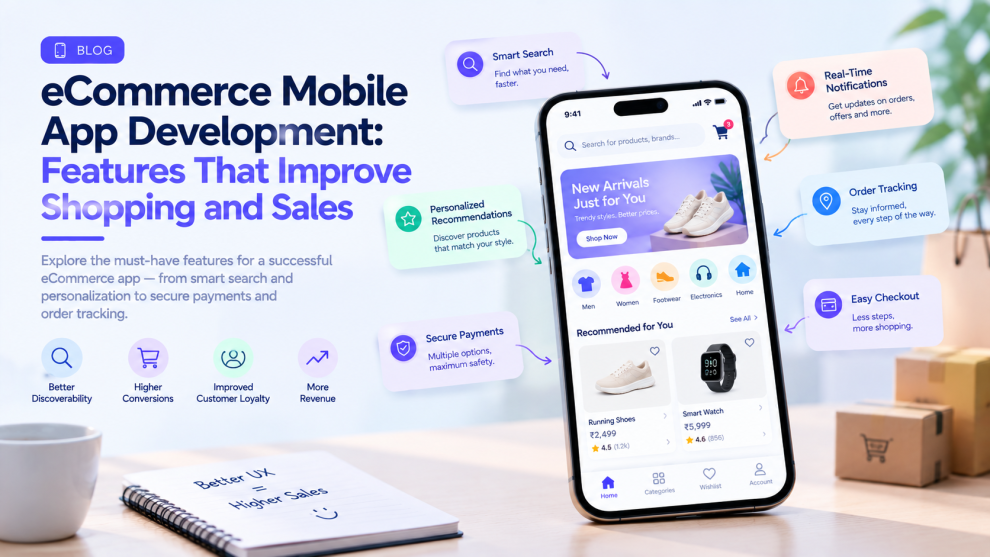

Shopping on a smartphone has become a normal part of the customer journey.
Users may discover products through social media, search for a specific item, compare prices, save products for later, and complete purchases without ever visiting a physical store.
For businesses, this makes eCommerce mobile app development more than simply putting a website inside an application.
A well-designed eCommerce app should make product discovery easier, simplify purchasing, and create reasons for customers to return.
1. Fast Product Search
Search is one of the most important features in an eCommerce application.
Users should be able to quickly find products using:
- Keywords
- Categories
- Filters
- Product attributes
- Search suggestions
For large catalogs, intelligent search can help users find relevant products even when they do not know the exact product name.
2. Smart Product Filters
A large product catalog can become overwhelming without effective filtering.
Depending on the store, filters may include:
- Price
- Brand
- Size
- Color
- Rating
- Availability
- Material
- Category
Filters should be easy to apply, review, and remove.
A user should never feel trapped inside a complicated filter interface.
3. Personalized Recommendations
An eCommerce app can use browsing and purchasing behavior to surface relevant products.
For example:
You may also like
Frequently bought together
Similar products
Recommended for you
Personalization can reduce the amount of searching required to discover relevant products.
However, recommendations should remain useful rather than becoming an endless stream of irrelevant products.
4. High-Quality Product Pages
Product pages need to answer the questions customers would normally ask in a store.
Important information can include:
- Product photos
- Price
- Variations
- Availability
- Specifications
- Reviews
- Delivery information
- Return policy
Images should allow users to inspect products closely.
For certain categories, features such as zoom, video, 360-degree views, or size guides can provide additional context.
5. Simple Add-to-Cart Experience
Adding a product to the cart should be straightforward.
The app should clearly communicate that the item was added.
Useful interactions can include:
Add to Cart
Buy Now
View Cart
The user should not have to search for the cart after adding an item.
6. A Faster Checkout
Checkout abandonment is a major concern for eCommerce businesses.
A complicated checkout can create unnecessary friction.
A mobile checkout should minimize unnecessary fields and make the sequence clear.
For example:
Address → Delivery → Payment → Review → Order
Features such as saved addresses, autofill, digital payment options, and guest checkout can reduce repetitive work where appropriate.
7. Multiple Payment Options
Different customers prefer different payment methods.
Depending on the market and product, an app may support:
- Credit and debit cards
- Digital wallets
- Bank transfers
- Buy-now-pay-later services
- Local payment methods
- Cash on delivery
Payment options should be presented clearly without overwhelming the checkout experience.
8. Real-Time Order Tracking
After a customer purchases something, the experience should continue.
Order tracking can show:
Order Confirmed
Preparing
Shipped
Out for Delivery
Delivered
Providing clear updates reduces uncertainty and can reduce the need for customers to contact support.
9. Wishlist and Save-for-Later Features
Not every customer is ready to purchase immediately.
A wishlist allows users to save products they may want later.
This can be especially useful for:
- Fashion
- Electronics
- Furniture
- Travel products
- Gifts
A good wishlist experience makes it easy to return to saved products and see whether prices or availability have changed.
10. Push Notifications That Provide Value
Notifications can bring customers back to the application.
Useful notifications might include:
- Order updates
- Delivery alerts
- Price changes
- Back-in-stock notifications
- Wishlist updates
- Relevant promotions
But too many promotional notifications can quickly become annoying.
Notifications should be relevant and give users control over what they receive.
AI Features in eCommerce Apps
AI is adding another layer to mobile shopping experiences.
Applications can use AI for:
- Product recommendations
- Conversational search
- Personalized discovery
- Product descriptions
- Visual search
- Shopping assistants
- Customer support
- Review summarization
For example, instead of searching for:
“black running shoes under ₹5,000”
a customer could ask:
“Find comfortable black running shoes for long-distance running under ₹5,000.”
The application can interpret the intent and present relevant results.
Visual Search Can Change Product Discovery
A customer may see a product they like but not know what it is called.
With visual search, they can potentially upload or capture an image and search for visually similar products.
This can be particularly useful for:
- Fashion
- Home decor
- Furniture
- Accessories
- Consumer products
It creates another path between inspiration and purchase.
Reviews Should Be Easy to Understand
Reviews provide social proof, but large numbers of reviews can be difficult to process.
An eCommerce app can make reviews easier to navigate using:
- Ratings
- Review filters
- Photos
- Verified purchase indicators
- Common themes
- Helpful review sorting
AI-assisted summaries can also help users quickly understand recurring positive and negative points, provided the underlying reviews remain accessible.
Build Trust Into the Shopping Experience
Customers need confidence before making an online purchase.
Important trust signals can include:
- Clear pricing
- Delivery estimates
- Return policies
- Secure payment
- Seller information
- Product reviews
- Customer support
Trust should be visible throughout the shopping journey rather than appearing only at checkout.
Performance Matters
An eCommerce application can have excellent features and still lose customers if it feels slow.
Product images, search results, recommendations, and checkout screens should load efficiently.
Developers should also consider users on slower networks and less powerful devices.
Fast interactions are particularly important during shopping because customers can easily switch to another product or retailer when an experience becomes frustrating.
Accessibility Should Be Part of eCommerce UX
An eCommerce application should be usable by people with different abilities.
This can include:
- Readable text
- Sufficient contrast
- Accessible controls
- Screen-reader support
- Clear form errors
- Appropriate touch targets
- Captions where relevant
Accessibility improvements can also benefit users shopping in bright environments, using small screens, or interacting with one hand.
Cross-Platform or Native?
Businesses developing an eCommerce app may consider native, cross-platform, or hybrid approaches.
The right choice depends on:
- Required device capabilities
- Development team
- Performance requirements
- Product roadmap
- Platform coverage
- Integrations
For many commerce applications, shared development can be useful because the core shopping experience is similar across platforms, while native capabilities can still be introduced where necessary.
What Makes an eCommerce App Successful?
A successful eCommerce app does not necessarily need every possible feature.
It needs to make the most important customer journey easy:
Discover → Explore → Evaluate → Purchase → Track → Return
Every feature should support that journey.
Search should help discovery.
Product pages should help evaluation.
Checkout should remove friction.
Tracking should provide confidence.
Personalization should make future shopping more relevant.
Final Thoughts
eCommerce mobile app development is increasingly about creating a complete shopping experience rather than simply displaying products.
The strongest applications combine intuitive UX, fast performance, secure payments, personalized discovery, useful notifications, and reliable post-purchase experiences.
Companies such as GeekyAnts work across mobile app development, UI/UX, AI-powered product engineering, and backend systems, allowing eCommerce products to connect the shopping interface with the technology supporting it.
Ultimately, the goal is straightforward:
Help customers find what they want, understand what they are buying, complete the purchase easily, and have a reason to come back.




Add Comment