



Restaurant mobile apps have moved beyond being simple digital menus.
Customers can now use restaurant apps to discover dishes, order food, reserve tables, earn rewards, track deliveries, manage preferences, and receive personalized offers.
But adding every possible feature does not necessarily create a better restaurant app.
The most useful applications focus on the actions customers perform repeatedly.
For restaurants considering mobile app development, understanding these core customer behaviors can help determine which features deserve priority.
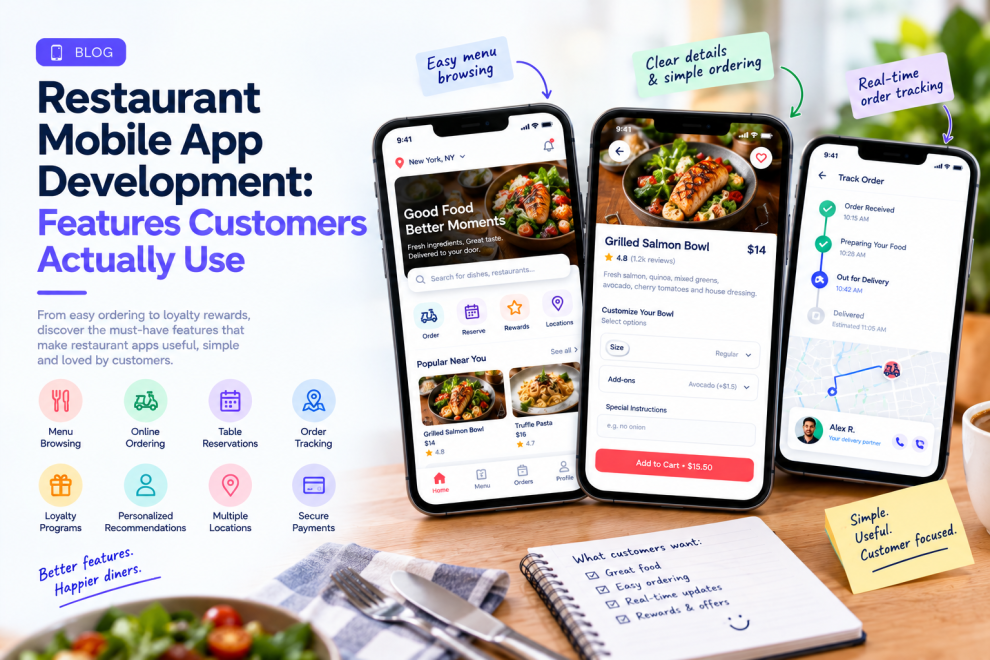
1. Easy Menu Browsing
The menu is one of the most important parts of a restaurant application.
Customers should be able to browse categories, view dishes, check prices, see photos, and understand available options without unnecessary navigation.
Search and filters can make larger menus easier to explore.
The experience should also make it simple to return to frequently ordered items.
2. Online Food Ordering
Ordering should be one of the most straightforward journeys in the application.
A typical flow should feel natural:
Choose Restaurant → Browse Menu → Customize → Add to Cart → Pay → Track Order
Customers should not need to repeatedly move between unrelated screens.
Customization options such as add-ons, toppings, portion sizes, or special instructions should also be presented clearly.
3. Table Reservations
For dine-in restaurants, reservations can be an important app feature.
Customers should be able to select:
- Restaurant location
- Date
- Time
- Number of guests
- Seating preferences where available
After booking, the application should provide a clear confirmation and allow customers to manage or cancel reservations when applicable.
4. Order Tracking
Once an order has been placed, customers want to know what is happening.
An order-tracking experience can communicate stages such as:
Order Received → Preparing → Ready → Out for Delivery → Delivered
This reduces uncertainty and can also reduce the need for customers to contact restaurant staff for basic status updates.
5. Digital Loyalty Programs
Loyalty is one of the strongest reasons customers may return to a restaurant application.
Instead of relying entirely on physical cards or generic promotions, an app can provide a digital loyalty experience.
Customers can view points, rewards, available offers, and progress toward benefits in one place.
The important part is making the reward system easy to understand.
6. Personalized Recommendations
A restaurant app can use previous activity to make discovery easier.
For example, it could surface recently ordered dishes, frequently visited restaurants, favorite categories, or relevant promotions.
Personalization should save customers time rather than overwhelm them with recommendations.
7. Multiple Restaurant Locations
Restaurant chains need to make location selection simple.
The app can help customers discover nearby branches and view relevant information such as:
- Opening hours
- Menu availability
- Distance
- Pickup options
- Delivery availability
- Reservation availability
Location-aware experiences can reduce the number of steps required to place an order.
8. Secure Mobile Payments
Payment is a critical part of the restaurant app experience.
Customers may expect options such as cards, digital wallets, saved payment methods, or other supported payment services.
The payment flow should be secure while remaining straightforward.
Clear pricing, taxes, delivery fees, discounts, and the final total should be visible before confirmation.
9. Push Notifications That Are Actually Useful
Notifications can help customers stay informed about orders, reservations, rewards, and relevant offers.
But excessive promotional notifications can quickly become annoying.
The best notifications are timely and useful.
For example, an order-status update is directly connected to an action the customer has already taken.
A generic promotional message may be less valuable.
10. Customer Support
Problems can still happen.
An order may be delayed. A payment may fail. A customer may receive the wrong item.
The application should provide a simple way to get help.
Support can include FAQs, order-specific assistance, chat, phone contact, or other available channels.
The important part is connecting support to the user’s current context.
Features Should Follow Customer Behavior
A restaurant does not necessarily need every feature listed above.
A small independent restaurant may benefit most from menu browsing, reservations, ordering, and loyalty.
A large restaurant chain may need location management, personalized recommendations, multiple payment methods, delivery tracking, and deeper customer-account functionality.
The product should therefore be built around actual customer behavior.
What Makes a Restaurant App Easy to Use?
A good restaurant application should answer common questions quickly:
What can I order?
How much does it cost?
When will I receive it?
Can I reserve a table?
What rewards do I have?
Where is the nearest restaurant?
If customers can answer these questions without navigating through unnecessary screens, the application is doing its job.
Do Not Overload the Home Screen
Restaurant applications often have plenty of content to display.
Promotions, recommendations, categories, loyalty rewards, banners, seasonal menus, and nearby restaurants can all compete for attention.
The home screen should prioritize the actions customers use most often.
A simple interface with clear hierarchy is generally more useful than a crowded screen containing every available feature.
Plan the App Beyond the First Release
The first version does not need to contain everything.
A restaurant can begin with its core journey and expand after collecting customer feedback.
For example:
Phase 1: Menu + Ordering + Payment
Phase 2: Tracking + Loyalty + Reservations
Phase 3: Personalization + Advanced customer engagement
This approach allows the product team to validate the experience before investing heavily in less-proven features.
Companies such as GeekyAnts work on mobile product engineering across areas such as app development, UX, backend systems, integrations, and scalable product architecture.
For restaurant businesses, the technology should ultimately remain secondary to the customer journey.
A successful restaurant app is not the one with the longest feature list.
It is the one that makes ordering, discovering, booking, paying, and returning easier.




Add Comment