






For years, mobile app development followed a familiar pattern.
A company would identify a problem, create a list of features, design a user interface, and launch an application. Success was often measured by the number of features packed into the product.
That approach is changing.
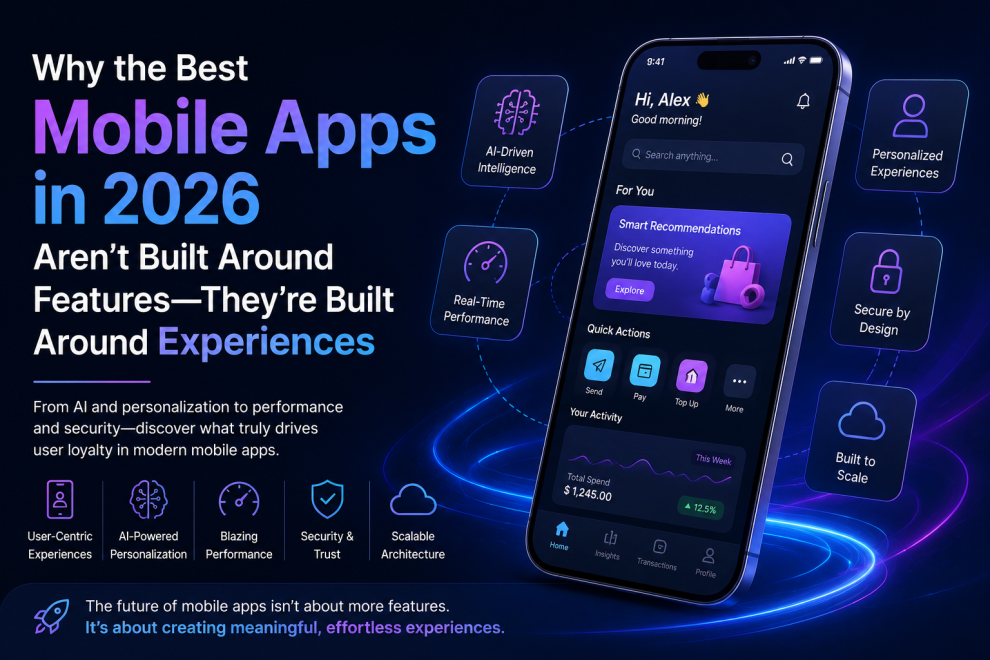
Today’s most successful mobile apps aren’t competing by offering more features. They’re competing by delivering better experiences.
As artificial intelligence, cloud computing, and real-time personalization become part of everyday applications, users expect apps to understand their needs instead of waiting for instructions.
The future of mobile development is becoming less about what an app can do and more about how intelligently it helps people achieve their goals.
Users Expect More Than Functionality
Downloading an app is easy.
Keeping users engaged is much harder.
People now compare every new application with the best digital experiences they’ve already had.
They expect:
- fast performance,
- seamless onboarding,
- personalized recommendations,
- intelligent search,
- smooth navigation,
- and consistent experiences across devices.
An app that simply works is no longer enough.
Users expect applications to anticipate their next action while remaining simple and intuitive.
AI Is Quietly Transforming Mobile Experiences
Artificial intelligence is changing the role of mobile applications.
Instead of acting as passive tools, apps are becoming active assistants.
Modern applications can now:
- personalize content,
- summarize information,
- automate repetitive tasks,
- recommend actions,
- detect unusual behavior,
- and provide contextual assistance.
The goal isn’t to showcase AI.
The goal is to reduce effort for the user.
The best AI-powered mobile experiences are often the ones where users barely notice AI is involved.
Performance Is Still the Biggest Competitive Advantage
No matter how intelligent an application becomes, users won’t tolerate poor performance.
Research consistently shows that slow loading times, crashes, and inconsistent interactions remain among the biggest reasons users uninstall mobile applications.
Performance optimization now includes much more than reducing app size.
Development teams also need to think about:
- efficient APIs,
- intelligent caching,
- offline capabilities,
- cloud synchronization,
- battery optimization,
- and scalable backend infrastructure.
A fast experience builds trust long before users notice advanced features.
Cross-Platform Development Has Matured
A few years ago, businesses often debated whether to build separate native applications or use cross-platform technologies.
Today, frameworks such as Flutter and React Native have matured significantly, allowing organizations to deliver consistent experiences across Android, iOS, desktop, and web with greater efficiency.
This allows engineering teams to spend more time improving the product instead of maintaining multiple codebases.
Companies exploring modern mobile development strategies increasingly view cross-platform development as a business decision rather than simply a technical one.
Organizations like GeekyAnts have contributed to this evolution through their work with Flutter, React Native, and product engineering, demonstrating how modern development practices can accelerate delivery while maintaining quality.
Security Can No Longer Be an Afterthought
As mobile applications increasingly handle financial transactions, healthcare information, enterprise workflows, and personal data, security has become a core part of product design.
Users expect applications to protect their information without creating unnecessary friction.
Development teams now prioritize:
- secure authentication,
- encrypted communication,
- privacy-first architecture,
- secure cloud infrastructure,
- and regular security updates.
Strong security isn’t just a technical requirement.
It’s part of the overall user experience.
The Future Belongs to Intelligent Products
The next generation of successful mobile applications won’t necessarily have the most features.
Instead, they’ll provide:
- faster interactions,
- smarter recommendations,
- fewer manual steps,
- better accessibility,
- and more personalized experiences.
Rather than asking users to adapt to software, software will increasingly adapt to users.
That shift represents one of the biggest transformations mobile development has experienced in the past decade.
Final Thoughts
The future of mobile app development isn’t about building larger applications.
It’s about building applications that feel effortless.
As AI, cloud technologies, and modern engineering practices continue to evolve, the companies creating lasting products will be those that focus on experience first and technology second.
Because users rarely remember how many features an app offered.
They remember how easy it made their lives.





Add Comment