

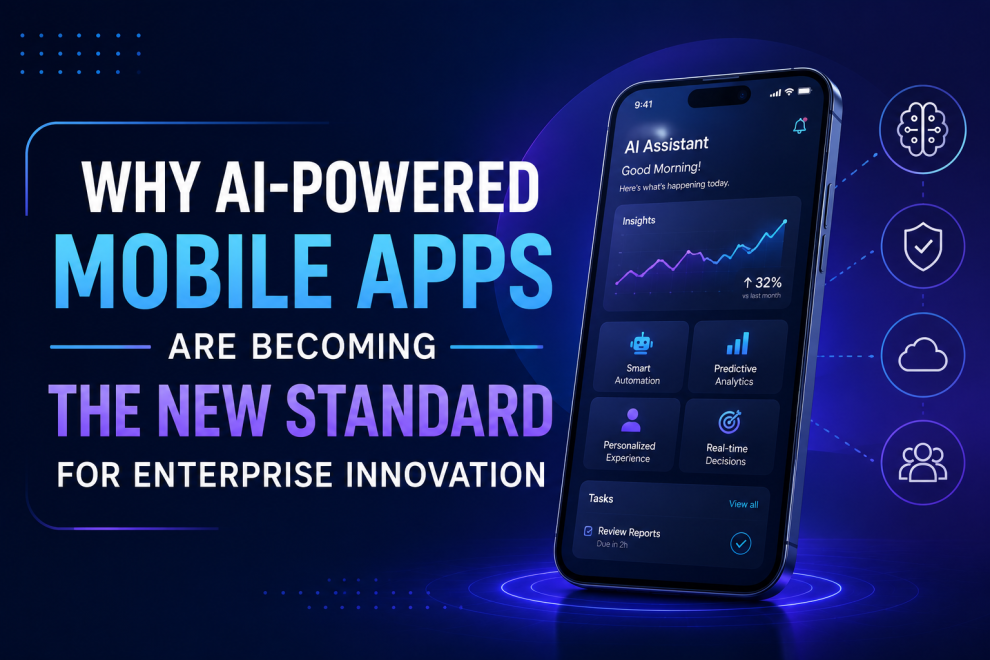

Mobile applications have become the backbone of modern enterprises. From empowering remote employees to delivering seamless customer experiences, they now play a critical role in how organizations operate and compete. As artificial intelligence continues to evolve, enterprise leaders are rethinking what mobile applications should be capable of.
The conversation is no longer about simply adding AI features to an app. Instead, organizations are designing AI-powered mobile applications that improve productivity, automate workflows, and deliver personalized experiences from the very first interaction.
Enterprise Mobility Is Entering a New Era
Businesses across industries are investing in mobile platforms to support employees, customers, and partners. Healthcare providers rely on mobile apps for patient engagement, financial institutions use them for secure digital banking, while retailers deliver personalized shopping experiences through intelligent mobile platforms.
Artificial intelligence is accelerating this transformation by enabling applications to understand user behavior, analyze data in real time, and recommend actions that help users complete tasks more efficiently.
The result is a smarter mobile experience that delivers value beyond traditional functionality.
Why AI-First Thinking Matters
Many organizations treat AI as an additional feature that can be added after an application is built. While this approach may deliver short-term improvements, it often limits the overall user experience.
An AI-first strategy begins with understanding user needs and identifying where intelligence can simplify interactions. Instead of asking users to navigate multiple screens or perform repetitive actions, AI can automate routine tasks, predict user intent, and surface relevant information at the right moment.
This creates applications that feel more intuitive while reducing friction throughout the user journey.
Security and Performance Must Evolve Together
Enterprise mobile applications often handle sensitive customer information, financial data, and confidential business operations. As AI becomes part of these platforms, organizations must ensure that innovation does not compromise security.
Successful enterprise mobile apps prioritize:
- Secure authentication
- End-to-end encryption
- Regulatory compliance
- Reliable cloud infrastructure
- Fast application performance
- Scalable backend architecture
Balancing security with usability is essential for maintaining user trust and supporting long-term growth.
User Experience Remains the Biggest Differentiator
Even the most advanced AI capabilities will fail to deliver value if users struggle to interact with them.
Modern enterprise mobile apps should focus on:
- Simple navigation
- Personalized experiences
- Context-aware recommendations
- Faster task completion
- Clear AI interactions
- Accessibility across devices
A well-designed user experience increases adoption, reduces support requests, and helps organizations maximize the return on their technology investments.
Building Mobile Apps That Scale
Enterprise applications rarely remain static. They evolve alongside business requirements, customer expectations, and emerging technologies.
To support long-term growth, development teams should build applications using scalable architectures, reusable components, API-driven integrations, and cloud-native infrastructure. This allows organizations to introduce new AI capabilities without rebuilding the entire application.
Scalability is no longer just a technical objective—it is a business necessity.
Industry Perspective
Across the enterprise technology ecosystem, organizations are increasingly bringing together mobile engineering, UX design, cloud infrastructure, and AI expertise to build intelligent digital products. Companies such as GeekyAnts have publicly showcased enterprise solutions across healthcare, fintech, retail, and SaaS, reflecting a broader industry trend toward integrated product engineering where mobile applications are designed for both scalability and exceptional user experience.
Preparing for the Future of Enterprise Mobility
The next generation of enterprise mobile applications will move beyond traditional interfaces. AI assistants, predictive workflows, voice interactions, and personalized automation will become standard capabilities rather than competitive advantages.
Organizations that invest in flexible architectures, responsible AI practices, and user-centered mobile experiences today will be better equipped to adapt to future business needs and technological advancements.
Conclusion
Enterprise mobility is evolving faster than ever, and AI is becoming a core driver of that transformation. However, long-term success depends on more than adopting the latest technology. It requires building secure, scalable, and intuitive mobile applications that solve real business problems.
By combining intelligent automation with thoughtful design and strong engineering practices, enterprises can create mobile experiences that improve productivity, strengthen customer relationships, and support sustainable digital growth.



Add Comment