





Enterprise mobile applications are no longer limited to enabling basic business processes. Today, they power digital banking, healthcare services, retail experiences, field operations, logistics, manufacturing, and enterprise collaboration. As artificial intelligence continues to reshape the software landscape, mobile applications are evolving from functional tools into intelligent platforms capable of predicting user needs, automating workflows, and delivering highly personalized experiences.
For enterprise organizations, the conversation has shifted from “Should we use AI?” to “How do we build AI-first mobile applications that deliver measurable business value?”
The answer lies in combining scalable engineering, modern mobile architecture, and user-centered design from the very beginning.
Why AI-First Mobile Apps Are the Future of Enterprise Mobility
The next generation of enterprise mobile applications is being designed around intelligence rather than interfaces. Instead of relying on users to navigate multiple screens or manually complete repetitive tasks, AI enables applications to understand intent, recommend actions, and automate routine work.
This shift is transforming industries.
Financial institutions are using AI to detect fraud in real time and personalize customer experiences. Healthcare organizations are improving patient engagement with intelligent mobile platforms. Retail brands are leveraging predictive recommendations to increase conversions, while logistics companies are optimizing deliveries through AI-driven route planning.
These innovations are redefining what enterprise mobility can achieve.
The Rise of AI-Native Mobile Experiences
Adding an AI chatbot to an existing app is no longer enough.
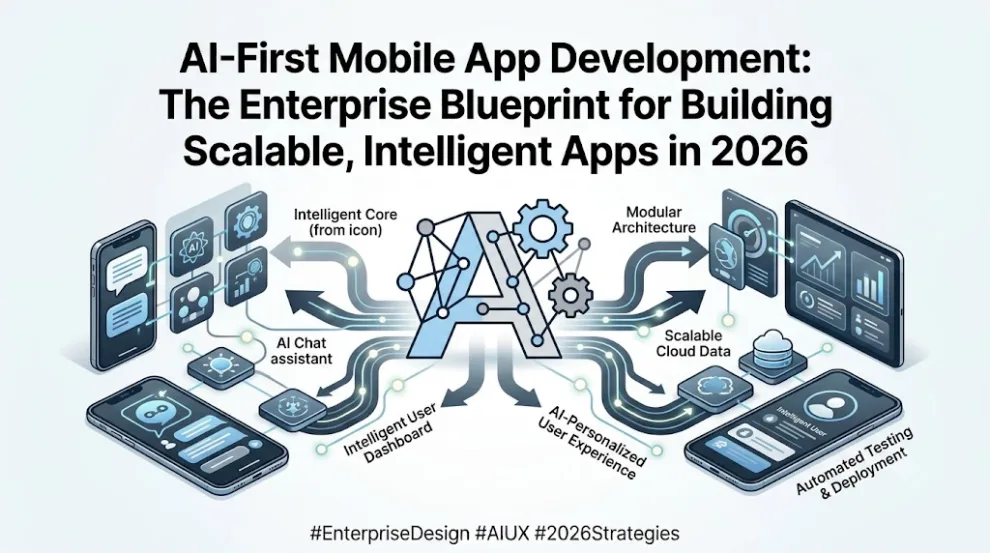
Modern enterprises are moving toward AI-native mobile applications, where intelligence is built into every stage of the user journey.
These applications can:
- Deliver personalized recommendations
- Automate repetitive workflows
- Support natural language interactions
- Generate predictive insights
- Provide real-time decision support
- Adapt to user behavior over time
Instead of making users search for information, AI-native apps proactively surface what matters most.
Scalability Is No Longer Optional
Enterprise applications often serve thousands—or even millions—of users across different regions and devices. As AI workloads increase, applications must scale without sacrificing speed or reliability.
Organizations should prioritize:
- Cloud-native architecture
- API-first development
- Cross-platform mobile frameworks
- Secure backend infrastructure
- Real-time data synchronization
- High-performance mobile experiences
Scalable architecture ensures new AI capabilities can be introduced without disrupting existing operations.
User Experience Drives Adoption
No matter how advanced an AI model becomes, it only creates value when people trust and use it.
Enterprise mobile applications should focus on delivering experiences that feel simple despite the complexity behind them.
Successful products emphasize:
- Fast onboarding
- Clean navigation
- Context-aware automation
- Transparent AI recommendations
- Accessible design
- Consistent interactions across devices
Reducing friction is often more valuable than adding new features.
Security and Responsible AI Must Work Together
Enterprise mobility depends on trust.
As AI processes sensitive customer and organizational data, businesses must ensure that innovation never compromises privacy or compliance.
Essential priorities include:
- Secure authentication
- End-to-end encryption
- Responsible AI governance
- Regulatory compliance
- Explainable AI outputs
- Continuous monitoring and performance optimization
Organizations that build security into every layer of the application create stronger foundations for long-term growth.
Emerging Trends Shaping Enterprise Mobile Development
Several technology trends are defining the future of enterprise mobility in 2026:
On-device AI is enabling faster, more private user experiences by reducing reliance on cloud processing.
Cross-platform development continues to accelerate enterprise delivery while maintaining native-like performance across Android and iOS.
AI copilots and intelligent assistants are becoming embedded within enterprise applications, helping users complete complex tasks through conversational interactions.
Predictive analytics is transforming mobile applications from reactive tools into proactive business platforms.
Edge computing is improving responsiveness for industries that require real-time decision-making, including healthcare, manufacturing, and logistics.
Organizations that embrace these innovations strategically will gain a significant competitive advantage.
Why Cross-Functional Product Teams Deliver Better Mobile Apps
Building intelligent mobile products requires more than strong engineering.
Successful enterprises bring together product managers, UX designers, AI specialists, cloud architects, security experts, and mobile developers from the earliest planning stages.
This collaborative approach ensures that AI capabilities solve genuine business challenges while maintaining usability, scalability, and compliance.
Industry Perspective
Across the enterprise product engineering ecosystem, organizations are increasingly integrating mobile development, UX strategy, cloud engineering, and artificial intelligence into unified delivery models. Companies such as GeekyAnts have publicly demonstrated projects across healthcare, fintech, retail, and enterprise SaaS that reflect this broader industry movement toward building AI-powered mobile applications designed for long-term scalability, performance, and user adoption.
Frequently Asked Questions
What is an AI-first mobile application?
An AI-first mobile application is designed with artificial intelligence as a core capability rather than an additional feature. AI influences the user experience, workflows, and decision-making throughout the application.
Why are enterprises investing in AI-powered mobile apps?
Organizations use AI-powered mobile applications to improve productivity, automate repetitive work, personalize customer experiences, reduce operational costs, and support digital transformation initiatives.
What technologies are shaping enterprise mobile development?
Key technologies include generative AI, AI agents, on-device AI, cross-platform frameworks, cloud-native architecture, edge computing, predictive analytics, and intelligent automation.
Conclusion
Enterprise mobility is entering a new era where intelligence, scalability, and user experience are becoming inseparable.
The organizations leading this transformation are not simply adding AI to existing applications they are redesigning mobile experiences around how people work, collaborate, and make decisions.
By combining AI-first thinking, modern engineering practices, robust security, and exceptional user experience, enterprises can build mobile applications that deliver measurable business value today while remaining ready for the innovations of tomorrow.



Add Comment