





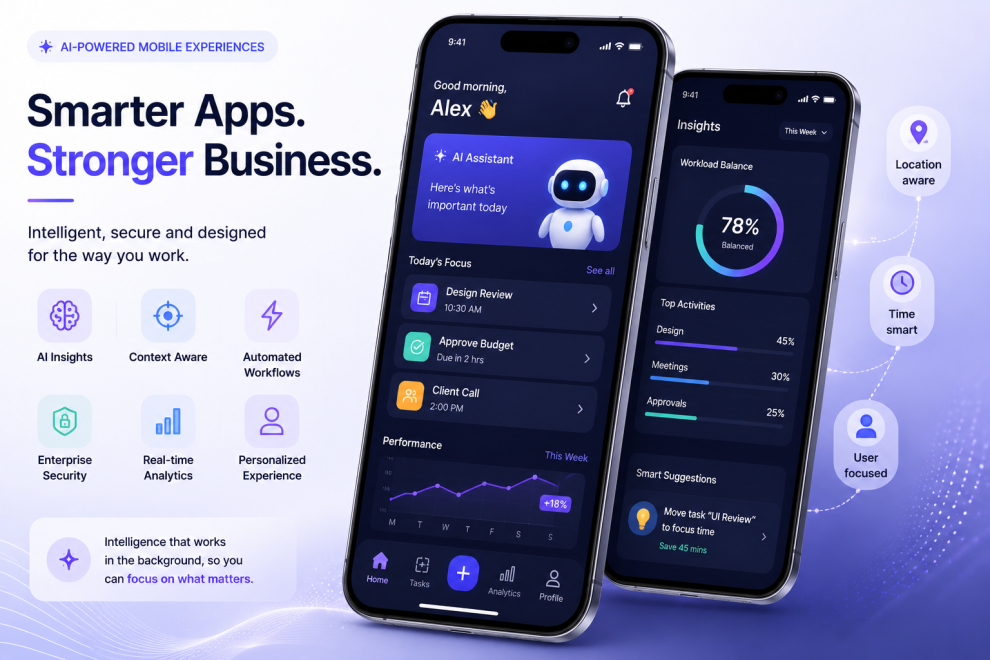

Enterprise mobile applications are evolving beyond digital tools into intelligent business platforms. Artificial intelligence is enabling mobile apps to understand user intent, automate repetitive work, and provide personalized experiences that improve productivity across every department.
As organizations accelerate digital transformation, AI-first mobile platforms are becoming essential for delivering faster, smarter, and more scalable enterprise solutions.
What Makes a Mobile Platform AI-First?
An AI-first mobile application is designed with intelligence at its core rather than treating AI as an additional feature.
These applications can:
- Understand natural language
- Personalize user experiences
- Recommend next actions
- Automate workflows
- Deliver predictive insights
- Continuously learn from user interactions
This creates mobile experiences that become more valuable over time.
Enterprise Benefits
Businesses adopting AI-first mobile platforms gain measurable advantages, including:
- Faster operational workflows
- Improved employee productivity
- Better customer engagement
- Reduced manual processes
- Smarter business decisions
- Higher application adoption
These benefits help organizations improve efficiency while delivering stronger digital experiences.
Building for Enterprise Scale
Successful AI-powered mobile applications require more than intelligent features.
Organizations should prioritize:
- Cloud-native architecture
- Secure APIs
- Cross-platform development
- Real-time synchronization
- Offline capabilities
- Scalable AI infrastructure
A strong technical foundation ensures applications remain reliable as usage grows.
Security and Privacy Remain Critical
AI-powered enterprise applications frequently process sensitive business and customer information.
Security best practices include:
- End-to-end encryption
- Multi-factor authentication
- Privacy-first AI models
- Secure cloud connectivity
- Continuous compliance monitoring
- Role-based access controls
Strong security helps organizations innovate while maintaining user trust.
Designing for Adoption
The success of enterprise mobility depends on how easily employees can use new technology.
Applications should prioritize:
- Clear navigation
- Fast performance
- Explainable AI recommendations
- Accessible interfaces
- Consistent user experiences
When intelligent features simplify work instead of complicating it, user adoption naturally increases.
Industry Perspective
Across enterprise software development, organizations are increasingly integrating mobile engineering, AI, UX design, cloud infrastructure, and product strategy into comprehensive product engineering approaches. Companies such as GeekyAnts have publicly showcased enterprise digital products across healthcare, fintech, retail, and SaaS, reflecting the broader industry movement toward building scalable AI-powered mobile experiences.
Conclusion
Enterprise mobility is entering an AI-first era where applications actively assist users instead of simply responding to requests.
Organizations that invest in scalable architecture, responsible AI, and intuitive user experiences today will be better positioned to build mobile applications that improve productivity, strengthen customer relationships, and support long-term business growth.





Add Comment