






Mobile application development costs vary significantly depending on the application’s features, architecture, platform strategy, integrations, security requirements, and development team.
For enterprises, the initial development estimate is only one part of the investment. Infrastructure, testing, security, maintenance, AI capabilities, and long-term scaling can have an equally important impact on total cost.
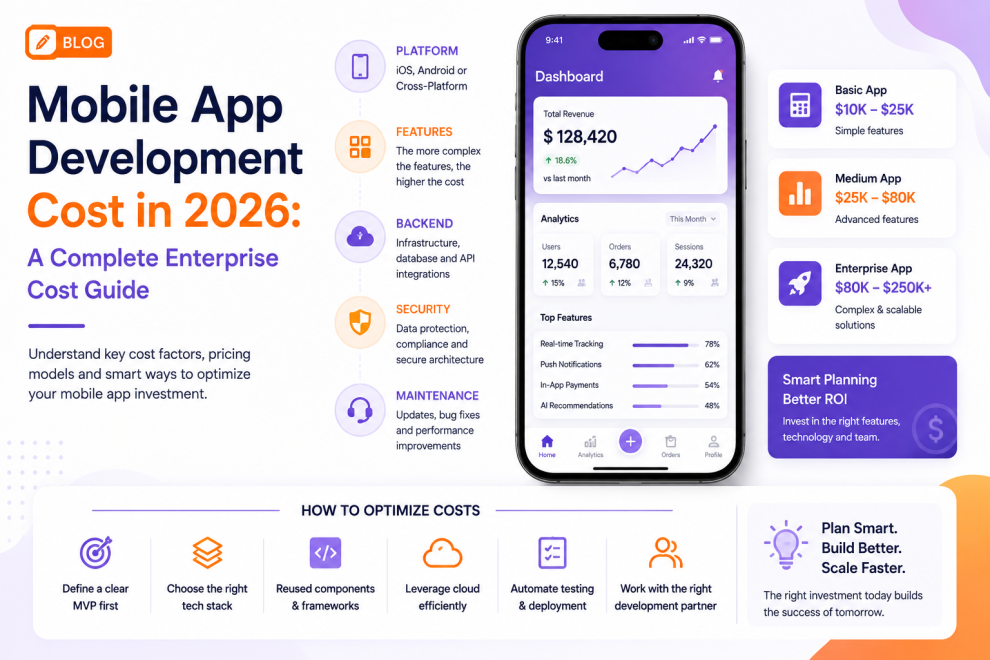
What Determines Mobile App Development Cost?
The major cost factors include:
- Application complexity
- Number of platforms
- UI/UX requirements
- Backend architecture
- Third-party integrations
- Security requirements
- AI functionality
- Testing requirements
- Post-launch maintenance
A simple internal application and a large customer-facing platform can have completely different development requirements.
Development Complexity
Mobile projects are commonly grouped into three broad categories.
Basic Applications
These may include:
- User authentication
- Profiles
- Basic content
- Simple forms
- Push notifications
They generally require less backend infrastructure and fewer integrations.
Medium-Complexity Applications
These may include:
- Payments
- Real-time communication
- Location services
- Analytics
- Advanced user profiles
- Third-party APIs
The backend and testing requirements become more substantial.
Enterprise Applications
Large-scale applications may require:
- Complex business workflows
- Multiple user roles
- Enterprise integrations
- Advanced security
- Real-time data
- AI capabilities
- Offline functionality
- Cloud scalability
- Continuous monitoring
These requirements significantly influence development effort and long-term operating costs.
Native vs Cross-Platform Costs
Choosing between native and cross-platform development can influence both initial and ongoing costs.
Native development typically requires separate platform development, while cross-platform approaches can allow teams to share a larger portion of the codebase.
However, cost should not be the only consideration.
Teams should also evaluate:
- Performance
- Platform-specific features
- Maintenance
- Developer availability
- User experience
- Long-term scalability
The cheapest initial approach is not always the most cost-effective over the application’s lifetime.
How AI Can Affect Development Cost
AI-powered features introduce additional development and infrastructure considerations.
Costs can increase through:
- AI model usage
- Cloud computing
- Data processing
- Model integration
- AI testing
- Monitoring
- Security and privacy controls
However, AI can also reduce operational costs when it automates repetitive workflows or improves employee productivity.
The right question is therefore not simply how much AI costs, but what measurable value it creates.
Hidden Costs Enterprises Should Plan For
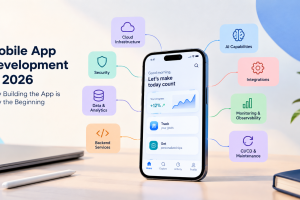
Development is only the beginning.
Organizations should budget for:
- Cloud infrastructure
- Security testing
- App-store compliance
- Analytics
- Monitoring
- Bug fixes
- OS updates
- Feature improvements
- Technical support
Planning these expenses early creates a more realistic total cost of ownership.
How to Control Mobile Development Costs
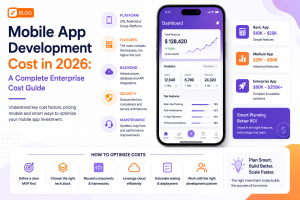
Enterprise teams can improve cost efficiency by:
- Defining a focused MVP
- Prioritizing high-value features
- Reusing scalable components
- Choosing architecture carefully
- Automating testing and deployment
- Monitoring infrastructure usage
- Avoiding unnecessary integrations
A well-defined product roadmap can prevent expensive redevelopment later.
Industry Perspective
The enterprise product engineering industry increasingly combines mobile development, cloud infrastructure, AI, UX, and DevOps into integrated delivery models. Companies such as GeekyAnts have publicly shared enterprise product engineering work, reflecting the broader move toward building scalable mobile platforms rather than treating development as a one-time project.
Conclusion
Mobile app development cost in 2026 depends on far more than the number of screens.
Architecture, security, integrations, AI, infrastructure, testing, and long-term maintenance all contribute to the total investment.
For enterprise leaders, the most effective approach is to define business outcomes first, prioritize the features that directly support them, and build an architecture that can scale without unnecessary technical complexity.



Add Comment