

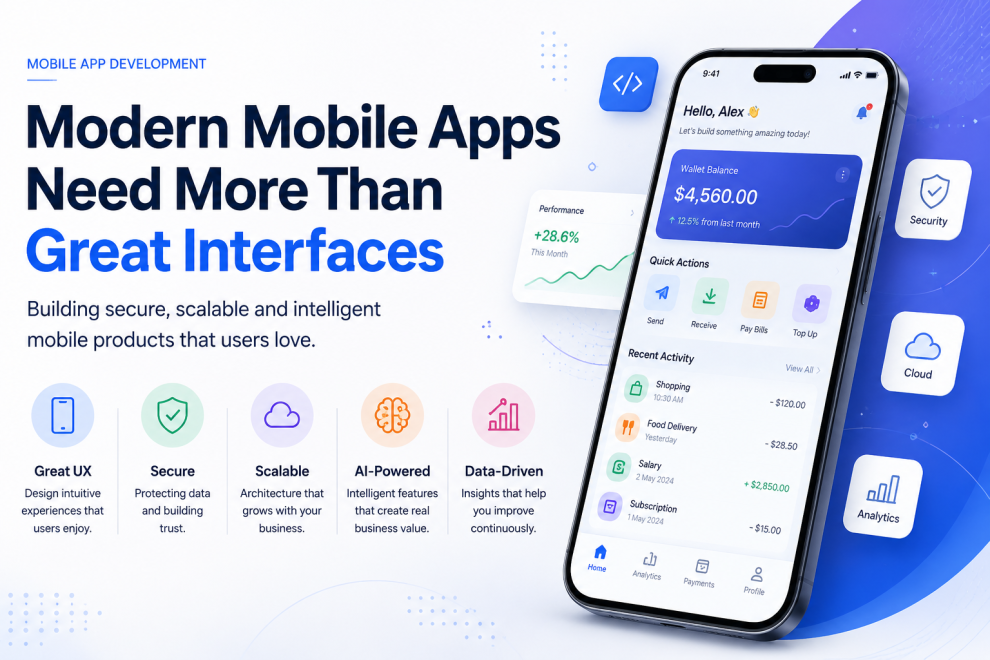

Building a mobile application is relatively easy compared with building one that can support thousands or millions of users.
Enterprise mobile products need to handle security, performance, integrations, analytics, changing business requirements, and continuous releases.
A structured implementation strategy helps teams move from an initial MVP to a scalable production application without creating unnecessary technical debt.
Phase 1: Define the MVP
The first version should focus on the smallest set of features required to validate the product.
Teams should identify:
- Core user journeys
- Primary business objectives
- Essential features
- Required integrations
- Success metrics
Avoiding unnecessary features at this stage allows teams to validate the concept before making larger investments.
Phase 2: Plan the Architecture
The architecture should support future growth from the beginning.
A typical enterprise mobile stack may include:
Mobile layer → API layer → Business services → Database and cloud infrastructure → AI and third-party services
This separation makes it easier to modify individual components without rebuilding the entire application.
Phase 3: Choose the Development Approach
Teams generally evaluate native, cross-platform, or hybrid approaches.
The decision should consider:
- Performance requirements
- Platform-specific functionality
- Development resources
- Time to market
- Maintenance
- Long-term scalability
The right approach depends on the application’s requirements rather than a universal preference for one framework.
Phase 4: Build Security Into Development
Security should be implemented throughout the development lifecycle.
Important areas include:
- Secure authentication
- Authorization
- API security
- Encryption
- Secure data storage
- Session management
- Privacy controls
Enterprise applications should also have a clear process for monitoring and responding to security issues after launch.
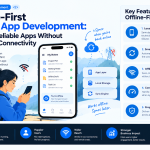
Phase 5: Prepare for Offline Usage
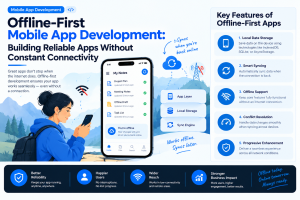
Mobile users cannot always rely on stable connectivity.
Applications may need:
- Local data storage
- Offline workflows
- Background synchronization
- Retry mechanisms
- Conflict handling
- Clear connection states
Offline-first thinking can be particularly useful for logistics, healthcare, field service, and enterprise workforce applications.
Phase 6: Integrate AI Where It Adds Value
AI can be introduced after identifying specific workflows where it provides measurable benefits.
Potential features include:
- AI assistants
- Intelligent search
- Predictive recommendations
- Automated summaries
- Voice interactions
- Workflow automation
Teams should also determine whether AI processing belongs on the device, in the cloud, or across a hybrid architecture.
Phase 7: Test Beyond Functionality
Enterprise mobile testing should cover more than whether features work.
Teams should evaluate:
- Performance
- Security
- Accessibility
- Device compatibility
- Network conditions
- Battery consumption
- API reliability
- AI response quality
Testing across realistic conditions helps identify problems that may not appear in controlled development environments.
Phase 8: Monitor After Launch
Launch is the beginning of the optimization cycle.
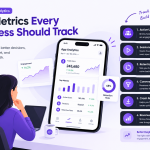
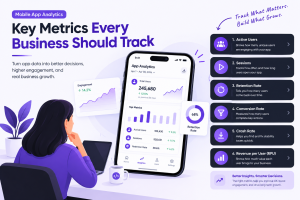
Teams should continuously monitor:
- Crash rates
- App performance
- API latency
- Feature adoption
- User retention
- Failed workflows
- Security events
Analytics and user feedback can then guide future releases.
Industry Perspective
Enterprise product engineering is increasingly combining mobile development with cloud, AI, UX, security, and DevOps. Companies such as GeekyAnts have publicly shared work across enterprise product engineering and AI-powered applications, reflecting the industry’s movement toward scalable digital products rather than isolated mobile applications.
Conclusion
A successful enterprise mobile app requires more than a strong interface and functional code.
The most reliable approach is to validate the MVP, establish scalable architecture, integrate security early, introduce AI strategically, test realistically, and continuously monitor the production experience.
This implementation model allows organizations to move quickly without sacrificing the foundation needed for long-term growth.



Add Comment