


AI-powered mobile applications are moving from experimental products to mainstream business tools. From personalized recommendations to intelligent assistants and automated workflows, AI is changing what users expect from mobile experiences.
For product and technology teams, the challenge is no longer simply adding an AI model to an application. The real challenge is building a mobile product where AI, user experience, security, and backend infrastructure work together reliably.
Start With a Clear Use Case
The strongest AI mobile apps begin with a specific user problem.
Common opportunities include:
- Intelligent search
- Personalized recommendations
- AI assistants
- Document summarization
- Predictive alerts
- Workflow automation
- Voice-based interactions
Instead of adding AI to every feature, teams should identify where it can remove friction or improve an important workflow.
Choose the Right AI Architecture
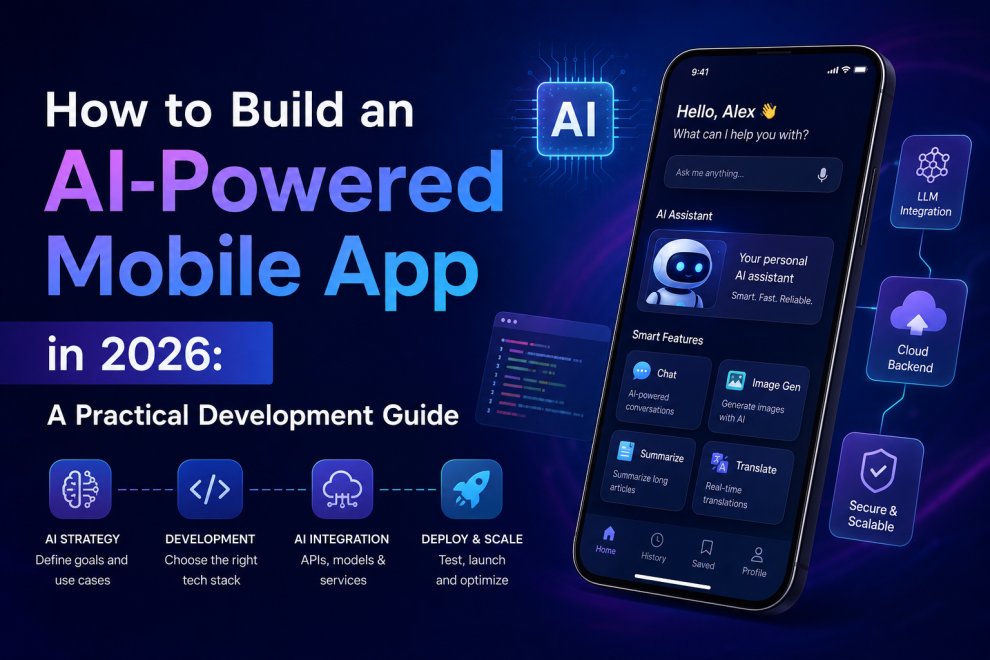
An AI-powered mobile application usually consists of three major layers:
Mobile application: Handles the interface, user interactions, device capabilities, and local processing.
Backend services: Manage authentication, business logic, APIs, databases, and communication with AI services.
AI layer: Provides capabilities such as language understanding, recommendations, classification, generation, or prediction.
Keeping these responsibilities separated makes the application easier to scale and maintain.
Decide Between On-Device and Cloud AI
The location of AI processing can significantly affect the mobile experience.
On-Device AI
Useful when applications require:
- Low latency
- Offline functionality
- Greater privacy
- Reduced network dependency
Cloud AI
Useful when applications require:
- Larger AI models
- More computational power
- Centralized model management
- Complex data processing
Many modern applications use a hybrid approach, combining on-device capabilities with cloud-based intelligence.
Design the AI Experience Carefully
A powerful model does not automatically create a good mobile experience.
AI interactions should be:
- Easy to understand
- Context-aware
- Fast enough for the workflow
- Transparent about limitations
- Simple to correct
Users should also understand when they are interacting with AI and when a decision requires human approval.
Build Security Into the Product
AI-powered applications may process sensitive customer or business information.
Development teams should consider:
- Secure authentication
- Encrypted communication
- API protection
- Role-based access
- Secure data storage
- Privacy controls
- AI input and output validation
Security should be part of the architecture from the beginning rather than a final-stage activity.
Optimize for Mobile Performance
AI features can increase network usage, processing requirements, and battery consumption.
Teams should continuously monitor:
- App launch time
- API latency
- Memory usage
- Battery consumption
- Crash rates
- AI response time
- Network failures
Caching, asynchronous processing, efficient API calls, and selective AI inference can help maintain a responsive experience.
Test AI Features Differently
Traditional mobile testing is not enough for AI-powered applications.
Teams should also evaluate:
- Accuracy
- Response consistency
- Unexpected inputs
- Hallucinations
- Privacy risks
- Failure recovery
- Model response latency
Human evaluation can be particularly valuable for AI-generated content and recommendations.
Plan for Continuous Improvement
AI-powered mobile apps should evolve after launch.
Product teams can use real-world feedback and analytics to identify:
- Frequently used AI features
- Unsuccessful interactions
- Abandoned workflows
- Performance bottlenecks
- New automation opportunities
This creates a continuous improvement cycle rather than treating launch as the end of development.
Industry Perspective
The mobile product engineering industry is increasingly combining AI, UX, cloud infrastructure, and DevOps into unified development practices. Companies such as GeekyAnts have publicly shared work around AI-powered and enterprise product engineering, reflecting the broader shift toward building mobile applications where intelligence is integrated into the overall product experience.
Conclusion
Building an AI-powered mobile app in 2026 requires more than selecting an AI model.
Successful products combine a clear use case, appropriate AI architecture, strong mobile UX, secure infrastructure, reliable performance, and continuous testing.
For enterprise teams, the strongest strategy is to start with one valuable workflow, validate the AI experience, and then scale the architecture as adoption grows.



Add Comment