



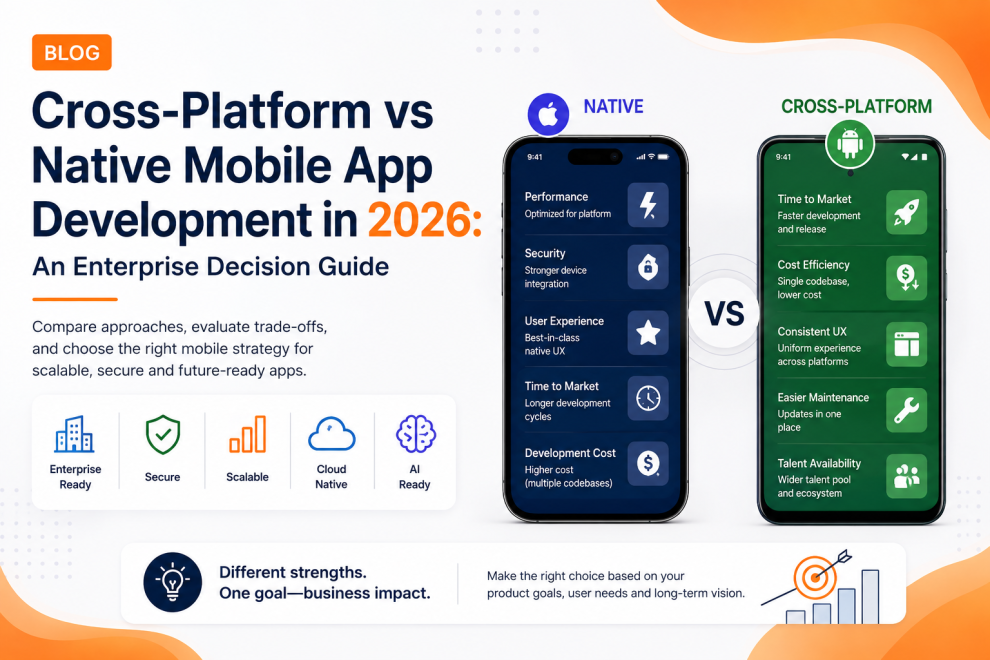

Choosing between native and cross-platform mobile development remains an important decision for enterprise technology teams.
Modern frameworks have significantly improved cross-platform performance and developer productivity, while native development continues to offer deep access to platform-specific capabilities.
The right choice depends less on which technology is “best” and more on what the application needs to accomplish.
Native vs Cross-Platform at a Glance
Native development typically means building separately for iOS and Android using their respective platform technologies.
Cross-platform development allows teams to share a significant portion of the application code across platforms.
Native Development
Strengths
- Deep platform integration
- Strong performance optimization
- Early access to platform capabilities
- Maximum platform-specific control
Challenges
- Separate development efforts
- Higher maintenance requirements
- More specialized teams
- Potentially longer development cycles
Cross-Platform Development
Strengths
- Shared codebase
- Faster development
- Consistent experiences
- Easier feature maintenance
- Efficient resource utilization
Challenges
- Some platform-specific limitations
- Additional abstraction
- Native integration may require platform-specific code
Performance Considerations
Modern smartphones are powerful enough that many enterprise applications can achieve excellent performance using cross-platform approaches.
However, applications involving intensive graphics, advanced device capabilities, real-time processing, or highly specialized platform functionality may benefit from native development.
The decision should therefore be based on actual performance requirements rather than assumptions about the technology.
Development Speed and Cost
Cross-platform development can reduce duplicated engineering work because teams can share components and business logic.
This can be particularly useful when organizations need to release the same core functionality across iOS and Android within a limited timeframe.
Native development may require separate teams or specialized expertise for each platform, increasing the operational overhead of maintaining two independent applications.
When Native Makes More Sense
Native development can be a strong choice when an application requires:
- Advanced camera functionality
- High-performance graphics
- Complex device integrations
- Platform-specific experiences
- Intensive background processing
- Early access to new OS capabilities
For these use cases, deeper platform control can justify the additional engineering investment.
When Cross-Platform Makes More Sense
Cross-platform development can be attractive when organizations prioritize:
- Faster time to market
- Consistent user experiences
- Shared engineering resources
- Multiple platform releases
- Easier long-term maintenance
- Efficient product iteration
This approach can be especially effective for enterprise applications where business workflows are more important than highly specialized device capabilities.
Don’t Ignore Architecture
The framework is only one part of a successful mobile strategy.
Enterprise teams should also evaluate:
- API architecture
- Cloud infrastructure
- Authentication
- Data synchronization
- Offline support
- Security
- Analytics
- CI/CD
- Observability
A well-designed architecture can have a greater impact on long-term application success than the choice between native and cross-platform development alone.
AI Changes the Decision
AI is becoming another consideration in mobile architecture.
Modern applications may require:
- On-device AI
- Cloud-based AI models
- AI assistants
- Intelligent search
- Predictive recommendations
- Voice interfaces
Teams should determine where AI processing will occur and how the application will handle latency, privacy, security, and offline scenarios.
Industry Perspective
Enterprise product engineering is increasingly moving toward integrated teams that combine mobile development, UX, AI, cloud engineering, and DevOps. Companies such as GeekyAnts have publicly demonstrated mobile and enterprise product engineering work, reflecting the broader shift toward building scalable applications rather than treating mobile development as an isolated frontend exercise.
Final Decision Framework
There is no universal winner.
Choose native when: deep platform capabilities, maximum performance, or highly specialized device functionality are critical.
Choose cross-platform when: speed, shared development, consistent experiences, and efficient maintenance are higher priorities.
For many enterprise applications, the best strategy may also be hybrid—sharing most product logic while using native capabilities where they provide meaningful value.
Conclusion
The native-versus-cross-platform debate is becoming less about technology preference and more about business requirements.
Enterprise leaders should evaluate performance, development velocity, architecture, security, AI readiness, maintenance, and long-term scalability before selecting an approach.
The strongest mobile strategy is ultimately the one that supports the organization’s product goals without creating unnecessary technical complexity.



Add Comment