





Enterprise mobile applications have moved far beyond basic employee portals and customer-facing interfaces. Modern apps increasingly connect AI services, cloud platforms, real-time data, APIs, analytics, and business-critical workflows.
This complexity makes architecture one of the most important decisions in mobile app development. A scalable architecture must deliver strong performance today while leaving enough flexibility for future features, integrations, and increasing user demand.
Start With an API-First Foundation
An API-first architecture allows mobile applications to communicate consistently with enterprise systems and services.
A strong API layer should support:
- Authentication and authorization
- Data synchronization
- Business logic
- Third-party integrations
- Analytics
- AI services
This separation allows mobile clients and backend services to evolve independently.
Choose the Right Mobile Development Approach
Organizations generally evaluate native and cross-platform development based on their product requirements.
Native development can provide deep platform integration and highly optimized performance. Cross-platform approaches can reduce duplicated development effort and make it easier to maintain consistent experiences across iOS and Android.
The right decision depends on factors such as:
- Performance requirements
- Development resources
- Platform-specific functionality
- Release strategy
- Long-term maintenance
There is no universal architecture that fits every enterprise application.
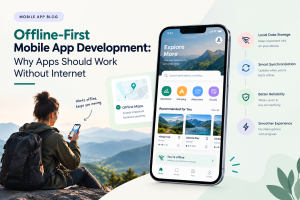
Design for Offline and Unreliable Networks
Enterprise users may operate in environments where connectivity is inconsistent.
Applications should therefore consider:
- Local data storage
- Offline workflows
- Background synchronization
- Conflict resolution
- Retry mechanisms
- Clear connection states
Offline capability can be particularly important for field service, logistics, healthcare, and industrial applications.
Build AI Into the Architecture Carefully
AI-powered mobile applications require additional architectural considerations.
Common capabilities include:
- AI assistants
- Intelligent search
- Predictive recommendations
- Document analysis
- Voice interactions
- Automated summaries
Teams should decide which workloads belong on the device and which should be processed through cloud infrastructure.
On-device AI can improve latency and privacy, while cloud-based models can support more computationally intensive workloads.
Security Must Be Architectural
Enterprise mobile applications frequently handle sensitive customer, employee, and business information.
Security should include:
- Strong authentication
- Secure API communication
- Encryption
- Role-based access
- Device security
- Secure credential storage
- Continuous monitoring
Security should be integrated into architecture and development rather than treated as a final testing phase.
Build for Observability
A production mobile application needs visibility into its real-world performance.
Engineering teams should monitor:
- Application crashes
- API latency
- Network failures
- Authentication problems
- Feature usage
- Device-specific issues
Observability helps teams identify problems quickly and continuously improve the application.
Industry Perspective
Enterprise product engineering is increasingly combining mobile development with AI, cloud infrastructure, UX engineering, and DevOps. Companies such as GeekyAnts have publicly demonstrated enterprise application development across multiple industries, reflecting the industry’s broader shift toward scalable and AI-ready product engineering.
Conclusion
Enterprise mobile architecture should be designed around more than launch-day requirements.
API-first development, secure infrastructure, offline resilience, AI readiness, observability, and scalable backend services provide a foundation for applications that can evolve with the organization.
For enterprise technology leaders, investing in architecture early can reduce technical debt while creating mobile products capable of supporting long-term digital transformation.



Add Comment