



One of the first questions businesses ask before starting a mobile application project is also one of the hardest to answer:
How much does it cost to build a mobile app?
There is no universal price.
A basic utility application can require a relatively small development effort, while an enterprise application with advanced integrations, real-time functionality, AI, payments, analytics, and multiple user roles can require significantly more time and resources.
The biggest mistake is treating mobile app development cost as a single development quote.
The actual budget depends on product scope, design, technology, backend architecture, integrations, security, testing, deployment, and long-term maintenance.
For organizations planning a new mobile product in 2026, understanding these cost drivers can make budgeting considerably more realistic.
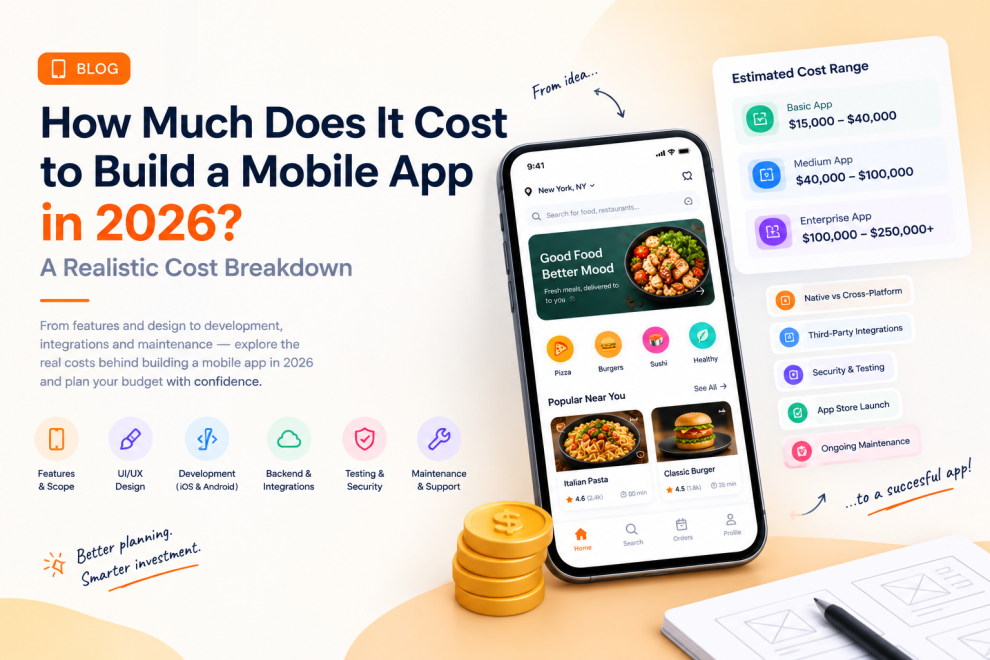
Typical Mobile App Cost Ranges
A practical way to think about mobile development is to divide applications into three broad categories.
| App type | Typical complexity | Approximate development range |
|---|---|---|
| Basic app | Limited features and simple backend | $15,000–$40,000 |
| Medium-complexity app | Multiple features, backend, integrations | $40,000–$100,000 |
| Complex/enterprise app | Advanced workflows, integrations, security, scale | $100,000–$250,000+ |
These are planning ranges rather than fixed market prices.
The final cost can move considerably depending on geography, development team structure, technology choices, product requirements, and integration complexity.
1. App Features Have the Biggest Impact
Features are one of the clearest cost drivers.
A simple application with a few static screens requires a very different development effort from an application containing:
- User accounts
- Payments
- Real-time messaging
- Maps
- Push notifications
- Social features
- Booking
- Subscription management
- AI functionality
- Real-time tracking
- Admin dashboards
Each feature introduces design, development, testing, security, and maintenance requirements.
This is why two applications that appear similar from the outside can have completely different development budgets.
2. UI/UX Design Adds More Than Visual Screens
Design is not simply about creating attractive screens.
A complete mobile UX process can include:
- User research
- Information architecture
- User flows
- Wireframes
- Prototypes
- Visual design
- Design systems
- Accessibility
- Usability testing
- Developer handoff
The more complex the application, the more important this work becomes.
An enterprise application with dozens of workflows requires significantly more UX planning than a simple content application.
Skipping design work may reduce the initial budget but can create higher development costs later when teams need to redesign workflows or rebuild implemented screens.
3. Native vs Cross-Platform Development
Technology choice also affects development cost.
Native development typically involves building separately for platforms such as iOS and Android.
Cross-platform frameworks such as Flutter and React Native can allow teams to share a significant portion of the application code across platforms.
The right choice depends on the product.
Cross-platform development can be attractive when:
- iOS and Android need similar functionality
- The team wants a shared codebase
- Faster multi-platform delivery is important
- The application does not require highly platform-specific functionality
Native development may be more appropriate when an application depends heavily on platform-specific capabilities or requires highly customized native experiences.
The cheapest technology is not automatically the best technology.
The decision should be based on product requirements and long-term maintenance.
4. Backend Development Can Significantly Increase Cost
The mobile application is only one part of the product.
Most serious applications need backend infrastructure to manage:
- Users
- Authentication
- Data
- Business logic
- Transactions
- Notifications
- APIs
- Files
- Analytics
- Integrations
A simple application may use a relatively straightforward backend.
An enterprise application may require distributed services, complex databases, event processing, monitoring, access controls, and high availability.
As backend complexity increases, development and infrastructure costs increase as well.
5. Third-Party Integrations Add Complexity
Many mobile applications depend on external services.
Examples include:
- Payment gateways
- Maps
- Cloud storage
- Analytics
- CRM systems
- ERP platforms
- Communication services
- Identity providers
- AI APIs
- Marketing platforms
Integrating an external service is rarely just a matter of connecting an API.
The team also needs to consider authentication, error handling, data synchronization, rate limits, monitoring, security, and future API changes.
An application with ten important integrations can therefore require considerably more engineering than a similar-looking application with only one or two.
6. Security Should Be Included in the Budget
Security is particularly important for applications handling financial, healthcare, personal, or enterprise data.
Development may need to account for:
- Secure authentication
- Authorization
- Encryption
- Secure API communication
- Data protection
- Session management
- Secure storage
- Logging
- Vulnerability testing
Security should not be treated as an optional final stage.
Building secure architecture from the beginning can reduce the risk of expensive changes later.
7. Testing Adds Time but Protects the Investment
Testing is another major cost component.
Mobile teams may need to test:
- Different screen sizes
- Operating-system versions
- Network conditions
- Permissions
- Authentication
- Payments
- Notifications
- Offline behavior
- Accessibility
- Performance
- Security
Automated testing can help teams cover repeatable scenarios, while manual testing remains important for real-device and usability validation.
The cost of testing is generally much easier to justify than the cost of discovering critical problems after launch.
8. App Store Launch Is Not the End
Launching an application creates another set of responsibilities.
Teams need to manage:
- App-store requirements
- Release builds
- Store listings
- Privacy documentation
- Analytics
- Crash monitoring
- Version management
- User feedback
The first release should therefore be treated as the beginning of the product lifecycle rather than the final milestone.
9. Maintenance Is an Ongoing Cost
Mobile applications require continuous maintenance.
Operating systems change.
Devices change.
Third-party APIs change.
Security vulnerabilities emerge.
Users request improvements.
Businesses add new features.
A development budget that includes only the initial build can therefore underestimate the real cost of ownership.
Long-term costs may include:
- Bug fixes
- OS compatibility updates
- Security updates
- Cloud infrastructure
- Monitoring
- New features
- Performance improvements
- Third-party service changes
A realistic mobile strategy should budget for these expenses from the beginning.
10. AI Can Change the Cost Structure
AI functionality can introduce additional development and infrastructure requirements.
An application may use AI for:
- Recommendations
- Search
- Content generation
- Document processing
- Conversational interfaces
- Personalization
- Fraud detection
- Workflow automation
The cost depends heavily on the implementation.
A simple API integration may require relatively little engineering.
A production AI feature with custom models, data pipelines, evaluation systems, security controls, monitoring, and human oversight can require substantially more investment.
AI should therefore be treated as a product capability rather than simply another checkbox on a feature list.
MVP Development Can Reduce Initial Cost
Businesses do not always need to build the complete product before testing the market.
An MVP can focus on the smallest set of capabilities needed to validate the core idea.
For example, instead of launching a food delivery application with dozens of features, an initial release might focus on:
Restaurant discovery → Menu → Ordering → Payment → Order status
Once real users provide feedback, the product can expand based on actual demand.
This approach can reduce initial investment and prevent teams from spending heavily on features that customers rarely use.
How to Reduce Mobile App Development Costs
Cost optimization does not necessarily mean choosing the cheapest developer or removing important quality processes.
Better approaches include:
- Define the MVP clearly
- Prioritize high-value features
- Reuse proven components
- Choose technology based on requirements
- Use a scalable architecture
- Automate repetitive testing
- Plan integrations early
- Avoid unnecessary custom functionality
- Monitor infrastructure usage
- Design for maintainability
The objective should be lower total cost of ownership, not simply a lower initial quote.
What Should a Mobile App Budget Include?
Before approving a project, organizations should consider the full lifecycle:
Research → UX/UI → Development → Backend → Integrations → Testing → Security → Deployment → Infrastructure → Maintenance
A proposal that includes only app development may not represent the actual investment required to operate the product successfully.
The Real Cost Depends on the Product
There is no meaningful single answer to the question of how much a mobile app costs.
A basic application might be built within a relatively modest budget.
A complex enterprise platform can require hundreds of thousands of dollars and a larger multidisciplinary team.
The important thing is to understand what is driving the cost.
Companies such as GeekyAnts have worked across mobile application development and product engineering, reflecting the broader industry focus on combining UX, engineering, integrations, security, and long-term product scalability.
For businesses planning a mobile application in 2026, the strongest approach is not to begin with a fixed number.
It is to begin with the product requirements, identify the essential user journeys, define the MVP, map the technical architecture, and then build a budget around the actual scope.
That produces a much more useful answer than simply asking for the cheapest possible app.
The right question is not “How cheaply can the app be built?”
It is “What investment is required to build the right app, launch it reliably, and keep it valuable as it grows?”



Add Comment