



Apps that use a structured user acquisition strategy see 143% higher user growth than apps running ad hoc efforts, according to AppSamurai’s mobile user acquisition strategy analysis. That number matters because it reframes the job. User acquisition isn’t a channel problem. It’s a systems problem.
In the U.S. market, mobile app teams often don’t lose because they skipped one ad platform. They lose because paid, ASO, onboarding, attribution, and retention operate like separate functions with separate goals. That creates waste, slow learning, and the classic trap of buying installs that never become durable users.
A good mobile app user acquisition strategy compounds. Paid campaigns create demand, ASO captures it, onboarding converts it, and measurement tells you where to push harder and where to cut. Privacy constraints only make this more important. When signal quality drops, teams with integrated systems outperform teams chasing isolated channel hacks.
Laying the Groundwork for User Acquisition
Teams usually lose money before they spend money. In practice, the biggest early mistakes come from weak audience definition, fuzzy positioning, and guessing which users will stick long enough to matter.
If your target user is everyone with a smartphone, acquisition costs rise fast and learning slows down.

Build an ICP from evidence, not founder instinct
A useful ideal customer profile for a U.S. app combines demand signals, early behavior, channel realities, and business model fit. That sounds basic. It is also where many launch plans break.
Start with the language already showing up in your category. App Store and Google Play reviews are one of the fastest ways to hear how users describe the problem in their own words. Look for repeated frustrations, desired outcomes, and moments of disappointment. That language should shape your store listing, paid creative, and onboarding copy so the message stays consistent from impression to activation.
Then examine early user behavior. If you have beta traffic or a soft launch cohort, break it down by acquisition source, device type, geography, and onboarding path. Small samples still reveal useful patterns. One source may produce cheaper installs, while another produces users who finish setup and come back on day three. In a privacy-constrained U.S. market, those differences matter because you often cannot rely on perfect downstream attribution later.
Competitor research helps, but only if you use it correctly. Search competitors in the app stores and review their titles, subtitles, screenshots, preview videos, and top reviews. Then check their paid presence on Meta, TikTok, YouTube, and Apple Search Ads. The point is not to copy their angle. The point is to see which audience they are trying to attract, what promise they lead with, and whether their paid message matches their store page.
Finally, pressure-test the audience against monetization. A subscription app can afford a higher acquisition cost if the cohort retains and converts to paid. An ad-supported app often needs broader reach and stronger session economics. The right audience for one model can be the wrong audience for the other.
Aarki recommends defining high-LTV segments with both demographic and behavioral signals in its mobile app user acquisition strategy guide, such as U.S. urban professionals ages 25 to 44 for a productivity app. That level of specificity is useful because it gives the growth team something observable to target, message against, and validate in retention data.
Practical rule: If your media buyer cannot describe the user, the trigger, and the value proposition in one sentence, campaigns usually drift toward low-intent installs.
Run a fast competitor teardown
A strong competitor review does not need a research sprint. It needs a tight framework and a few hours of disciplined work.
Use this checklist:
Store positioning
What promise shows up in the first screenshot set? Speed, trust, community, savings, and simplicity attract different users and set different expectations.Keyword strategy
Which phrases repeat in titles, subtitles, and descriptions? Those terms reveal how the app is framing search intent and category relevance.Creative pattern
Are the ads polished brand spots, UGC-style explainers, creator partnerships, testimonial clips, or direct product demos? This shows what kind of persuasion the market is responding to.Monetization clues
Trial language, premium feature gates, discount offers, and pricing references indicate who they are trying to convert and how quickly.Retention promise
What reason does the user have to come back after install? If the answer is unclear in both creative and product experience, paid scale will get expensive.
This work should inform more than ads. It should shape your ASO test queue, creative briefs, partnership angles, and onboarding priorities. The best U.S. growth teams do not separate those decisions. They use one market view across paid and organic so each channel sharpens the others.
Define the user you can win first
Early scale usually comes from focus, not breadth.
Start with the segment that has the clearest pain point, the shortest path to first value, and the best chance of retaining. That could be iPhone users in a handful of major U.S. cities, college athletes using a training app in-season, or busy parents looking for same-day meal planning. The point is to choose a segment where message, channel, and product experience line up tightly enough to produce clean learning.
I have seen this play out repeatedly. Paid social can generate demand quickly, but if your App Store page speaks to a broader audience than the ad, conversion drops. Partnerships can drive strong top-of-funnel awareness, but if onboarding is built for a different use case, those users churn before they ever become a valuable cohort. Groundwork fixes that by aligning who you target, what you promise, and what the product delivers in the first session.
As noted earlier, structured acquisition planning outperforms ad hoc execution. The gain comes from sharper sequencing, clearer audience choices, and tighter coordination across paid, ASO, and retention.
Defining Your North Star Goals and KPIs
Apps that scale efficiently in the U.S. rarely optimize for installs alone for very long. The teams that keep growing under privacy constraints usually align acquisition, product, and monetization around one business outcome, then use supporting KPIs to catch quality problems early.
That alignment matters because channel performance is no longer cleanly visible. Paid social can drive a spike in downloads while ASO captures branded demand those ads created. A partnership can send high-intent traffic that looks expensive on CPI but wins on retention and payback. If each channel is judged in isolation, good budget gets cut and weak traffic gets rewarded.
Build a KPI stack that reflects how growth actually happens
Use a layered scorecard instead of one headline metric.
| KPI Layer | What it tells you | Best use |
|---|---|---|
| Install volume | Whether a channel can create demand and drive store visits | Useful for launch pacing and early creative testing |
| Activation | Whether new users reach first value | Best early signal of traffic quality |
| In-app event completion | Whether users behave like real prospects or buyers | Useful for optimization and audience feedback loops |
| CPA or cost per qualified user | Whether spend is controlled at the quality threshold you care about | Good for comparing channels with different intent levels |
| ROAS, payback, or LTV by cohort | Whether acquisition creates profitable growth | Best for budget allocation once enough data matures |
The stack matters because each metric answers a different question. Install volume shows reach. Activation shows product-market fit at the top of the funnel. Cohort revenue shows whether the whole system works.
Match the primary KPI to the business model
A subscription app usually needs to move past CPI quickly. Cheap installs often come from broad targeting, weak intent, or creative that overpromises. That can help an ad account learn in the first few weeks, but it becomes expensive fast if trial start and trial-to-paid conversion are weak.
For subscriptions, I usually want the team marching toward trial starts, subscriber acquisition cost, and cohort payback as soon as event volume supports it. For commerce, first purchase rate and contribution margin matter more. For ad-supported apps, session depth, repeat opens, and monetizable engagement often offer a better indication earlier than revenue does.
A productivity app might judge Meta by setup completion and week-one return rate, while its Apple Search Ads campaigns are held to a tighter cost-per-activated-user target because that traffic arrives with stronger intent. Same app. Different channel roles. Different KPI thresholds.
Retention is the quality gate
Retention is where weak acquisition gets exposed.
If users from paid social install, browse for thirty seconds, and disappear, the problem is not just media efficiency. It can be audience targeting, creative promise, App Store positioning, onboarding friction, or a mismatch between who the ad attracts and who the product serves. That is why retention should sit inside acquisition reviews, not off in a separate product dashboard.
The practical read is simple. Compare channels by cohort quality, not by front-end cost alone. A creator partnership may look less efficient than TikTok on day zero, then outperform by day thirty because those users understood the use case before they installed. Branded search may appear to convert better than Meta, but some of that demand exists because paid social created it. Teams that understand this interplay make better budget calls.
If you need a broader playbook for tying promotion goals to business outcomes, this guide on how to promote a mobile application effectively is a useful reference point.
Use a simple operating model
Keep three KPI types in view at all times:
- North star KPI: subscription ROAS, first purchase rate, or qualified activation volume
- Quality control KPI: onboarding completion, account setup, or a core in-app event
- Efficiency KPI: CPA, payback period, or cost per qualified user
This structure keeps trade-offs visible. A campaign can miss on CPI and still deserve more budget if downstream quality is strong. Another can hit install goals and still be a bad buy if retention collapses after day one.
That is the discipline. Set one primary outcome, define the quality gate that protects it, and judge channels based on their contribution to the full growth engine rather than a siloed dashboard.
Building Your Multi-Channel Growth Engine
Privacy changes have made single-channel growth fragile. In the U.S. market, the apps that keep scaling usually spread acquisition across paid, organic, and partner channels, then build systems that let each one improve the others.

A healthy mobile app user acquisition strategy does not ask one channel to do every job. Meta is useful for testing message-market fit and reaching scale fast. Apple Search Ads captures users already looking for a solution. ASO converts demand created elsewhere. Partnerships add trust and reduce dependence on auction prices. Programmatic extends reach when first-party data is good enough to guide buying.
That mix matters because channel performance is connected. Paid social often lifts branded search. Strong creative improves app store conversion because users arrive with clearer expectations. Creator campaigns can raise direct traffic, search volume, and review velocity at the same time. Teams that manage channels separately miss those second-order effects.
ASO should absorb demand your paid channels create
ASO belongs in the acquisition engine, not in a separate app store workstream. If paid media is creating interest and your product page is weak, you pay twice. First for the click, then again in the form of lost conversion.
Apple explains in its App Store product page optimization documentation how teams can test screenshots, preview videos, and app icons to improve product page conversion. That is the practical standard. Treat the store listing like a landing page with weekly testing cadence, not a one-time brand asset.
A serious ASO program usually includes:
Keyword coverage tied to user language
Titles, subtitles, and descriptions should reflect terms real users search for, not internal product wording.Store conversion testing
Screenshots, video, icon, and first-screen copy need ongoing tests tied to install and activation rates.Review and rating operations
Recent reviews shape trust fast, especially for finance, health, and utility apps where users are cautious.Audience-specific positioning
A U.S. audience is not one audience. Student users, working parents, and side-hustle sellers respond to different value props.
If you want a broader framework for launch planning and promotion outside app stores, this guide on how to promote a mobile application effectively is a useful companion.
Paid social is where message-market fit gets tested under pressure
Meta is still one of the fastest places to learn which promise gets a user to install and complete a meaningful action. I use it less as a pure scale channel at the start and more as a market feedback loop. Which hook gets thumb-stop rate? Which proof point gets account creation, not just installs? Which audience responds to urgency versus utility?
The trade-off is clear. Meta can mask weak economics if campaigns are optimized too high in the funnel or if creative wins on curiosity but loses on post-install quality. Broader automation has made setup easier, but it has also made discipline more important.
Meta outlines how Advantage+ app campaigns use automation across targeting, placements, and delivery. In practice, that works best after you have clean event signals and enough creative variation. Without those inputs, automation leads to faster spending.
TikTok plays a different role. It is often better at discovering winning creative angles than delivering stable efficiency from day one. Products with a visible before-and-after, a strong demo, or social proof from creators tend to fit best. Utility apps with no obvious visual story usually need stronger scripting and tighter editing to work there.
Search channels capture intent that paid social creates
Apple Search Ads deserves a permanent place in most iOS mixes because the user has already declared intent. That usually means cleaner traffic, stronger activation, and less creative dependency than paid social. The ceiling is lower, but quality is often better.
Google’s App campaigns best practices make the same point in a different way. Campaign structure should follow the business goal. Teams generally get better results when they separate install volume, in-app action, and value-based bidding instead of combining everything into one campaign. That structure gives Google’s systems a clearer optimization target and gives the growth team a cleaner read on trade-offs.
Search also protects efficiency when social CPMs spike. During Q4, for example, many U.S. consumer apps see paid social costs rise fast while branded and category search remains more stable. The right response is usually not to cut social entirely. It is to keep social feeding demand while search and ASO capture the demand with less waste.
Programmatic and partnerships reduce platform dependence
Programmatic is useful once measurement, event quality, and audience definitions are in order. If those basics are weak, DSPs expose the problem quickly. If they are strong, programmatic can expand reach beyond the major walled gardens and give the team more control over inventory, frequency, and audience construction.
AppsFlyer’s guide to programmatic advertising explains why this channel tends to work best when marketers bring strong first-party data and clear post-install goals. That matches what experienced UA teams see. Programmatic is rarely the first growth lever for an early-stage app, but it becomes useful when saturation hits on Meta, Google, and TikTok.
Partnerships serve a different purpose. They add credibility that paid ads usually cannot manufacture. A personal finance app can perform well with credit-building newsletters, budgeting creators, and payroll or banking adjacencies. A fitness app may get better users from trainers, wellness publishers, and employer benefit partners than from another round of broad prospecting on paid social.
The test is simple. Does the partner reach the user at a moment of real need, and can you track quality beyond the click? Audience overlap alone is not enough.
Comparison of Top Mobile User Acquisition Channels
| Channel | Primary Use Case | Targeting Strength | Typical Scale |
|---|---|---|---|
| ASO | Capture existing demand and improve listing conversion | Strong around search intent and category relevance | High over time |
| Meta | Test messaging and scale broad paid acquisition | Strong with event-based optimization | High |
| TikTok | Creative-led discovery and attention capture | Strong when hooks and demonstrations are clear | Medium to high |
| Apple Search Ads | Capture high-intent iOS searches | Strong because users are actively searching | Limited to medium |
| Google App Campaigns | Broad cross-property reach | Strong when campaign objectives are segmented well | High |
| Programmatic DSPs | Expand beyond major platforms using first-party data | Strong if data quality is solid | Medium to high |
| Partnerships and referrals | Access trusted audiences and lower dependence on paid media | Varies by partner fit | Varies |
The strongest growth engines in the U.S. market compound. Paid social creates awareness and messaging insight. Search and ASO convert that demand more efficiently. Partnerships add trust and diversify traffic sources. Programmatic fills reach gaps once first-party data is mature enough to support it.
That is the shift many teams still need to make. Stop treating channels as isolated lines in a dashboard. Build a system where each one makes the others perform better.
Executing with High-Impact Creative and Funnels
A small drop in install-to-activation rate can erase the gains from a strong media buy. I have seen teams cut CAC in the ad account, then give all of it back through weak store conversion and slow onboarding.
Creative and funnel work decide whether your channel mix compounds or stalls. In the U.S. market, that matters more than ever because privacy limits make it harder to brute-force growth with targeting alone. Paid social has to create demand, ASO has to capture and convert it, and onboarding has to deliver the promise fast enough to keep that user.

Start with the hook users actually care about
We often see app ads open with polished branding, abstract value propositions, or motion-heavy intros that delay the actual product story. On Meta and TikTok, that usually wastes the most valuable second of the ad.
Good hooks get specific fast. They name the problem, show the product in use, and make the payoff believable.
A stronger creative brief usually includes:
The user problem in plain language
“I keep missing deadlines” beats “optimize your workflow.”A visible product moment
Show the feature solving the problem. Don’t open on the logo.A believable payoff
Saved time, fewer steps, clearer planning, easier tracking.An audience cue
Let the right user recognize themselves in the first few seconds.
In practice, UGC-style creative often gives teams more usable variation than polished brand spots. It is faster to produce, easier to refresh, and usually better suited to testing different jobs-to-be-done, creators, and proof angles. That does not mean brand quality stops mattering. It means performance creative should be built to earn attention first, then reinforce trust.
Test creatives like a system
High-performing teams do not ask for “more ads.” They run a testing system with clear hypotheses and a tight feedback loop from media buying, store conversion, and onboarding.
Use separate hypotheses for:
- opening hook
- proof format
- CTA framing
- visual style
- audience context
That structure matters because channel learnings should travel. If a pain-point-led TikTok concept improves thumb-stop rate and qualified installs, that message should show up in Meta variations, on your store page, and inside onboarding. If a creator-led ad drives cheaper installs but weak activation, the issue may be message quality rather than media efficiency.
For app store assets, use the same discipline. Screenshot order, preview video framing, and first-caption language should reflect what your paid creative is already proving. If you are tightening listing conversion, this guide to app store optimization best practices is a useful reference.
Strong creative says one thing clearly to one user.
Align the ad, the store page, and the first session
A lot of wasted spend comes from message breaks between surfaces.
Here is the weak version:
- Ad promises “all-in-one productivity”
- Store page shows generic screenshots
- Onboarding asks for too much setup before value appears
- The user leaves before the first meaningful action
Here is the stronger version:
- Ad shows one urgent job-to-be-done
- Store page repeats that benefit visually and verbally
- Onboarding asks only for what is needed to reach first value
- The app earns deeper setup after the user gets a quick win
Paid and organic strategies start compounding. A paid social ad can teach you which problem statement gets attention. ASO can turn that same message into better listing conversion. Partnerships can add proof and trust that strengthen the same story. The point is not to optimize each surface in isolation. The point is to move the same winning narrative through the full path from impression to retained user.
A strong post-click funnel answers four questions fast:
- Am I in the right place?
- What does this app help me do?
- How soon do I get value?
- Why should I come back tomorrow?
A useful walkthrough on funnel thinking appears below.
Fix onboarding leaks before pushing spend
Scaling traffic into a weak first-session experience is one of the fastest ways to hide a growth problem inside channel reporting. Media can look efficient while payback gets worse.
Audit onboarding with the same rigor you use for paid campaigns. Focus on the points where intent dies:
Premature account creation
If sign-up blocks product understanding, conversion drops.Feature overload
Day-one onboarding should guide users to the first win, not explain the whole product.Poor event instrumentation
If the team cannot see where users stall, the team cannot fix it.Message mismatch
Ad, store listing, and onboarding need to tell the same story.
The trade-off is straightforward. Asking for more data up front can improve personalization later, but it usually hurts activation now. For many consumer apps, getting the user to value first is the better choice. Ask for permissions, preferences, or profile depth after the app has earned enough trust.
When creative, store conversion, and onboarding line up, CAC quality improves across channels. Meta gets cleaner signals. TikTok concepts become easier to evaluate. ASO converts more of the demand paid media creates. That is how a channel mix starts acting like a growth engine instead of a set of disconnected campaigns.
Measuring Attributing and Scaling Your Success
Privacy changes pushed mobile measurement into a probabilistic system. Teams that keep scaling well in the U.S. are the ones that built decision systems around imperfect data, not the ones waiting for perfect attribution to come back.

Your measurement stack needs a source of truth
A workable setup combines four inputs. An MMP for standardized acquisition data. Product analytics for activation and retention. App store analytics for conversion signals. Finance or BI for payback and contribution margin.
Those systems will disagree. That is normal.
Meta may claim more conversions than your MMP. Your BI team may show weaker payback than platform ROAS suggests. Apple Search Ads may look expensive on last-touch reporting while branded search volume and App Store conversion improve after paid social flights. Good operators reconcile those views instead of arguing over which dashboard is “right.”
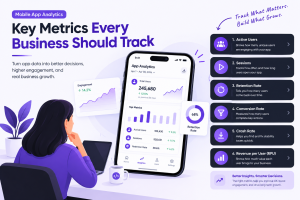
The goal is a decision framework that ties spend to business outcomes. If you need a refresher on the KPIs that belong in that framework, this guide to mobile app metrics is a useful reference.
Attribution is incomplete, so read signals in layers
Post-IDFA attribution works best as a stack of evidence, not a single answer.
| Measurement Lens | What it does well | Where it falls short |
|---|---|---|
| Platform reporting | Fast read on creative fatigue, CPA movement, and audience response | Tends to over-credit its own media |
| MMP data | Standardizes installs and post-install events across channels | Limited visibility in privacy-restricted environments |
| Cohort analysis | Shows which sources retain, subscribe, or purchase over time | Needs time to mature before you can act with confidence |
| Blended performance view | Captures total impact across paid and organic demand | Cannot assign exact credit cleanly |
| MMM or modeled analysis | Helps estimate contribution when user-level tracking is weak | Better for budget allocation than daily optimization |
What matters is convergence. If paid social reporting improves, D7 activation holds, and blended revenue per install rises, there is enough evidence to increase budget carefully. If one view looks strong and the other two weaken, hold spend.
This integrated read matters more now because channels influence each other. A strong TikTok concept can lift branded search. Meta can create demand that ASO harvests later. Influencer whitelisting can improve paid click-through rate and also raise store conversion because the message already feels familiar by the time the user lands.
Scale only after cohort quality holds up
Cheap installs are not scale proof. Retained users are.
I use a simple progression before approving meaningful budget increases:
- Creative earns efficient early traffic
- Users reach a high-intent in-app event
- Retention is acceptable for that source and audience
- Revenue or downstream value supports reinvestment
- Spend rises in controlled steps while quality is checked weekly
Teams create their own leak. They push spend because CPIs look good on Monday, then find out two weeks later that those users never completed onboarding, never subscribed, or churned before payback had a chance.
The fix is operational discipline. Review scale decisions by cohort, not just by campaign totals. Break performance out by creative concept, audience, geo, and landing path into the store. In the U.S. market, I have seen the same Meta campaign look healthy in aggregate while one age segment produced strong payback and another produced almost none. Blended averages hide that problem until spend is already too high.
Fraud, quality control, and channel truth
Attribution cleanup also means filtering out traffic that should never influence budget decisions in the first place.
That risk rises as teams expand beyond the largest self-serve platforms into affiliate traffic, OEM inventory, rewarded placements, and partner campaigns. Reported installs can look fine while post-install behavior is clearly off. Session depth is near zero. Registration velocity looks unnatural. Retention collapses immediately. Those are quality problems, not creative problems.
A practical review cadence checks every channel through three lenses:
- What the channel reports
- What users do after install
- What shows up in blended business results
That triage usually settles the argument. Some channels look expensive on first-touch reporting but bring in high-retention users who search for the brand again later and convert at a higher rate. Other channels look efficient because they generate volume, but they add little revenue and contaminate optimization signals for the rest of the account.
Scaling gets easier once paid, organic, product, and finance are reading from the same scorecard. That is how user acquisition stops acting like a collection of channel bets and starts compounding like a real growth engine.
Navigating U.S. Privacy and Future-Proofing Your Strategy
Privacy-first marketing isn’t a burden you tolerate. It’s a capability you build.
In the U.S. market, that starts with treating compliance as product and growth infrastructure, not legal cleanup after launch. If your team still views consent flows, event hygiene, and data minimization as blockers, you’re already behind.
Privacy discipline improves acquisition quality
The strongest teams now rely more on first-party data, contextual signals, and modeled performance instead of assuming user-level tracking will always be available. That shift is healthy. It forces better fundamentals.
The verified Aarki data notes that privacy-first targeting can maintain 95%+ data validity and help prevent 15 to 25% budget loss tied to poor compliance practices in its privacy-focused user acquisition guidance. That’s not a legal footnote. That’s an operational advantage.
A practical privacy-first approach includes:
Clear consent logic
Ask for data access in context, with a reason the user understands.First-party event prioritization
Instrument the events that matter most to product value and business outcomes.Contextual targeting
Place more weight on environment, content, and user intent signals where possible.Data discipline across vendors
Every SDK, ad partner, and analytics tool needs scrutiny.
Automation is useful, but only when your inputs are clean
AI-driven campaign products are getting better at bid optimization, creative assembly, and audience expansion. That doesn’t mean you should surrender strategy to black-box systems.
Automation works best when you provide:
- clear event priorities
- strong creative variety
- clean naming conventions
- disciplined budget tests
- enough time for learning
The teams that benefit most from machine-led acquisition aren’t passive. They feed the system better inputs and judge results with a skeptical eye.
Compliance and experimentation belong together. A privacy-safe measurement setup gives you cleaner learning loops, better vendor control, and less budget waste.
Build a testing culture that can survive platform shifts
Future-proofing doesn’t come from predicting the next platform feature. It comes from building an organization that adapts fast.
That means documenting test logic, keeping creative production continuous, reviewing cohorts weekly, and resisting overdependence on any single channel. It also means aligning growth, product, analytics, and legal earlier than most companies do.
A durable mobile app user acquisition strategy isn’t built on perfect data. It’s built on disciplined experimentation under imperfect conditions. Teams that accept that reality tend to outperform teams still waiting for attribution to become easy again.
Mobile App User Acquisition FAQs
How much should a startup spend on initial user acquisition?
There isn’t one correct number. The better question is how much you can spend while learning fast enough to make the next decision with confidence.
For an early-stage app, the first budget should buy learning across audience, creative, onboarding, and channel fit. If the budget is so small that you can’t see meaningful differences between tests, you won’t learn much. If it’s so large that you scale before retention and activation are clear, you’ll burn cash faster than insight accumulates.
How long does it take to see results?
Paid acquisition produces directional feedback quickly, especially on click-through, install volume, and early activation. Organic efforts like ASO take longer because they depend on listing quality, review velocity, and store search behavior over time.
What matters is separating signal from conclusion. You can see early signal from paid channels fast. You usually need more time to determine whether a channel can scale profitably and whether an ASO change improved durable conversion.
What does scaling too fast look like?
It usually looks like celebrating install growth while activation, retention, or downstream monetization weakens.
A healthy scale pattern is boring in the best way. You raise spend in controlled steps, keep creative refreshes moving, and watch cohort quality closely. An unhealthy scale pattern is aggressive budget expansion based on shallow platform metrics with no retention proof.
Should founders manage UA themselves at first?
Often, yes. Founders and product leaders are usually closest to the user problem, and that helps in the early phase when messaging and positioning matter more than channel sophistication.
The handoff should happen when campaigns need daily management, creative testing gets more complex, attribution requires tighter interpretation, or multiple channels need to be coordinated at once. At that point, a dedicated UA manager or an experienced partner can enhance effectiveness, as long as strategy stays connected to product reality.
What’s the biggest mistake teams make?
Treating acquisition as a media buying function instead of a full-funnel system.
If the app store page is weak, paid gets more expensive. If onboarding is weak, good traffic looks bad. If attribution is weak, bad channels survive too long. The teams that win usually connect those pieces early and keep them connected.
If you're planning, building, or scaling an app for the U.S. market, Mobile App Development offers practical guidance across product strategy, UX, engineering, optimization, and launch execution. It’s a strong resource for founders, product leaders, and teams that want sharper decisions before they spend more on growth.



Add Comment