



Launching a mobile application is no longer the hardest part of mobile development.
The bigger challenge is keeping the application reliable when users, data, integrations, and feature requirements begin to grow.
An application that works perfectly with 10,000 users can behave very differently at 500,000 users.
API traffic increases. Databases become larger. Push notifications become more complex. Analytics generate more data. AI features introduce additional infrastructure requirements.
This makes mobile app architecture one of the most important decisions in the development lifecycle.
Start With the Product, Not the Technology
Architecture decisions should begin with the product requirements.
Before selecting a framework or cloud provider, teams should understand:
- Who will use the application?
- What workflows are most important?
- How frequently will users interact with it?
- Does it require offline functionality?
- What data will it process?
- Which third-party systems are required?
- How quickly is the product expected to scale?
Technology should support these requirements rather than determine them.
Native vs Cross-Platform Architecture
One of the first decisions is whether to build separately for iOS and Android or use a cross-platform approach.
Native development
Native applications can provide strong access to platform-specific capabilities and are useful when applications require deep device integration or highly specialized performance.
Cross-platform development
Cross-platform frameworks can allow teams to share a significant portion of application code.
This can help with:
- Faster development
- Shared business logic
- Consistent experiences
- Smaller development teams
- Easier feature parity
But the decision should consider the application’s long-term requirements rather than simply comparing initial development costs.
Design the Backend for Scale
The mobile application is only one part of the system.
A scalable architecture typically separates:
Mobile client → API layer → Business services → Data layer → External services
This separation allows backend components to scale independently as demand changes.
It also makes it easier to introduce additional capabilities later.
API Design Can Make or Break Performance
Mobile users expect quick responses.
Poor API architecture can create slow applications even when the mobile interface itself is optimized.
Teams should consider:
- API response size
- Pagination
- Caching
- Request batching
- Authentication
- Rate limiting
- Error handling
- Versioning
APIs should return the information required for the current workflow rather than unnecessarily large datasets.
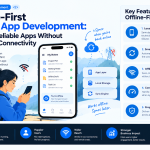
Offline-First Architecture
Enterprise applications increasingly need to operate beyond reliable Wi-Fi.
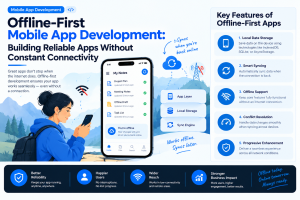
Offline-first architecture allows important workflows to continue when connectivity disappears.
A typical workflow can look like:
User action → Local storage → Queue → Network restored → Synchronization
The difficult part is not storing information locally.
The difficult part is deciding what happens when multiple systems modify the same information.
Teams therefore need explicit conflict-resolution rules.
AI Changes Mobile Architecture
AI-powered applications introduce another architectural layer.
A mobile application may use AI for:
- Intelligent search
- Recommendations
- Text generation
- Voice interfaces
- Image understanding
- Document processing
- Predictive features
- AI assistants
The architecture needs to determine whether processing occurs on-device or through cloud services.
On-device AI
Potential advantages include:
- Lower latency
- Offline capability
- Reduced data transmission
- Greater privacy for certain workloads
Cloud AI
Potential advantages include:
- Larger models
- More computational capacity
- Centralized model management
- Easier model updates
A hybrid architecture can combine both approaches.
Security Should Be Architectural
Security cannot be treated as a final checklist.
Mobile applications can expose sensitive information through:
- APIs
- Local storage
- Authentication tokens
- Logs
- Third-party SDKs
- Push notifications
Enterprise teams should establish security controls around the complete data lifecycle.
Important considerations include:
- Encryption
- Secure authentication
- Authorization
- API protection
- Device security
- Secure local storage
- Session management
- Privacy controls
Observability After Launch
Production monitoring is essential for understanding how the application behaves in the real world.
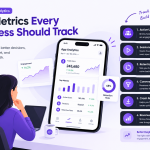
Teams should track:
- Crash-free sessions
- App startup time
- API latency
- Network failures
- Memory usage
- Battery impact
- Feature adoption
- Backend errors
This information helps engineering teams identify problems before they become widespread.
Continuous Delivery Matters
Mobile applications cannot remain static.
Operating systems change. Devices change. Security vulnerabilities emerge. Users expect new features.
A modern delivery pipeline can automate:
Code → Build → Test → Security checks → Release → Monitor
Smaller, frequent releases can reduce the risk associated with large deployments.
Build for Observed Scale, Not Hypothetical Scale
One common architectural mistake is overengineering from day one.
An application designed for future global scale may introduce unnecessary complexity before the product has validated its market.
A better approach is to create an architecture that can evolve.
Start with clear service boundaries, reliable APIs, automated testing, observability, and scalable infrastructure.
Then increase architectural complexity when actual usage justifies it.
Mobile App Architecture Checklist
Before launch, enterprise teams should be able to answer:
- Is the API architecture scalable?
- Can critical workflows operate during network failures?
- How is sensitive data protected?
- How will AI workloads be handled?
- What happens when synchronization conflicts occur?
- Can the application be monitored in production?
- How are releases tested?
- Can individual services scale independently?
- Is the UX consistent across supported platforms?
If these questions have clear answers, the application has a stronger foundation for growth.
Industry Perspective
Modern mobile product engineering increasingly combines cross-platform development, cloud architecture, AI integration, security, UX, DevOps, and observability. Companies such as GeekyAnts have publicly shared work spanning mobile and enterprise product engineering, reflecting the broader shift toward mobile platforms designed as long-term digital products rather than standalone applications.
Conclusion
Scalable mobile development is not about predicting every future requirement.
It is about making architectural decisions that keep future changes manageable.
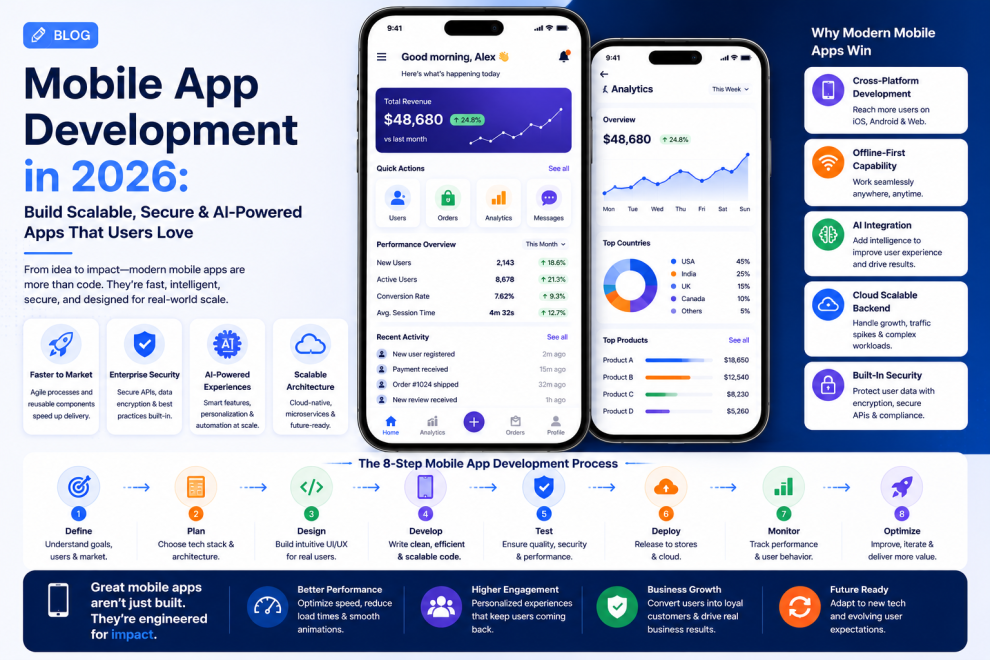
The strongest mobile applications in 2026 will combine efficient client architecture, scalable APIs, offline capabilities, secure data handling, AI-ready infrastructure, strong observability, and continuous delivery.
For enterprise teams, the goal should be simple: build an architecture that supports today’s product while making tomorrow’s growth easier not harder.




Add Comment