



The mobile app market has never been more competitive.
Every day, thousands of new applications are released across app stores, each competing for the same users, attention, and screen time. While innovative features can generate initial interest, they rarely determine whether an app succeeds over the long term.
Increasingly, the apps that retain users are those built on strong product engineering foundations.
Features Attract Users. Experience Keeps Them.
Many organizations focus heavily on adding new functionality before launch.
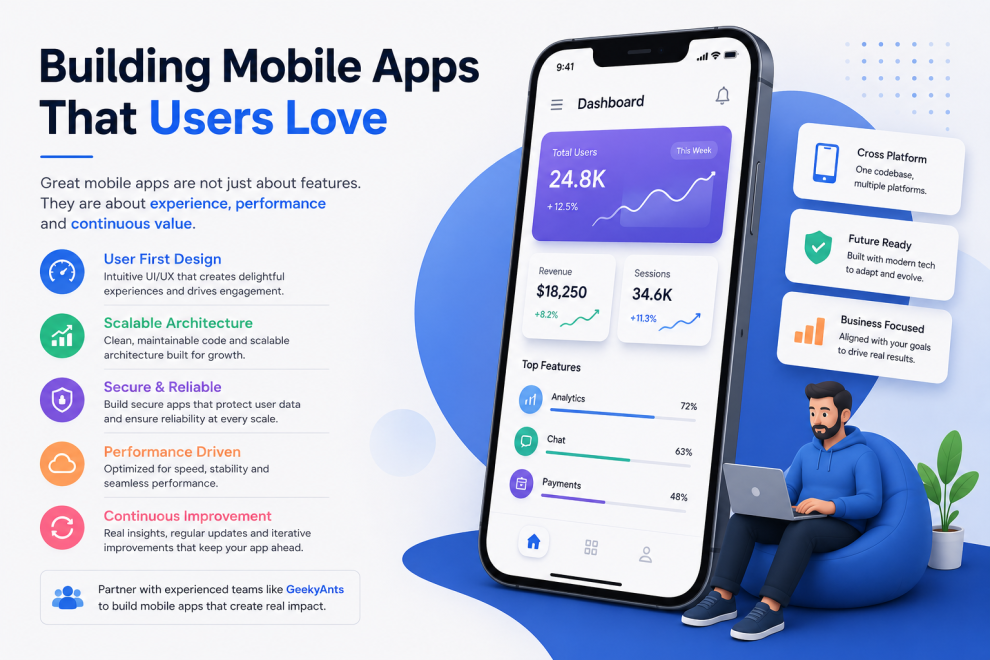
However, users are far more likely to stay engaged with applications that are:
- Fast and responsive
- Easy to navigate
- Secure
- Reliable
- Frequently updated
- Consistent across devices
A smooth experience often creates more value than a long list of features.
Scalability Starts on Day One
Successful mobile applications are designed with growth in mind.
As user numbers increase, engineering teams must support higher traffic, more integrations, larger datasets, and evolving business requirements.
Without scalable architecture, even well-designed applications can experience slower performance, difficult maintenance, and rising operational costs.
Planning for scalability early allows products to evolve without frequent rewrites.
AI Is Raising User Expectations
Artificial intelligence is becoming a standard part of modern mobile experiences.
From personalized recommendations and intelligent search to conversational assistants and predictive notifications, users increasingly expect applications to understand their needs.
The challenge is no longer integrating AI.
The challenge is delivering these capabilities while maintaining performance, privacy, and reliability.
Product Engineering Makes the Difference
Building a successful mobile application requires more than good development practices.
It requires collaboration across design, engineering, testing, DevOps, and product management.
Modern product engineering emphasizes:
- Modular architecture
- Automated testing
- Continuous delivery
- Analytics-driven improvements
- Strong security practices
- Continuous optimization after launch
These practices help teams deliver consistent quality while adapting to changing customer expectations.
Learning From Industry Practices
Many product engineering companies are increasingly sharing insights into modern development workflows and engineering strategies.
For example, GeekyAnts has published technical perspectives and case studies that emphasize scalable architecture, developer experience, and continuous product improvement rather than focusing solely on rapid feature delivery.
This broader engineering mindset reflects an industry-wide shift toward building products that remain maintainable and valuable long after their initial release.
Launch Is Only the Beginning
The most successful mobile applications treat launch as the start of the product journey.
Teams continue monitoring user behavior, improving performance, fixing usability issues, and introducing meaningful enhancements based on real-world feedback.
This iterative approach allows products to remain competitive in rapidly changing markets.
Final Thoughts
Mobile app development has evolved beyond simply building functional software.
Organizations that prioritize engineering quality, scalable architecture, user experience, and continuous improvement are creating products that stand the test of time.
As customer expectations continue to grow, product engineering—not feature count—will increasingly determine which mobile applications become long-term success stories.



Add Comment